
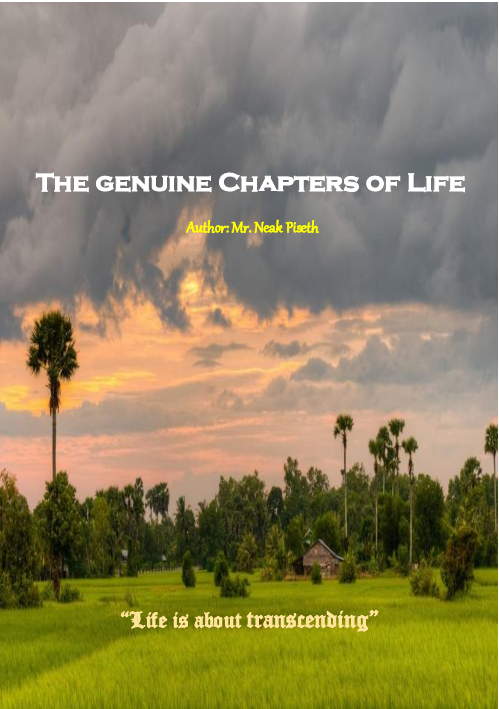
I’m not sure how I stumbled on this e-book which you can access through academia.edu or through issu. In fact, I’m not really quite sure what it is: on one level it is a memoir of a young man growing up in rural poverty in the 1990s to attain his dream of high education at the Royal University of Phnom Penh. But at another level, particularly near the end, it seems to become a scholarship application document where he outlines his vision for changes that he would make to his society were he successful in studying overseas. It must have worked, because he received a scholarship to pursue his master’s degree in Non-Formal Education at Chulalongkorn University in Thailand in 2019, continuing on as a PhD candidate from 2022. He has been working as an English Lecturer and as a lecturer in the Faculty of Education at the Royal University of Phnom Penh and has a number of publications under his belt.
His grandparents died under the Pol Pot regime and he was born to poor parents in 1994 with, at that stage, only one older sister. His father, an illiterate orphan, had inherited a one-hectare plantation in a village, and the family lived in a crumbling cottage while his father worked as a motor taxi driver in the city. In 1999 they received a contract to grow rubber trees on their plantation, but this necessitated moving to another dilapidated thatched, earth cottage closer to the trees. After the contract expired, they used the money they had earned to move back into the village where the author and his sister began attending school. They walked the three kilometres to school, and had to help after school looking after their three cows, while their parents worked in a small business, arriving home at midnight. In 2003 his mother had another daughter, who was often sick, and his father had to stop working to assist his mother at home. This meant that, in order to keep attending school, the author and his sister had to sell banana cakes after school to support the family. The family remained in poverty, especially after an accident on the rubber plantation resulted in his father’s blindness. Despite his father’s violence against his mother, the author deeply respects his father, and craves his approval.
He gives a fairly damning view of education in Cambodia. Teachers often took on private students as tutors in order to get additional money, which meant that they often did not teach the full curriculum at school, or charged for teaching and examination materials as a way of gaining extra students. The tutored students often received passing grades, to encourage their parents to continuing paying out for tutoring. Some students’ parents bribed the teachers, and many teachers arrived late.
Despite these difficulties, he was a very conscientious student, spending hours at night rote-memorizing his work. He really struggled to learn English- and indeed, this text is clearly written by a second-language learner- and he lacked confidence to speak in English, even when he knew the answers. By sheer hard work, and the good and well-earned fortune of a scholarship, he was able to attend Western International School in Phnom Penh. He lived in a small, dark room, continuing to rote-learn as much as he could. By the end of the book, his hard work is paying off, despite the discrimination against poor kids from the provinces.
I hadn’t expected to encounter Jane Austen and Bill Gate (i.e. Gates) in this book, but each chapter closes with an inspirational quote that he has gleaned as part of his studies. Beyond this, though, I’m really glad that I read this book while I’m here in Phnom Penh. I’ve found myself looking at the school children walking to their schools, and tuk-tuk drivers who are possibly working for their families in the provinces, with new eyes.
 The Resident Judge of Port Phillip