
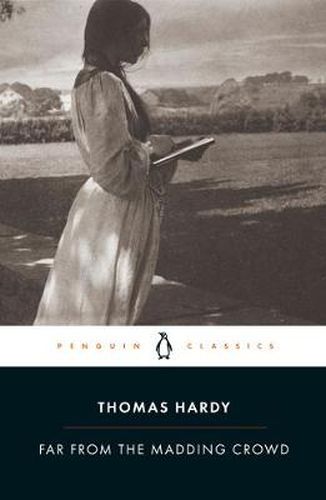
I didn’t read Far From the Madding Crowd at school, even though many people of my age did. It seemed to be a perennial of the Year 12 (HSC) English reading list. I hadn’t read any Hardy at all until I read Tess of the D’Urbervilles at university, which I remember enjoying although now, having read Far From the Madding Crowd, I wonder whether I would still do so.
Like Hardy’s other Wessex novels, Far From the Madding Crowd is set in rural England, harking back to an agricultural past and village life that had been largely eclipsed by the time the book was written in 1874. Although the novel is peopled with stock characters from tales of rural life- the chortling peasants in the local pub, the perfidious army officer, the worthy but stodgy landowner next door- the two main characters, Bathsheba Everdene and Gabriel Oak are of a more complicated economic and social milieu. When we first meet Bathsheba, she is a young, well-educated, independent but young woman without her own financial resources, confident enough in her own opinions to reject the marriage proposal of the hard-working and earnest Gabriel Oak. By the next time we meet her, she has inherited property from her aunt and is determined to manage the farm by herself, without the assistance of a bailiff. Gabriel Oak suffers a reversal in fortune and is now forced to work on Bathsheba’s farm, undertaking the tasks of a bailiff without the title.
Clever but impetuous Bathsheba sends a Valentine to her older, rather stodgy neighbour Mr Boldwood, daring him to ‘Marry Me’. He takes Bathsheba at her word, and tries to woo her but Bathsheba, who wants more passion in a relationship than she could ever feel with Mr Boldwood, rebuffs him. Gabriel, aware of the hopelessness of his love, continues to care for Bathsheba. He tries to warn Bathsheba against the perfidious Sgt. Troy, but she plunges into a hasty marriage with him anyway, only to find that he is gambling away all her inheritance. When Troy disappears after his illicit relationship with servant-girl Fanny becomes public, Bathsheba is in a holding pattern, still legally married to Troy and having to bat away Mr Boldwood’s renewed wooing. It is only after Troy is finally killed, and Mr Boldwood taken away as his murderer, that Bathsheba and Gabriel are free to marry. Unusually for Hardy, there is a happily-ever-after-ending.
I grant that Hardy’s depiction of Bathsheba is nuanced and complex. In some ways she is an air-head, toying with men and their emotions, self-centred and wilful. However, she is also independent and principled, although she is exposed to almost intolerable emotional coercion by both Troy and Boldwood. The timeless theme of a woman surrounded by eager suitors, of differing degrees of integrity and suitability, reappears in different guises throughout film and literature.
But each time the book got bogged down in yet another pub-scene or drowned the reader in its lush descriptions of sunrises and fields, I found myself thinking “How on earth would you interest a Year 12 boy in THIS?” I was relieved to hear in the discussion at the Ivanhoe Reading Circle that this book is no longer on reading lists for secondary students, and thank God for that. I may roll my eyes at yet the recently-published but ultimately forgettable fiction books drenched in current politics and sensibilities that are assigned to students today, but some “classics” are too heavily freighted with the politics, sensibilities and stylistics of their own earlier time to become virtually unreadable without a strong reason for doing so.
My rating: 6/10
Read because: Ivanhoe Reading Circle July selection.
 The Resident Judge of Port Phillip