
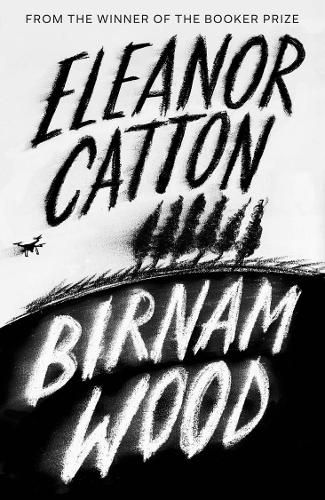
2023, 423 p.
Silly me. Here I was assuming that this book, with a title referencing Macbeth, would be an updated telling of the Macbeth story – but any connections with Macbeth are rather tangential. You may remember that in Shakespeare’s Macbeth, he took comfort in his security as King from the prediction that “Macbeth shall never vanquished be until / Great Birnam Wood to high Dunsinane Hill / Shall come against him”. Assuring himself that trees could not move, he later realized the true meaning of the prediction when his enemy and his army advanced on Macbeth’s castle under the protection of the tree branches they carried, thus appearing to be a forest moving up the hill.
‘Birnham Wood’ was the name that a gardening co-operative adopted for themselves as they engaged in organic ‘guerilla gardening’ on unattended plots and spaces, living on the food grown as they squatted on disused sites, using water if it was available, carting their own if it was not. There’s elements of humour in Catton’s book, and this is one of them: in a world of terrorists and rogue militias, guerrilla gardening seems rather incongruous. [Having said that, the son of one of my distant relatives is a hard-core forager and dumpster-diver, and his parents have found it very difficult to cope with his subversion of all of their expectations for his career and future in his outright rejection of the capitalist economy.]
Acting as a collective, there are nonetheless power differentials between the members of Birnam Wood. The group was founded by 29 year old Mira Bunting who is approached by Robert Lemoine, a shadowy multi-millionaire attracted to New Zealand as part of the wave of ultra-rich Westerners looking for a bolt-hole in the event of nuclear war. His true intent is the surreptitious mining of rare-earth minerals in a remote national park, carried out under the cover of his pest-eradication drone company. He offers the Birnam Wood collective the opportunity to farm on his property and funding, and takes on the ‘conquest’ of Mira as a personal challenge. At the meeting of the collective to decide whether to accept Lemoine’s offer, Mira is confronted by Tony, with whom she had had a drunken sexual encounter before Tony left for overseas, four years earlier. He has now returned to the collective and rejects Lemoine’s offer as blood money. When his objection is voted down, he leaves, suspicious – correctly as it turns out- that there is more to Lemoine’s proposal to the group. The group meeting to decide the matter evoked brilliantly the interminable earnest university meetings I remember, overlaid with a 21st century patina of political correctness. In the meeting, Mira was backed up by her best friend Shelley, who was actually thinking of leaving the collective.
The book is quintessentially New Zealand, with its ‘pure’ image, green and fertile national parks, and propensity for earthquakes and landslips that has rendered the wider Christchurch area largely inaccessible after the main highway is cut. There is something slightly ‘woolly jumper’ about the collective which includes sincere and rather unworldly workers, inspired by ideas of conservation, ecology and rejection of capitalism.
Against this bucolic background, Robert Lemoine stands out as a 21st century James Bond villian/ Egon Musk type caricature. His sheer evilness is made more believable by his control over the electronic communications channels of mobile phone and internet and his surveillance of the members of the collective, which keeps him one step ahead of Mira, Shelley and Tony as they each think that they are acting autonomously, competing to come out on top in dealing with Lemoine.
The satire drops away and the book ramps up in the second half to become a page-turning, cat-and-mouse thriller, something I would have thought impossible in a story about an idealistic group of guerilla gardeners (of all things!). It’s to Catton’s credit that she’s able to carry this off at all. I won’t give away the ending, except to say that the ending probably had more to do with Macbeth than anything else in the book.
I read this book with the Ivanhoe Reading Circle as their June selection. Many of the members were disappointed with the ending: I was perhaps less critical, seeing any other possible ending as a cop-out, and spying a few loose ends that Catton may left dangling that could presage a different outcome.
Most of all with this book, I was so impressed with Catton’s ability to switch so skillfully into a completely different genre to that of the historical fiction The Luminaries, the only other Catton book that I have read. So many writers ‘stick to their lane’ after having a book as successful as The Luminaries was, but Catton has upended these expectations completely. It is a book that surprised with its completely modern setting and its morphing from a somewhat prickly social satire into a page-turning thriller. Eleanor Catton is completely in charge of her narrative, and has the flexibility of a very skilled writer with decades of writing ahead of her!
My rating: 8.5/10
Read because: Ivanhoe Reading Circle selection.
 The Resident Judge of Port Phillip