
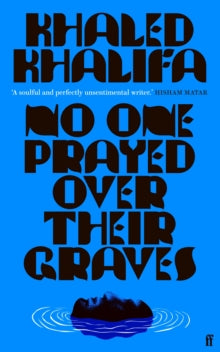
Translated by Leri Price
Sitting in the warmth, with the red leaves of the ornamental grapevine filtering the late-autumn sunlight, I finished this book feeling as if I had been on a very long journey to a strange land. It is a strange land to me: set mainly in Aleppo, Syria, this book has been translated from the Arabic and I felt the whole way through as if I was listening to a story-telling mode that is unfamiliar to me.
The book opens with a sudden, devastating flood in the village of Hosh Hannah in January 1907. Two women cling to a tree as bodies, wreckage and furniture stream past them in one of those red torrents that we are seeing all too often on the news today. One of the women, Shaha Sheikh Musa is the wife of Zakariya Bayazidi, who is absent from the village that day with his friend and adopted brother Hanna Gregoros as they are off visiting their brothel/casino ‘The Citadel’. She clutches her dead son as the water swirls around them. The other woman is Mariana Nassar, the local teacher. She sees the bodies of Hanna’s wife Josephine and her son being swept past, and those of her family, neighbours, students and family friends from other villages. As Zakariya and Hanna return to the ruined village, the flood marks for them a ‘before’ and an ‘after’, and they carry it with them for the rest of their lives. They bury the bodies, heedless of the distinction between Muslim, Christian and Jew, but they live on for decades later yearning for death to complete the cycle for them.
Just as we saw in Syria over a century later, when the country again ripped itself apart in the latest manifestation of its Civil War, Aleppo and the village of Hosh Hanna were religiously complex communities, with interpersonal links between religious groupings overlaid by deep enmity at a broader political level. Hanna had been brought into Zakariya Bayazidi’s Muslim family after his Christian family was massacred by the Ottoman Turks, and the interconnections between the families of the two men (sisters, nieces, nephews, grandchildren) continued across the novel in a series of lost chances, feuds and unconsummated love. As the twentieth century progresses and religious faultlines harden, politics and history make it harder for breaches to be healed.
I must confess that I found this book very difficult. The text is almost relentless, with only ten chapters in nearly 400 pages and no white space at all to separate one paragraph from the next. The chapters are not headed and so they feel as if they are stretching on interminably. I know little about Syrian history and the book is strangely devoid of descriptions which could help you gain a sense of place. Middle-eastern names are unfamiliar to me, and I kept getting confused between characters. The narrative moves between 1881,1903,1907, 1908, 1915, 1948 and 1951 but not strictly chronologically.
Nor is the book written in a way to help the reader. Paragraphs slip back and forward in time without warning, and the author introduces new characters almost at will and with little rationale. Big events happen abruptly. Some chapters are written in a third-person, detached tone, interspersed with italicized segments of Hanna’s autobiography, and then a story-within-a-story written by a minor character. If ever a book cried out for a family tree, it’s this one.
But, if you’re willing to persevere, the book repays the effort. Its closing pages close the circle, enclosing myriad regrets and lost opportunities. But be warned: you’ll have to work hard as a reader with this one.
My rating: 7/10
Sourced from: Yarra Plenty Regional Library
 The Resident Judge of Port Phillip