Monthly Archives: May 2024

I hear with my little ear: Podcasts 24-30 April 2024

History Listen (ABC) Section 71 The Hindmarsh Island Bridge Affair Part 2 Times changed. Robert Tickner lost his seat in the 1996 election, and John Howard was now Prime Minister, voted in promising “bucketloads of extinguishment” of Native Title. In December 1996 the Hindmarsh Island Bridge Bill before Parliament specifically ruled out Doreen Kartinyeri’s cultural heritage challenge to the Hindmarsh Island Bridge proposal. The May 1998 case before the High Court challenged the power of the Federal Government to make laws using the ‘race powers’ of the Constitution against Aboriginal People. Kartinyeri’s case was not successful, with a 5-1 judgment against her. The developers of the bridge, the Chapmans, claimed $20 million compensation, and it went back to court. This time, in 2001, Justice John von Doussa of the Federal Court rejected the claims for malfeasance and was not satisfied that the restricted women’s knowledge was fabricated or that it was not part of genuine Aboriginal tradition. Since then, the panic among miners and pastoralists over Native Title has abated (although not gone away completely). In 2002 bones were found on Hindmarsh Island and a formal apology was issued by the local Alexandrina council. The bridge is still there.

Emperors of Rome Episode CIX Saturnalia. In Roman mythology, Saturn was the father of Jupiter, and he ceded his power to him. Saturnalia marked the end of the sowing time, before winter set in and was celebrated around 17 December, but the length of the celebration varied. Nonetheless, it was the longest festival that the Romans celebrated. It’s hard to tell exactly what they did as part of the celebrations. Fifth century sources tell us that there was a sacrifice at the Temple of Saturn, but other than that, it’s hard to work out. There may have been an element of topsy-turviness, with masters serving their servants- or maybe not.

History Hack and Little Atoms. I have just finished reading Sarah Churchwell’s The Wrath to Come (my review here) and so I though that I’d listen to a couple of podcasts interviews with the author. In the The History Hack podcast the author points out that Mitchell’s grandmother had seen the burning of Atlanta, and that Mitchell grew up with these stories, supplemented by a reading diet of plantation romances. GWTW is the ultimate rich-poor-rich again Cinderella story valorizing survival and resilience, with a strong female anti-hero. The Little Atoms episode covered much of the same territory, and she explains about the Lost Cause, and emphasizes that the book and the film is revisionist history.

Three Million BBC Episode 3: The F-word What really struck me about this episode is how closely it reflects what is going on in Gaza today. As with the Israeli/Western governments today, there was a real squeamishness about the word ‘famine’, and the British Government was using its wartime censorship powers to censor the letters passing between Indian soldiers and their families. In the end, even the British censor (based in India) felt very uncomfortable about the suppression of knowledge of the famine. Aware that the optics of people dying in the streets of Calcutta could be used for propaganda purposes by the Germans and Japanese, the Bengal Vagrancy Act was passed in July 1943 to get the bodies off the street. Stevens, a British journalist and editor of the English language Statesman newspaper in Calcutta, knew that any text would be censored, but he realized that there was a loophole which would allow photographs to escape censorship. So he sent out a team of photographers, and the following week was emboldened to write an editorial condemning the lack of action. By October, it was being raised in Parliament, and the BBC was drawn into conflict with the government over the “India Food Question” (they still couldn’t say ‘famine’). Then a book called ‘Hungry Bengal’ was published which showed sketches of starving Indians. Of course, it was banned, but there is one copy in the British Library and here a starving man actually gets a name. Three million didn’t.

Things Fell Apart Episode 7 You’ll Own Nothing and You’ll Be Happy The theory of ‘The Great Reset’ which has been protested by people caught up in the sovereign citizen movement was centred on the idea that the World Economic Forum had plans for a radical reordering of society, expunging private property and restricting people’s movement to a small geographical area. It drew on several individually innocuous proposals: a suggestion of bus lanes; a business of ‘sleep pods’, and especially a thought experiment piece presented to the World Economic Forum speculating on the implications of products being turned into services (I guess, in the way that DVDs and CDs which we used to own are now streaming services). These ideas became weaponized, and their proponents demonized in a way that they never anticipated.
‘The Weekend’ by Charlotte Wood

2021, 288 p.

I’m trying to resist the temptation to think that this book was written to order: ” This’ll attract sales -how about a book about aging women that book groups can discuss!?” It certainly felt as if it were aimed at an educated, older female audience of readers. Aging, women’s friendships, betrayal… all set in a beachside setting over the Christmas weekend on the central coast of NSW.

Jude, Wendy and Adele, all in their seventies, have been going to Silvie’s beachside house for Christmas for years, and they head there again. But this time it is different: Silvie has died, and they have come to clean out the house for sale. The 1970s house has seen better days despite its ocean views, with its creaking inclinator (i.e. lift) obviating the need to scramble up the steep cliffside driveway, and it is full of the greasy, musty, scurf and accumulated detritus of a long residence. Jude, successful restaurant manager, has arrived to work; widowed public intellectual Wendy has brought her sick, old, mangy dog Finn, and washed-up actress Adele has come as an escape from her female partner who has been quite insistent that their relationship is at an end. They are all well aware that this phase of their life and friendship has come to an end.

They have been friends for over forty years, and I guess that in that time you could accumulate a long list of slights and peeves. They are judgmental of each other and hold secrets and deceptions from each other. Jude is the long-term mistress of the married Daniel, with whom she spends a week a year at the beach-house after the other women have gone home. Rather implausibly, these long-term friends have never met Daniel, although they are aware of his existence. Wendy is in the final stages of her academic career, but she feels that she still has one final book in her. She had two children, now adults, with her husband Lance, and after his death her friend Sylvie brought her the puppy Finn, who by now is a blind, deaf, incontinent and confused dog, who should have been put down long before. Adele has not worked for some time, but still dresses in skin-tight tops to reveal her cleavage and takes pride in her athleticism. However, years of sporadic theatre work have left her financially distressed and she has not worked in a long time, even though some other actresses her age have continued to do so.

The story is set over just a couple of days, and it felt rather like a play. I read this immediately after reading Demon Copperhead, which was such an exhilarating experience that this felt particularly jejune in comparison. It was a particularly ‘interior’ book, with lots of backstory and cogitation, revolving around relationships and choices and responses to aging and loss. She did capture the setting well: I could ‘see’ the house, and even the characters, in my mind’s eye, and there was a veracity in the complexity and ambivalence in their relationship together. I was surprised that Wood herself is ‘only’ 58 because she wrote well about aging women’s bodies and the indignities that they subject us to. But I can’t help feeling that she was writing to a particular audience- me- and perhaps the stereotypes she held up were just a little bit too close to home.

My rating: 7/10

Read because: CAE bookgroup

I hear with my little ear: Podcasts 16-23 April 2024

I Was a Teenage Fundamentalist Episode 97 What about Progressive Christianity? I must say, that when I was an evangelical Christian about 40 years ago, I didn’t ever have a problem with Christianity and Progressivism. I think that it says more about modern evangelical Christianity than it does about me, that there could even be a tension between the two. In this episode, Brian and Troy talk with Rev. Tim Costello, someone I generally admire for his work on refugees and gambling. In the introduction Brian and Troy give a trigger warning for how much Christianity is going to follow: I bet that Tim Costello hadn’t been introduced with a trigger warning before! I do find his frequent declarations that “I believe in Jesus” rather strident, given the general progressiveness of the rest of the podcasts- what does that mean? Resurrection? Salvation? etc.

Three Million Episode 2: The Cigarette Tin When the Japanese invaded Calcutta (I didn’t know they did!), people fled their lands and crowded into the cities. Because the British government was requisitioning supplies, the price of rice rocketed. Amartya Sen, one of the interviewees, who lived a comfortable middle class childhood, speaks of his mother allowing him to give half a cigarette tin of rice to people in his immediate neighbourhood who asked for it. The British Government refused to free up ships as a mere ‘goodwill gesture’ and merchants were buying up rice and stockpiling it. It was a class-based famine.

The Rest is History Episode 431: Titanic: Nightmare at Midnight (Part 5) The two hours and 40 minutes that it took the Titanic to sink makes it seem like a performance to us. Survivors mention the crunch (like running over gravel) as it hit the iceberg, then silence. People were paralyzed by deference, inertia and compliance. CQD (‘All stations help’), the emergency code, was sent out (SOS had been introduced 4 years earlier but was not in widespread use). All the crew knew that there was a lifeboat deficiency of about 1000 (it would have been almost 2000 if the Titanic was at full capacity). There was a fear of panic but also reluctance to face the 11-storey drop down to the water. The code was ‘women and children first’ but what did that mean? No men until all the women were off? Or let women and children fill up the lifeboat, then men could go on? The instructions were interpreted differently on one side of the ship to the other, so your survival depended on which side you went to. The gates blocking Third Class were opened after 45 minutes but there was a 3rd class reluctance to leave their baggage (their sole possessions) and it was very, very cold. Sir Cosmo Duff-Gordon and his wife survived in Lifeboat 1 which had only 12 occupants out of a capacity of 40 and were treated with obloquy for the rest of their lives. Isodor Strauss and his wife Ida, two of the few Jewish passengers and co-owners of Macy’s department store, chose to stay because, as a man, Isodor was refused a place on the lifeboat. J. Bruce Ismay, the chairman and managing director of White Star Line also survived when he got onto a spare lifeboat. Most of those who died did so because of the cold, rather than drowning. The survivors recalled hearing the clamour of voices, then a roar as the Titanic sank.

Very Short Introductions Podcast Abolitionism Abolitionism? Is that an American thing? This podcast, of very poor acoustic quality, is presented by Richard Newman, who has written on American Abolitionism, and is very US-centric. He sounds almost surprised by the fact that there was a continuous wave of activism through from the 1770s to the late 19th century on both sides of the Atlantic, and that it worked globally and tactically through petitions and courtcases. He notes the diversity among abolitionists, who worked as politicians, ministers, photographers, writers, men and women, black and white. He notes that African Americans were particularly important in the formation of the first Pennyslvania Abolition Society in 1775, and in Britain. He emphasizes the importance of the slave revolt in Saint-Domingue (Haiti) in 1793 which led to the end of French slavery, and attracted the attention of the whole world.

History Hit Episode 1424 Pontius Pilate features Helen Bond. She discusses the portrayal of Pilate in the canonical bibles, the apocryphal books of the Bible, and through secular writing at the time. In 6CE Judea came under direct Roman rule, and the first governors appointed were prefects, as was Pilate. The early Christian writers, who had the problem of squaring the Messiah with a crucified criminal, portrayed the Jewish leaders as responsible. Mark (the earliest of the gospels) speaks of the trade-off with Barabbas – is that plausible? Matthew depicts Pilate washing his hands, and Herod Antipas, another high-status man involved in his trial. John goes off on an esoteric frolic of his own. The Romans were mainly based at Caesaria Maritima, on the coast, and they were not a big presence in Jerusalem, where they knew they were not welcome. The Apocryphal gospels have The Acts of Pilate (or Gospel of Nicodemus) but they are generally viewed as being spurious. Among the non-biblical sources, Philo of Alexandria is contemptuous of Pilate, while Josephus is writing after the Jewish-Roman War and is looking for insensitivities amongst the prefects to explain the war. He notes times when Pilate backed down over Jewish demands, and generally sees him as mediocre. In the Coptic Ethiopic tradition, Pilate is a saint because he converted to Christianity. There are other stories about Pilate’s supposed suicide, and the idea that he was buried in a lake in Lucerne because evil spirits followed him. What we do know is that Pilate was in Judea for about 10 years (a relatively long posting) and that he really existed.

‘The Wrath to Come’ by Sarah Churchwell

2023, 464 p.(including notes)

Sometimes, a good essay is more forceful than a book, I reckon. This is what I kept thinking when reading this book, and although the pace picked up and the book ranged more widely once Part I was out of the way, I just felt as if I had been hit over the head with a mallet as the same argument was repeated again and again. I wish it had been a good long-form essay New Yorker-style rather than a 389 page book.

Churchwell’s argument, which she spells out succinctly in her prologue, is that there is a connection between Gone With the Wind, the instant bestseller of 1936 and the later movie adaptation which became the most successful of its time, and the events of January 6 2021 as the crowd, fortified by defeated-President Trump’s support (“So we’re going to, we’re going to walk down Pennsylvania Avenue. I love Pennsylvania Avenue. And we’re going to the Capitol…”) crashed its way into the US Capitol. It is not so much about the history, but about the book and the film as paired phenomena:

‘Gone with the Wind’ provides a kind of skeleton key, unlocking America’s illusions about itself. When we understand the dark truths of American experience that have been veiled by one of the nation’s favourite fantasies, we can see how the country travelled from the start of the Civil War in 1861 to parading the flag of the side that lost that war through the US Capitol in 2021. That journey was erratic and unpremeditated, but America ended up there all the same. (p. 8)

The book Gone With the Wind appeared in 1936, and sold a million copies in less than six months, won the Pulitzer Prize in 1937, was translated into at least 27 languages and became within a few years the best selling American novel of all time. The film Gone With the Wind was released in 1939 and smashed all records, and adjusted for inflation, is still the highest-grossing film of all time.

The book, which Churchwell has obviously read closely (and which I have not read at all), is more overtly racist than the film. David Selznick’s film consciously eliminated the novel’s many casually racist slurs, as a result of the lobbying from the film’s Black stars. However, the racism continued in the manifestation of the film as a phenomenon: the Black actors were not invited to the film’s premiere, and when Hattie McDaniel became the first Afro-American to win an Oscar for her portrayal of Mammy, she was sitting at a separate table to the rest of the cast, after Selznick had managed to overturn the Cocoanut Grove nightclub ban on black patrons.

Churchwell’s book follows the narrative of the book and film, starting off with ante-bellum Georgia and the rumblings of war. As Churchwell tells us over and over, Mitchell’s portrayal of plantation life (especially in the book) was gratuitously racist and infantalizing. I was relieved to move onto the post-war section of Churchwell’s book, even though I think I remember feeling (it was a very long time ago) that the film had lost impetus once Scarlett returned to Tara. But in Churchwell’s analysis, it is in the return to Tara that the book takes up its major purpose to reify the Lost Cause into American identity. Scarlett O’Hara is not the heroine of Gone With the Wind, instead the real heroine is Melanie, and it is not a love story, but a story of revenge. It is profoundly anti-democratic and consistent with fascism. And this, Churchwell argues, is what fuelled January 6.

I am not at all well-read in Reconstruction and Jim Crow legislation, many hours of listening to Heather Cox Richardson notwithstanding. I saw Gone With the Wind decades ago and have no particular wish to re-watch it, and I have never read the book and am not likely to do so. This book was too detailed for me, although admittedly I’m sure that it was not written for an Australian audience. I was deeply affected, though, by the sheer and graphic violence meted out by the Klan and other vigilante groups: I had not read this before.

Overwhelmingly, this is an angry book, which is ironic given that anger was the predominant driver of January 6 too. I felt that it was too repetitive in its critique, and would have been much punchier as a long-form essay. It felt a very long , and I was pleased to have reached the end of it so that I could move onto something else.

My rating: 7/10

Read because: I heard about it on a podcast, I think.

‘The Bloody Chamber’ by Angela Carter

1979, 126 p.

Sometimes I have heard about a book long before I have read it. This was the case with Angela Carter’s The Bloody Chamber. I didn’t know much about it, but I knew that it was a feminist take on traditional fairy stories, much admired by some pretty intense and impenetrable feminist writers. I assumed that I would find Carter’s writing as dense as I do these commentators but I was pleasantly surprised: Carter’s stories were easy to read, although the subject matter was disturbing. Although, fairy stories are pretty disturbing too, when you think about it.

The book contains a number of short stories. The first, The Bloody Chamber is the longest by far, set in a recognizably present time and unlike the other stories, has no supernatural or shape-shifting elements. Based on the story of Bluebeard, a young girl marries a wealthy older man who has had several other wives. Left alone in the their large old house, and warned not to enter a particular room, she of course enters the room where she finds pornographic and torture instruments and the body of one of her predecessors. I found this off-putting: I always find it difficult to watch screen depictions of torture, and this story was no exception. But it was saved by MUM riding to the rescue- good old mum!

The other stories also riffed off fairy stories- not a straight retelling necessarily, but certainly picking up on themes in the original. Several of them were based on Beauty and the Beast, or Little Red Riding Hood, and there are three stories about wolves or werewolves. There are enough resonances in the language and structure for you to relax into reading a fairy story, until she subverts your expectations by going in a different direction. Most of the stories are set in an undetermined, gothic European setting without specific reference to time and place. Some are very short, consisting of only one or two pages.

There is no sex in it as such, although there is plenty of disrobing and exposure, and it was also interwoven with coercion and threatened violence. I must confess to finding it disturbingly erotic as well. It is beautifully written, with very skilled control of pacing and a light touch in combining familiarity with disequilibrium.

My rating: 8/10

Sourced from: CAE reading group.

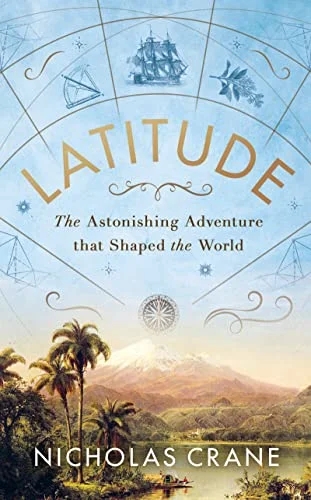
‘Latitude: The Astonishing Adventure that Shaped the World’ by Nicholas Crane

2021, 234 p.

There seemed to be a spate of books a few years back with a noun, followed by a subtitle that made a claim to greatness (“a world history” or “the fish that changed the world”). Nicholas Crane, who presented documentaries like ‘Coast’ or ‘Great British Journeys’, takes a similar approach in the title to his book. In this case, though, there is an element of truth, as the significance of latitude is that it does tell us the shape of the world, and in the 1700’s that was a big question. They knew that the earth wasn’t a perfect sphere, but was it stretched at the poles, or as Isaac Newton suggested, did it bulge out in the middle? To answer the question, the French government dispatched two expeditions, one to the Arctic Circle led by Maupertuis in 1735, and another to South America that same year, in order to compare results. Latitude is the story of the South American expedition.

In 1735 South America was part of Spain’s colonial holdings. The Wars of Independence would not occur for another 90-odd years and South America had not been divided up into the countries that we know today. After a voyage that took them to Martinique, Saint-Domingue (now the benighted Haiti), Cartegena de Indias and Panama, they finally made land at Guayaquil and headed towards Quito in what is now Ecuador. There were ten men in the French Geodesic Mission to the Equator, attended by four servants. They were headed by three members of the French Academy: Bouger, La Condamine and Godin. They were supported by Jean-Joseph Verguin, the principal surveyor, Jean-Louis de Morainville, an artist, a clockmaker technician, Theodore Hugo (whose role became increasingly important as their equipment faltered) and Joseph de Jussieu, doctor and botanist. The three final men in the French contingent were “a mixed bag of mates and favours” (p.11) – cousins, nephews of friends, a surgeon. However, having a French expedition on Spanish land was diplomatically tricky so, in order to encourage Spain’s co-operation, the French government offered services in measuring the longitude and latitude of key locations on the coast of Peru and the inclusion of “two intelligent Spaniards”. They were Jorge Juan y Santacilia and Antonio de Ulloa and de la Torre-Guiral, both graduates of the Academy of Navy Guards and trained in mathematics, astronomy, navigation, trigonometry, cartography and firearms. (p. 17)

There were lots of egos in amongst this group, and several of them were curious scientists who were perfectly happy to go off on frolics of their own to undertake their own experiments. The expedition split up, came together, split up again as personalities grated and egos clashed. Their main purpose was to undertake a geodesic survey which, despite Crane’s best efforts, I never really quite understood (don’t bother explaining it to me- I really don’t care). I gather that it involved the placement of triangles on high peaks with a clear sight line between them, measuring, then lots of computation. This tied in with astronomical surveys as well, undertaken using a zenith sector which required the observer to lie on the floor beneath the eyepiece of an immensely long, precisely aligned telescope erected in an observatory with a hole in the roof and a pendulum clock on the wall. There were also experiments about the speed of sound which I didn’t quite understand.

The trouble was that these high peaks were the Andes, with all the attendant perils of altitude sickness, frostbite, avalanche etc. There was a lot of scaling mountains, completely dependent on indigenous porters (as colonial mountain-expeditions always are )and the scientists were typically boorish in their dismissal of local knowledge about safe altitude levels. The triangles could be erected, then knocked down by wind or snow, requiring them to be put in place again. They took readings, but found discrepancies and so would repeat the measurements again, adding year after year to their expedition. Meanwhile they continually ran out of money, got involved in a brawl that led to murder, and they seriously insulted the Spanish contingent.

And what did they have to show for it, ten years later? Well, not all the men returned, but those who did not only proved Newton right, but they also undertook ground-breaking research on rubber and malaria, completed the first detailed survey of an Inca site, described platinum, took thousands of measurements and made thousands of botanical observations. But, as the final chapter which wraps up ‘what happened next’, several of them seemed infected by travel-restlessness (a pre-existing condition which had probably prompted them to go on the expedition in the first place), while others returned to France to die of amoebic dysentery, experimental hernia surgery (always the scientist), falling from scaffolding repairing a church or just old age.

This book is told in a rollicking narrative style, and the different characters are well-differentiated. What I couldn’t understand though, is why a book about geography, written by a geographer, had only two maps with minuscule writing located at the front of the book. I was flipping back and forth constantly, squinting trying to read the writing on the map. If only there had been legible maps tracing their journey placed appropriately within the text, I am sure that I would have followed their voyage more easily. Nonetheless, it was an enjoyable read which demonstrates both men’s (because they were all men) endurance and determination, and their selfishness, self-aggrandizement and inability to work together for ten whole years.

My rating: 7.5

Sourced from: Yarra Plenty Regional Library. And why?- a beautiful cover and it looked interesting.