
Monthly Archives: April 2024

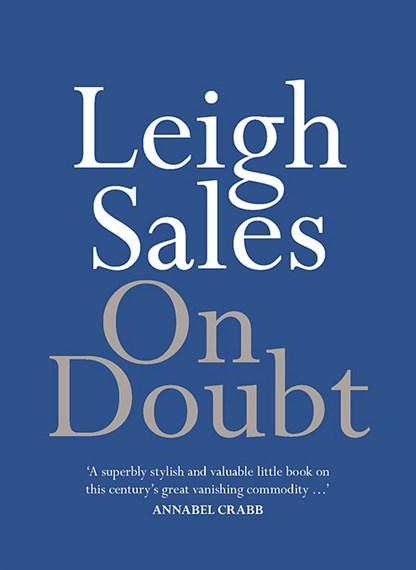
‘On Doubt’ by Leigh Sales

2020, 128 p

If nothing else, having to prepare talks for my Unitarian fellowship makes me read things I might not have read otherwise. On Doubt, by journalist Leigh Sales is part of the ‘On…’ series published by Hachette, and like the other books in the series, it is only short: in this case only 128 pages.

As a journalist, Sales has had plenty of experience with politicians who come onto her program, pumped up full of talking points and bombast. Her exploration of ‘doubt’ is largely through a political lens, but in Part I she starts by talking personally about her own curiosity and rebelliousness as a child. She rarely accepted anything as a given, and although converting to evangelical Christianity as a teenager, she soon rejected the ‘truths’ of religion that had to be accepted on faith, as well.

In Part 2 she turns to politics, struck by the certainty of Sarah Palin who boasted that she “didn’t blink” when asked to be George W. Bush’s vice president, despite her complete lack of experience. She notes that much of our media today is comprised of commentary rather than research or reporting, marked by point-scoring and moral certitude. This is most manifest in the US television that we receive here in Australia but she reports a similar unedifying spectacle between Gerard Henderson from the Sydney Institute and Robert Manne, who often writes for the Schwartz stable of publications. In the part of the book that was most useful to me, she quotes Pierre Abelard from the 11th century who wrote that the path to truth lies in the systematic application of doubt, and that those who have sought the truth begin from a premise of doubt, not certainty.

However, the expression of self-doubt is not seen as a virtue in politics. She was stunned when former Treasurer Wayne Swan revealed that he (and he assumed, most other people) had times of self-doubt. She compares this with George W. Bush who relied on his gut-feelings, bolstered by his religious faith, to the extent that even the people who surrounded him became uneasy. She talks about gut-feeling, citing Malcolm Gladwell’s Blink which asserts that people who are expert in their field (and that’s probably a very important qualification) use ‘thin slicing’ to instantly identify patterns in current situations, enabling them to make decision in the blink of an eye. But she also recognizes ‘the yips’ that assail someone who is very competent when they start to overthink something that they are already expert in- like playing the piano (for her maybe! Oh, to be good enough to get the yips!)

In Part IV she talk about people like her father, who leave nothing to chance, citing his mantra “Preparation and planning prevent piss-poor performance”. While bridling against the certainty and inflexibility that this approach guarantees, she observes that her own “what if” thinking, shot through with doubt, can lead to anxiety and a lack of all-consuming passion.

She finishes off in Part V with a post-script written in 2017, eight years after the original book. In those eight years, she suggests, we have become accustomed to distortion through social media, and we accept with equanimity the shrugs of corporate bosses and the misrepresentations of politicians. While refusing to divulge her own political leanings, she decries the idea of ‘balance’ which gives equal time to both sides.

As you can see, this book is a bit of a grab-bag of observations, not all of which are closely tied to the theme of ‘doubt’. It could almost do with another post-script, given the rise of deep fakes and AI which frighten me for the way that they undercut even what we have seen (or think we have seen). However, it’s an easy enough read- not unlike a long-form article that remains at a largely surface level and with its main interest in the political realm.

My rating: 6.5/10

Sourced from: borrowed e-book from Yarra Plenty Regional Library.

I hear with my little ear: Podcasts 8-15 March 2023

Emperors of Rome Episode CV Spartacus the Gladiator. Did you know that I have never watched ‘Spartacus’? He led a rebellion in 73BCE and it took three years for the republic to finally crush it. At first the Romans just saw it as a petty rebellion, but over time they realized that they had to take it more seriously. There had been previous slave wars in Sicily on the large estates during 2BCE but Spartacus’ rebellion took place on the mainland of Italy. Spartacus was from Thrace, and he had previously served as a soldier with the Romans, but he ended up as a prisoner (because of desertion?). He was sent to the Gladiator School in Capua. His uprising had initial success, and originally grew to between 70,000 and 120,000 slaves. There were two other leaders of the rebellion, but you don’t hear much about them.

History Extra From Russia to Texas: the Search for a Jewish Homeland. We’re watching the search for a Jewish homeland (or rather, the assertion of a Jewish homeland) playing out on our screens night after night. At the turn of the 20th century, millions of European Jews were seeking an escape from antisemitic persecution, especially from Russia, where they were restricted to the Pale of Settlement. The idea of Zionism had arisen a few years previously, and there was a flood of emigration to New York, where there were no immigration quotas, and over a million Jews had congregated in the Lower East Side. Things were getting desperate and when Uganda offered a homeland, the Jewish community was split between those who wanted Palestine-or-nothing, and those who saw Uganda as a short term fix. Actually, it wasn’t even Uganda, it was Kenya, which shows how nebulous the thinking was. Australia was approached too, but it rejected the proposal. Galveston had recently been devastated by a huge storm, and when it was suggested that Jewish people could immigrate there, the idea was attractive because so many other people had left town.

The Rest is History Episode 420 Britain in the 1970s: Thatcher Enters the Ring is the final episode in this 4 part series. Five days before the October 1974 election there was a bomb blast in a Guilford pub. People felt impotent to stop the IRA bombing, even though there were arrests (which ended up being the wrong people arrested anyway). Ted Heath, the Tory opposition leader, presented himself as the leader of a unity government, supported by the very visible Margaret Thatcher, and promised to cap the interest rate on loans at 9.5% (a very un-Torylike action). Liberal leader Jeremy Thorpe travelled on the hustings by hovercraft, and when it sank, it seems a metaphor for the country. It rained all the time, and people were sick of these Heath/Wilson electoral contests- this was the fourth time they went head to head. The Daily Mail did a special on Wilson’s finances, digging up the dirt on school fees and Swiss bank accounts, but they didn’t publish, preferring to leave it hanging over his head. Wilson ended up with a 3 seat majority. Then 5 weeks after the election there was another bombing, this time in Birmingham, and again they arrested the wrong people. Heath refused to give up the leadership of the Conservatives, even though he had lost four times in a row. Another Conservative, Keith Joseph decided to challenge, but after a disastrous speech in Birmingham, he stepped back from the leadership challenge and Margaret Thatcher stepped forward. And literally, the rest is history.

The Daily A Journey through Putin’s Russia This was recorded on the day that Russians went to the polls, but everyone knows what the result is going to be. Even though the West expected Putin to suffer from the deaths in the Ukraine war, and the economic sanctions that were imposed as part of the West’s response, he has a 86% approval rating and 75% of people think that Russia is heading in the right direction- his highest number ever. His generous compensation payments to the families of impoverished Russian men who volunteer for the Army mean that even bereaved families support Putin, seeing it as a war against the West.