
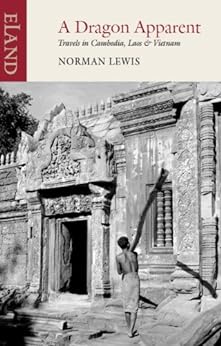
Any travel book written in 1951 will have aged, and this book is no exception. Indeed, the author Norman Lewis was well-aware that he was writing in the midst of history, noting in his preface that the stalemate in Indo-China had broken after four years, and that as the proofs of his book were being corrected in January 1951, the Viet-Minh were closing in on Hanoi.
It seems certain that before the book appears further important changes will have taken place.
He wasn’t wrong. One of the poignancies of this book is our knowledge, seventy years on, that the world he describes here was about to be obliterated. In the preface to the 1982 version of his book, Lewis writes:
…the greatest holocaust ever to be visited on the East…consumed not only the present, but the past; an obliteration of cultures and values as much as physical things. From the ashes that remained no phoenix would ever rise. Not enough survive even to recreate the memory of what the world had lost.
1982 preface
This meandering book is the story of Lewis’ travels through Vietnam, Cambodia and Laos. By 1951, France had offered independence to its former colonies, but although nominally independent, France still controlled foreign policy, and the French army was stationed throughout. Lewis was not there under the aegis of any press company, and after consulting with the French authorities, he was reliant on their goodwill to enable him to hitch rides under French protection across the three countries. The French Army at the time was at war with the Viet Minh, and so his whole narrative is permeated by a sense of oppression and coercion.
As a British writer, he has internalized much of the colonizers’ racism that sees people as a certain ‘type’. He spends considerable time with different tribes, the Mois, the Meos and the Rhades,distinguishing them from other tribal groups, and there is an elegiac sense that these groups will not survive. He is particularly critical of missionaries and their blithe confidence that they are doing good, and he castigates the planters and their cosy relationship with the French occupiers.
He is reliant on the army to get him from one place to another and he speaks only French and English. There is a lot of waiting around, angling for his next ride. As a result, he interacts mainly with French administrators and residents and those local officials that the French government have been willing to leave in place. He gains access to high places, but always with the permission and imprimatur of the French colonizers. It was almost with surprise that he found a young Cambodian boy who could speak “passable” French, which enabled him to understand more of a local dance performance than he would otherwise. It was only in the last chapter that he gains access to the Viet Minh, through the agency of Dinh, who he met in a doctor’s waiting room. Here he witnesses the influence of China and the Soviet Union in supporting the independence struggle against the French.
It is very much a book of its time in its Eurocentric classifications and descriptions of people and groups. For example, here’s his description of Dinh, his contact with the Viet Minh:
He introduced himself as Dinh- an assumed name, he assured me with a wry smile. I was interested to notice, in support of a theory I was beginning to form, that for a Vietnamese he was very ‘unmongolian’ in appearnce. He was thin-lipped and cadaverous and there was an unusual narrowness across the cheekbones. If not a Frenchman he could certainly have passed for a Slav. There had been many Caucasian characteristics about the other Vietnamese intellectually and revolutionaries I had met, and I was wondering whether whatever physical mutation it was that produced this decrease in mongolian peculiarities encouraged at the same time the emergence of certain well-known Western traits, such as a restless aggressiveness, an impatience with mere contemplation, and a taste for action.
Ch. 20
So what was the appeal for me in reading this racist, 70 year old text? For me, it was his descriptions of landscape. Take, for example, his description of Ta Phrom temple in Siem Reap:
Ta Prohm is an arrested cataclysm. In its invasion, the forest has not broken through it, but poured over the top, and the many courtyards have become cavities and holes in the forest’s false bottom. In places the cloisters are quite dark, where the windows have been covered with subsidences of earth, humus and trees. Otherwise they are illuminated with an aquarium light, filtered through screens of roots and green lianas.
Entering the courtyards, one comes into a new kind of vegetable world; not the one of branches and leaves with which one is familiar, but that of roots. Ta Prohm is an exhibition of the mysterious subterranean life of plants, of which it offers an infinite variety of cross-sections. Huge trees have seeded themselves on the roots of the squat towers and their soaring trunks are obscured from sight; but here one can study in comfort the drama of those secret and conspiratorial activities that labour to support their titanic growth.
Down, then, come the roots, pale, swelling and muscular. There is a grossness in the sight; a recollection of sagging ropes of lava, a parody of the bulging limbs of circus freaks, shamefully revealed. The approach is exploratory. The roots follow the outlines of the masonry; duplicating pilasters and pillars; never seeking to bridge a gap and always preserving a smooth living contact with the stone surfaces; burlesquing in their ropy bulk the architectural [motifs] which they cover. It is only long after the hold has been secured that the deadly wrestling bout begins. As the roots swell their grip contracts. Whole blocks of masonry are torn out, and brandished in mid-air. A section of wall is cracked, disjoint/ed and held in suspension like a gibbeted corpse; prevented by the roots’ embrace from disintegration. There are roots which appear suddenly, bursting through the flagstones to wander twenty yards like huge boa constrictors, before plunging through the upended stones to earth again.
Ch. 15
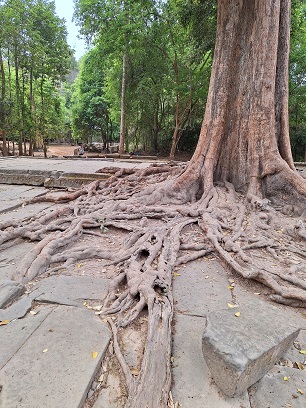
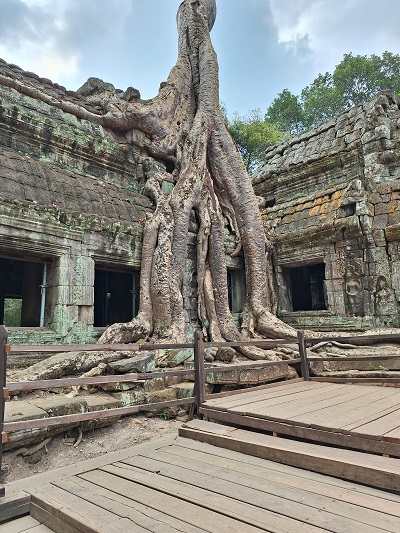
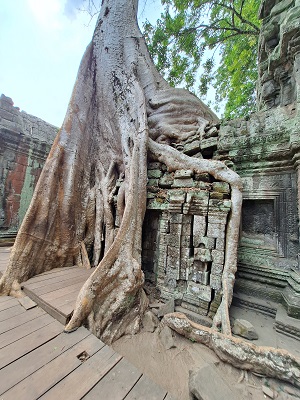
Absolutely brilliant writing. I found myself rethinking my perceptions -“grossness”- yes, that was the unease that I felt while I was there. Even though many of the villages and landscapes he describes may have disappeared, there is enough remaining that you think “Ah, yes, that’s how it was!” Although I’m not a great aficionado of travel narratives, I think that this is what good travel writing does best: it puts on paper something that you felt, or detected, and it captures it, just right, in words that you wish you thought of yourself.
My rating: 8/10 (taking it on its own terms)
Read because: I was travelling in Cambodia.
 The Resident Judge of Port Phillip
Pingback: Six Degrees of Separation: from ‘A Dragon Apparent’ to ‘The Dismissal Dossier’ | The Resident Judge of Port Phillip