
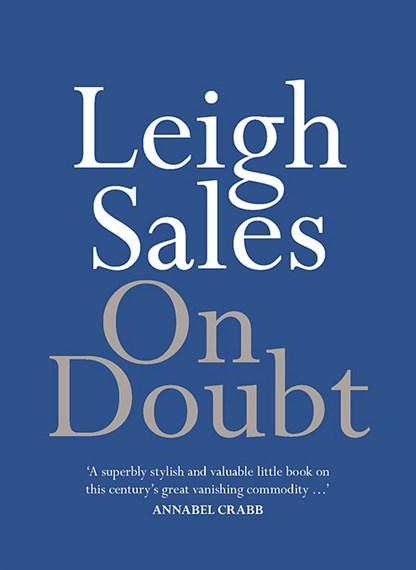
If nothing else, having to prepare talks for my Unitarian fellowship makes me read things I might not have read otherwise. On Doubt, by journalist Leigh Sales is part of the ‘On…’ series published by Hachette, and like the other books in the series, it is only short: in this case only 128 pages.
As a journalist, Sales has had plenty of experience with politicians who come onto her program, pumped up full of talking points and bombast. Her exploration of ‘doubt’ is largely through a political lens, but in Part I she starts by talking personally about her own curiosity and rebelliousness as a child. She rarely accepted anything as a given, and although converting to evangelical Christianity as a teenager, she soon rejected the ‘truths’ of religion that had to be accepted on faith, as well.
In Part 2 she turns to politics, struck by the certainty of Sarah Palin who boasted that she “didn’t blink” when asked to be George W. Bush’s vice president, despite her complete lack of experience. She notes that much of our media today is comprised of commentary rather than research or reporting, marked by point-scoring and moral certitude. This is most manifest in the US television that we receive here in Australia but she reports a similar unedifying spectacle between Gerard Henderson from the Sydney Institute and Robert Manne, who often writes for the Schwartz stable of publications. In the part of the book that was most useful to me, she quotes Pierre Abelard from the 11th century who wrote that the path to truth lies in the systematic application of doubt, and that those who have sought the truth begin from a premise of doubt, not certainty.
However, the expression of self-doubt is not seen as a virtue in politics. She was stunned when former Treasurer Wayne Swan revealed that he (and he assumed, most other people) had times of self-doubt. She compares this with George W. Bush who relied on his gut-feelings, bolstered by his religious faith, to the extent that even the people who surrounded him became uneasy. She talks about gut-feeling, citing Malcolm Gladwell’s Blink which asserts that people who are expert in their field (and that’s probably a very important qualification) use ‘thin slicing’ to instantly identify patterns in current situations, enabling them to make decision in the blink of an eye. But she also recognizes ‘the yips’ that assail someone who is very competent when they start to overthink something that they are already expert in- like playing the piano (for her maybe! Oh, to be good enough to get the yips!)
In Part IV she talk about people like her father, who leave nothing to chance, citing his mantra “Preparation and planning prevent piss-poor performance”. While bridling against the certainty and inflexibility that this approach guarantees, she observes that her own “what if” thinking, shot through with doubt, can lead to anxiety and a lack of all-consuming passion.
She finishes off in Part V with a post-script written in 2017, eight years after the original book. In those eight years, she suggests, we have become accustomed to distortion through social media, and we accept with equanimity the shrugs of corporate bosses and the misrepresentations of politicians. While refusing to divulge her own political leanings, she decries the idea of ‘balance’ which gives equal time to both sides.
As you can see, this book is a bit of a grab-bag of observations, not all of which are closely tied to the theme of ‘doubt’. It could almost do with another post-script, given the rise of deep fakes and AI which frighten me for the way that they undercut even what we have seen (or think we have seen). However, it’s an easy enough read- not unlike a long-form article that remains at a largely surface level and with its main interest in the political realm.
My rating: 6.5/10
Sourced from: borrowed e-book from Yarra Plenty Regional Library.
 The Resident Judge of Port Phillip