
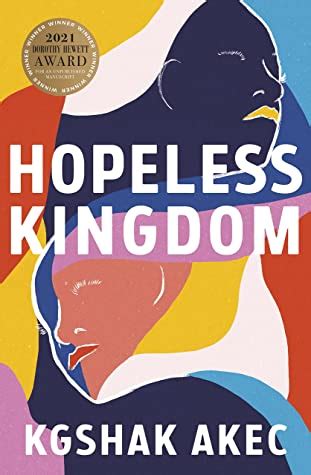
This book won the 2020 Dorothy Hewett award for an unpublished manuscript, and as a first book, I suspect that it has a strong autobiographical element. It has a double narrative of mother and daughter, retelling the same events from their own perspective. Taresai, a Sudanese woman, has emigrated to Australia with her husband and four children, while her eldest daughter Akita is forced to take over the care of her younger siblings as it is expected an eldest daughter will do. Ironically, Taresai herself was placed in a similar situation with her siblings back in Sudan, where her education was sacrificed for that of her younger sisters, still a source of festering resentment between Taresai and the other women in her family.
To the extent that there is a ‘typical’ migrant story, this is it, but told from the “other side”. Many of the tropes are here: the shift from Sydney down to Corio, a working class suburb of regional Victorian city Geelong; the father who cannot cope with the loss of status and returns ‘home’ to Sudan; the older brother who becomes enmeshed in drug addiction, crime and mental illness; the studious daughter burdened with domestic duties and academic expectations that her family does not have the financial or intellectual capital to support; chain migration of mothers, aunts and cousins; the shared multigenerational households and the clash between traditional upbringing and the perceived ‘slackness’ of Australian parenting.
The alternating structure between mother and daughter leads to a ‘bittyness’ in the narrative, presenting it as a series of episodes told in short chapters. While I find long chapters somewhat oppressive (as in, for example, Christos Tsiolkas’ The In-Between) short chapters seem to me to be a bit of a cop-out for the writer, enabling them to avoid the responsibility for carrying the narrative. Nor am I sure that the narrative voices of the two women are clearly enough defined, a viewpoint with which Lisa at ANZLitLovers differs (see her review here), seeing the question of voice as being more as one of register. I’m not convinced: I too often had to flip back a couple of pages to see who I was reading. At times the writing in both Taresai’s and Akita’s sections is quite beautiful, and psychologically perceptive; at other times it is a bit thin and marred by small errors which should have been picked up before publication.
I was puzzled by the title Hopeless Kingdom, because the ending certainly doesn’t reflect that, with Taresei reaching a point of equanimity, and Akita breaking free. The book was short-listed for the Miles Franklin, and it certainly does present first-generation Australian experience “in any of its phases”. It is a good exploration of belonging and not belonging, mother and daughter relationships, and the migrant experience. Akec isn’t the first first-generation Australian writer to gain acclaim with her debut work – I’m thinking particularly of Alice Pung- and I’m interested to see if her next novel takes her beyond autobiographical writing.
My rating: 7/10
Sourced from: Yarra Plenty
Read because: Lisa at ANZ Litlovers review
 The Resident Judge of Port Phillip