
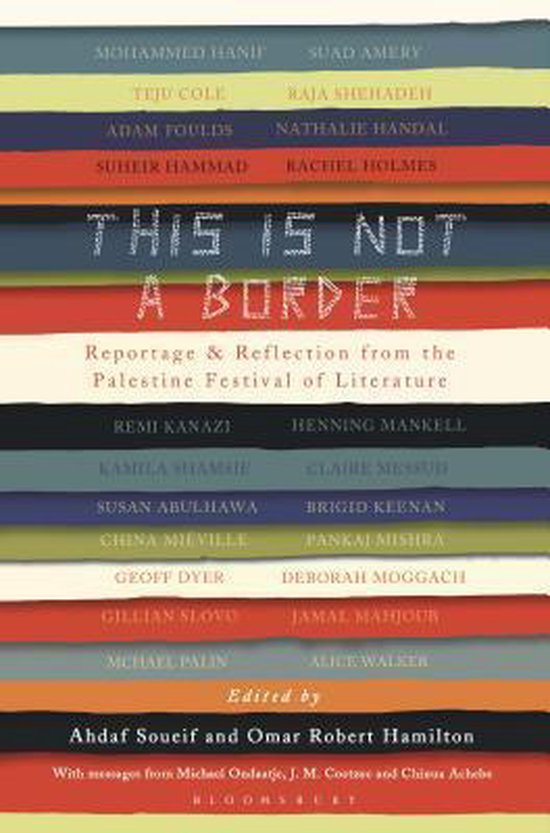
The first Palestinian Festival of Literature was conducted in 2008, and this volume of writing was produced to celebrate its tenth anniversary. We in Australia take for granted that if we want to go to a writing festival in our own city, or regional area, or interstate for that matter, then there is nothing to stop us. That isn’t the case for the residents of the Gaza Strip (especially now) or the West Bank, who face checkpoints and turnstiles and outright prohibitions against travelling from one place to another. So the founders decided that if people couldn’t go to the festival, then the festival would come to them. Attracting noted Western authors, the presenters were bussed from region to region, intentionally exposing them to what the Israeli government does not want outside visitors to see, with the hope and expectation that these authors would return home and use their words – their tools of trade- to expose what is happening.
So who are some of these authors? Among others: J. M. Coetzee, Geoff Dyers, Alice Walker, Deborah Moggach, Henning Mankell, Michael Ondaatje, Michael Palin, Chinua Achebe, and China Mieville, and many other Middle Eastern writers I am not so familiar with.
Most of the contributions are only about 4 pages in length, or else single-page poems, and I must confess to feeling a bit as if I were reading a lot of “What I Did on my Trip” responses. As you might expect from writers of this calibre, they are all well written, but the length constraint (and perhaps the task itself) imposed a sameness and almost a banality in most of the short chapters. In spite of this, certain images repeated: the Allenby Bridge and Qualandia checkpoints where unseen young Israelis surveil the waiting lines through CCTV; the wire netting constructed over markets where settlers in high rise buildings throw their rubbish, urine and faeces onto the street below; the incessant tunnelling conducted by Jewish settlers (facilitated by the Israeli government) under Palestinian homes and mosques, with the risk (expectation?) that the honeycombed land will collapse completely. For me, the power of a book can be measured by how much I tell other people about it, and I have been bailing up anyone who will listen with “Hey, there’s this book I’m reading and did you know….?”
The most powerful pieces in the book for me where when the author was able to exceed the word limit, particularly China Mieville’s piece that was actually illustrated with photographs of the checkpoints, even though photography at checkpoints is prohibited. It was followed by a longer chapter by one of the current trustees of the festival, Omar Robert Hamilton who speaks of the importance of J. M. Coetzee’s short half-page contribution where, after resisting attempts to urge him to name the situation ‘apartheid’, he defines South African apartheid then describes Palestine in exactly the same words and invites us to “draw your own conclusions” (p. 35). Hamilton highlights the importance of words in describing what is happening in Palestine, resisting the neutrality of language that we use for fear of being labelled ‘anti-Semitic’.
I’m struck by the injustice and the sheer vindictiveness of small power plays against the Palestinian people, carried out over and over again, day after day. This book was published years before October 7, but it’s all of a piece. I’m so far trying to resist seeing what is happening in Gaza in binary terms, but it’s becoming harder to do so, and this book has largely contributed to this.
My rating: Hard to say. As individual stories, perhaps an 8/10 but taken as a whole, and in terms of impact on me, 9.5/10
Sourced from: Yarra Plenty Regional Library
Read because: of my distress about what is happening in Gaza
 The Resident Judge of Port Phillip