
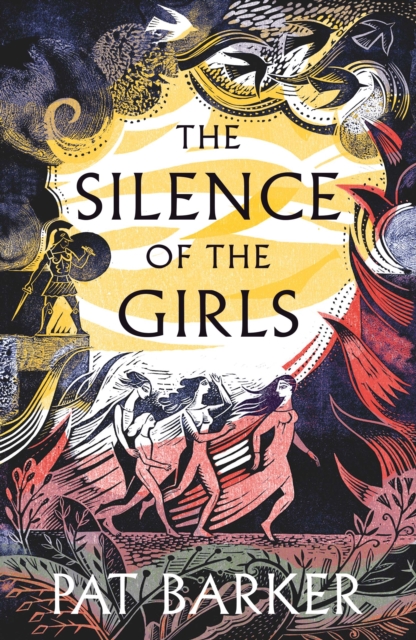
I have come late to The Iliad, only having just completed reading it (well, listening to it) for the first time. I had picked up bits and pieces of it over time, and read David Malouf’s Ransom some years ago, without having read the source material. I know that Pat Barker is not the first writer to approach The Iliad from a woman’s perspective, but after having been drenched auditorially in the gore and the testosterone of Homer’s work, I really enjoyed reading this book soon after reading the original, although I found the ending too neat, as if she was scratching around to end on a positive note.
It is mainly told from the viewpoint of Briseis, who had been captured when Achilles took Lyrnessus and slaughtered her whole family. She is his trophy, taken nonchalantly at first, until his commander Agamennon claimed her as his own after being forced to relinquish his own trophy sex-slave, Chryseis, when her father had called down plague on the troops encamped around Troy. Achilles bridles against this humiliation, not out of any great affection for Briseis, but because of the challenge to his own status as prized warrior by his commander. Briseis finds herself appropriated by Agamennon, who treats his women with violence, and then surrendered against back to Achilles who had previously treated her with nonchalance and disdain. As the war between the Trojans and Aecheans swings in the balance, so swings too her own future should she align herself with the Trojan women who are likely to meet the same fate as the women of Lyrnessus.
Perhaps it is because the reading of The Iliad is so fresh in my mind that Silence of the Girls seemed so powerful. The pathos and emotional depth of the final book 24 of The Iliad helps you to forget that you have sat through book after book of gore and vain-glory. Women are a by-product of that: either a disposable receptacle for lust, or valued mainly for their status as a trophy to be won or traded at the price that the enemy is willing to pay. I think, in a current-day context, of the Boko Haram “brides” kidnapped from Nigerian rural boarding schools (see a recent Amnesty International report here), and enslaved as a sexual convenience yes, but also as a challenge to the other side to fight or pay to ransom them. As in all hostage situations, the abductor is bringing into his – and yes, I will say “his”- ranks a resentful, frightened, angry enemy who, at first at least, must be terrorized into submission .
The women of Lyrnessus are slaves, outnumbered amongst violent men who, in this case, have the weight of military tradition and their kingdom, behind them. Women are the plaything of their Aechaen master, who can do what he will with them. ‘Unallocated’ women have an even more abject existence, available to any man in the camp. There is rape, violence and subjection, but I found myself particularly revolted by Agamennon’s act of deliberately spitting into Briseis’ mouth: there are, after all other fluids that a man can force into a woman. I don’t know why this disturbed me so much: perhaps it was the slow deliberation of the act. Resistance and agency, as a matter of survival, will be subtle, covert and “in the mind” despite what the body is forced to do.
Barker tells Briseis’ story in the first person, but with a twenty-first century viewpoint. The conversation and language, too, is twenty-first century. Often in historical fiction I am critical of such infelicities, but I have enough respect for Pat Barker as historical fiction writer to know that this would be a deliberate decision on her part, rather than ignorance or a lapse in concentration. I was disappointed in the ending though, because a writer of her status has no need to neaten things up, or end on an uplift.
At many times when listening to The Iliad I wondered why I was listening to so much boasting, repetition and gore. The final books made me forgive all that. And reading Barker’s The Silence of the Girls made me forgive all that boasting, repetition and gore too, because it provided a counterpoint to it, another reality more sobering and sordid and barely mentioned.
My rating: 8.5/10
Read because: I have a copy of Women of Troy (the next in the series) and I wanted to read the first book before embarking on it.
Sourced from: Yarra Plenty Regional Library Service (who I am horrified to see no longer hold any copies of the Regeneration trilogy. Surely a library service of this size could have one copy. This obsession with ‘chuck out the old and bring in the new’ is ridiculous.)
 The Resident Judge of Port Phillip
We had a lively discussion about this one on mine: https://anzlitlovers.com/2020/02/16/the-silence-of-the-girls-2018-by-pat-barker/
I obviously enjoyed the book more than you did. I wonder how much my reading was affected by, and probably enhanced by, listening to The Iliad for the first time at around the same time. I might check out some of the books that you mention.
Pingback: Six degrees of separation: From ‘The Safekeep’ to… | The Resident Judge of Port Phillip