
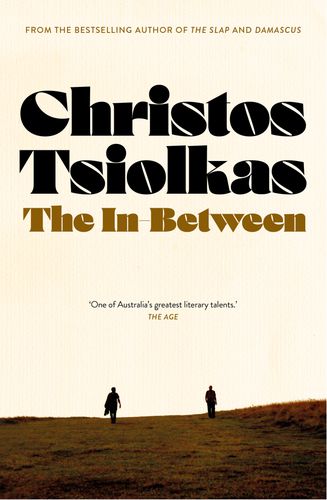
Whenever I read a Christos Tsiolkas novel, I come away wondering whether it’s him or me. Does everybody else think constantly of sex, appraising every random interaction as a possible liaison? Are everyone else’s eyes drawn immediately to groins or other sexual parts? Or is it me? Do I lack that whole sexual lens through which to view the world? Or am I too old? Have I forgotten? Was I ever like this? It’s as if the entrance price to a Tsiolkas novel is forced viewing of scenes that would certainly be designated for mature audiences only.
Yet, I think that there is a shift here as Tsiolkas himself, now in his late 50s, is ‘in between’ the shock value of his earlier novels, and something more mature (older) and reflective. The two main characters in The In-Between are middle-aged too, and embarking on a new relationship after both being burnt by previous relationships. Perry’s relationship in Europe with the urbane, educated Gerard ended when Gerard, largely because of his daughter, decided to commit himself exclusively to a heterosexual marriage with his wife, with whom he had a strained relationship. Back in Australia, Ivan’s relationship with Joe had more a suburban tenor, as the landscape gardener is ‘taken to the cleaners’ financially by Joe, much to his ex-wife’s fury. Both men are starting again, nervously and warily.
The book is told in five long chapters. Chapter 1 starts with Perry, 53 years old, catching a tram to their first date. Their restaurant meal leads to lovemaking at Parry’s inner-northern suburbs apartment. Chapter 2 focusses on Ivan, who is househunting in Frankston with his daughter Kat, who is planning her own daughter’s birthday. She wants Ivan to invite Perry, but her mother Dana, still furious about the financial shakedown by Joe, does not want Perry to attend. We follow Ivan to two of his landscaping jobs: one to an elderly Greek woman being bullied by her son, and the other to Clarissa and Simon in their Californian Bungalow, who make him feel dismissed and put down. Chapter 3 returns to Perry, and a dinner party held by lesbian friends Cora and Yasmin. This egg-shells dinner party, pure Tsiolkas in its incisiveness, sees Ivan being appraised by Perry’s friends, and the presence of straight couple Jed and Evelyn leads to too much drink, loose words and a confession. Chapter 4 has the most graphic and rather gratuitous sex in the book, I thought. Ivan breaks up with Troy, a long term male prostitute who he has been seeing for many years. Chapter 5 mirrors the previous chapter’s letting go of the past as Perry and Ivan travel to Europe to meet with Gerard’s daughter Lena. Lena has found a letter that Gerard wrote to Perry, but never sent but, receiving it years later, Perry decides not to read it.
When you’re in-between, things need to shift, and this book captures well the process of making space for a new person. It involves re-evaluating friendships, changing priorities and establishing new priorities. As Tsiolkas does so well, he captures Melbourne life crisply, with its suburbs and class distinctions played out through language, politics, interests and location. But there is also the element of age and maturity which, I think, is less often addressed in books with men (as distinct from women) as main characters – and often from an end-of-life backwards reflection rather than from this in-between stage. [ However, as I write this, a whole lot of other examples spring up: George Johnson’s books? Phillip Roth? ] In keeping with the title, this book looks both backwards and forwards; to letting go and building. It’s not just the sex: this is a book for grown-ups.
Rating: 9/10
Sourced from: Yarra Plenty Regional Library.
 The Resident Judge of Port Phillip