
The Rest is History Episode 411 The Man in the Iron Mask Have I ever read this? I don’t think I have, although I knew roughly what it was about. I always assumed that it was fiction, but there was in fact a real d’Artagnan and a real Saint-Mars and indeed a real man in the iron mask (although it may have been black velvet, rather than iron which rather changes the scenario somewhat). Tom and Dominic go through several scenarios. Several theories about the identity of the man in the iron mask were prompted by the fact that Louis XIV was rather a miracle baby, born after years of infertility. Was it Louis XIV’s older brother, fathered by a commoner? Or the commoner father himself? Or his identical twin brother born a few hours after Louis (which is often the case with twins), given that according to the beliefs of the time, the second twin born was actually the first conceived? Or was it a political prisoner, who knew too much? A valet for a famous man who knew things that he shouldn’t? Tom and Dominic seem to plump for the latter.
Unraveled (ABC) Firebomb I’ve been listening to this seven episode podcast for some time. It features actor Crispian Chan, who teamed up with investigative reporter Alex Manne to go back to investigate the fire-bombing of Crispian’s family’s Chinese restaurant in 1980s Perth. It was part of a neo-Nazi vigilante movement at the time, although it took the police some time to realize that. The two investigators catch up with men who were involved in neo-Nazi activities in the 1980s, then go in search of the ‘mastermind’ himself, before turning their attention to the rise of neo-Nazis in Australian politics today. This is all terribly drawn-out and could have been encapsulated in two or three episodes, and becomes rather too touchy-feely for me at the end.
The Daily (New York Times) The Mother Who Changed: A Story of Dementia I have dementia in my family history, and I’m frightened by it. This is a fantastic podcast about two middle-aged daughters and their mother with dementia, and the court battle that ensued after their wealthy widowed mother embarked on a most-unexpected relationship with one of the daughter’s former father-in-law, a three-times divorced man with few financial resources. It raises lots of questions about whether loved ones have a responsibility to the pre-dementia person of the past, and the wishes they expressed then, or the happiness of the person who is sitting in front of them now, who may be quite a different person. Really interesting.
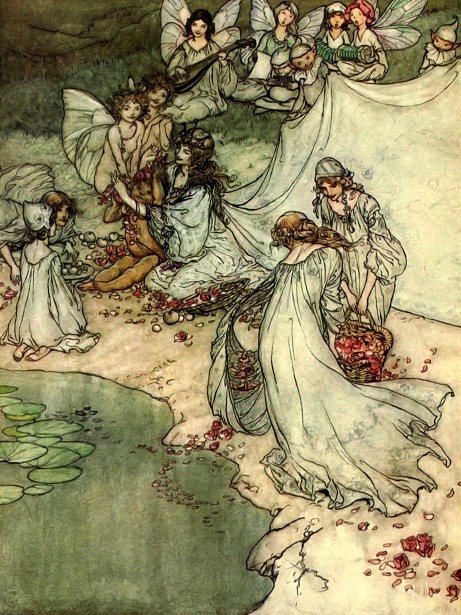
Expanding Eyes Episode 96: Shakespeare’s A Midsummers Nights Dream Act One We’re going to see this at the Botanic Gardens on Friday, so I thought I’d listen to Michael Dolzani’s series on A Midsummers Nights Dream. I have seen it before but to be honest, I thought it was a bit silly, so I thought it would be good to listen to a commentary on it first. So far Dolzani hasn’t disappointed. AMSD (my abbreviation) is one of a series of plays written by Shakespeare after the theatres re-opened after the Plague – resonances of COVID!- and it marks a change in Shakespeare’s use of rhyme and run-on in his narrative. Thematically, it is seen as a ‘festive play’ linked thematically with Romeo and Juliet and Richard II. It has four interlinked sub-plots, three of which represent social class distinctions: the ruling class (Theseus and Hippolyta), the well-born elite (the lovers), the working class (the “rude mechanicals”) and the fairies, and these story-lines play out contrapuntally. In this episode he deals with the first two. He points out that Shakespeare gives very rudimentary stage directions and little information about appearance, which is why Shakespeare’s plays can be reinterpreted so freely. The first grouping (Theseus and Hippolyta) is taken from Greek mythology which is a bit anachronistic. Hippolyta is an Amazon woman, taken by Theseus in victory (shades of the Iliad?) and they are about to marry in four days time. The second grouping, still upper class, sees the father Egius insist that his daughter Hermia, who is in love with Lysander, marry Demetrius, whom he has arranged for her to marry. Hermia and Lysander, star-crossed lovers- arrange to run away together (shades of Romeo and Juliet) but Hermia’s best friend Helena is going to spill the beans to Demetrius.
Episode 97 Acts 1 and 2 continued goes on with the other two plotlines. The mechanicals plan to put on a play for the wedding of the Duke and the Queen based on the story of Pyramus and Thisbe, from Ovid’s Metamorphoses, a fore-runner to Romeo and Juliet in that they both die needlessly, thinking the others dead. In Ovid’s story the metamorphosis occurs when their blood stains the white mulberry flower red. Shakespeare is not at all politically correct in his portrayal of the mechanics, making them out as dullards and fools. The name ‘Bottom’, which always amused me as a child, actually refers to weaving. Finally, there is the Fairy realm, where Shakespeare draws on Celtic mythology as well as Greco/Roman mythology, making much of the moon (modern readers/viewers are prompted by the other meaning of ‘moon’ with Bottom). Oberon, king of the fairies, is fighting with his wife Titania, and he decides to pay her back by arranging for her to be victim of a magic potion from a flower called ‘love-in-idleness’ which turns from white to purple when struck by Cupid’s arrow (shades of Ovid’s Pyramus and Thisbe). He finishes this episode by pointing out that AMND is often presented as a puff-piece- and I agree, this is how I have always seen it- but he’s certainly finding a lot of complexity in it.
Episode 98 The Green World AMND is one of Shakespeare’s “Green World” plays, which starts in a building, then goes outside into a forest, then returns inside with all the problems solved. This model was used in Two Gentlemen of Verona, in AMND, then in As you Like It and The Winters Tale. It continues to draw on Ovid’s Metamorpheses. Returning to the play itself, Oberon and Titania are fighting over a young boy. Oberon wants the boy to show his power, whereas Titania feels a sense of obligation to the boy’s mother, with whom she was friends. Puck – more strictly The Puck- is an English, rather than Irish character, and he plays the role of trickster.
History Hit What If Hitler Had Invaded Britain? As you know, I’m partial to a bit of counter-factual history, although this is more a discussion of Britain’s preparedness for a German invasion, featuring Andy Chatterton, author of Britain’s Secret Defences. Nine months after WWII started, Hitler was looking for an armistice, but Churchill was opposed to a truce so Hitler doubled down and planning started for Operation Sea Lion. This plan for a flotilla-based invasion was not put into place because of the power of the RAF. It was common knowledge that there were ‘auxiliary units’ on the coast, who were being trained to sabotage and resist any invasion, but they now know that they were throughout Britain, with their participants sworn to secrecy under the Secrets Act. Despite the fun made of “Dad’s Army”, these were actually trained saboteurs, with the details of their actions informed by the rapid fall of France and the Low Countries. They trained 16 year old suicide assassins, and respectable looking women as part of the resistance. I found myself thinking often of 16 year olds in Palestine….
History Extra Nicholas Winton: The ‘British Schindler’. I recently saw the film ‘One Life’, and this interview is with Edward Abel Smith, the author of The British Oskar Schindler: The Life and Work of Nicholas Winton (a title which the author admits Winston would have hated). He said that he was pleased to see that the film acknowledged Doreen Warriner and Trevor Chadwick who worked alongside Winton. Smith points out that, unlike the Kindertransport (which this was not part of), Winton’s attention was on all children, not just Jewish children. He had a list of 5000 children, and managed to bring out 600, which he viewed as a failure. Once war began, he was a conscientious objector and worked as an ambulance driver. However, he later joined the RAF where he worked as a trainer because of his poor eyesight, and after the work worked on recouping reparations for the Jewish community from the extracted gold teeth- a pretty gruelling job. In the television show that features in the film (it was actually two separate episodes), many of the ‘children’ themselves did not know how or who had saved them.
Not Just the Tudors. As I’m going to see A Midsummer’s Night Dream this coming weekend, I was interested in Transgender Fairies in Early Modern Literature. Dr. Ezra Horbury, lecturer in Renaissance literature at the University of York, talks about the transformation at the end of the 16th century and early 17th century where fairies were transformed from the rather scary threatening folklore creatures into something small, sweet and delicate. This, she argues, was because of the ‘literariness’ of plays for the theatre, which drew on the child actors to play the parts. She discusses the appropriateness of using the term ‘transgender’, suggesting that many historical terms like ‘medieval’ are just as anachronistic. Children were viewed as being of no gender until they were about 7, right through to the early 20th century. She talks about the slipperiness of gender in fairies, and the misogyny and misanthropy in depictions of witches and old people. Much of this podcast went past me, because I was not familiar with the stories she was describing.
 The Resident Judge of Port Phillip