
The Global Story (BBC)I had heard of the Houthis before the current attacks on ships in the Red Sea, but certainly they have more prominence in recent days as the Middle East becomes even more combustible. Why are the US and UK attacking the Houthis in Yemen?, featuring the BBC security correspondent Frank Gardner explains that the Houthis come from the north of Yemen, although they only constitute 15% of Yemenis. They are a Shia sect that overthrew the President in 2014 and teamed up with the Republican guard to take power. The Saudis bombed them for years because Saudi Arabia didn’t want an Iranian ally on their doorstep. When the Houthis withstood this bombing, they developed a sense of invincibility. As devout Muslims, they see themselves part of the Axis of Resistance, comprising Hezbollah, Hamas and the Houthi. They are attacking at a chokepoint in the Red Sea, where 15% of global shipping passes. Australia has given logistical support to the US/UK bombings as part of a twenty-country coalition. I think we did the right thing in refusing to send a ship there.
The Daily (NYT) What the Houthis Really Want. Continuing on about the Houthis, this podcast is from 18 January, after several bouts of bombing. Vivian Nereim, the Gulf bureau chief for The New York Times points out that the Houthis have a larger Western presence than might otherwise have been the case because of their internet presence through videos, songs and TikTok. They go back to the 1990s, but came to prominence after the 2003 US invasion of Iraq. After the 2010-2011 Arab Spring they toppled the US-back Yemeni strongman, and seized the capital in 2014 and installed themselves as the government. Saudi Arabia was concerned at having an Iran-aligned country on their border, so with US support, the Saudis began bombing Yemen, causing huge damage and famine- although this US support has frayed since 2018. The Houthis, at their core, are anti-US and anti-Zionist, and although their stated aim in the recent attacks on shipping is to support Palestine, it is also in their interests to distract attention from their difficulties in being the government and doing government-y things, rather than being rebels. October 7 was a gift to them, and they have nothing to lose from their pro-Israel support, and the US/UK bombings just feed into the anti-US rhetoric. They will not stop.
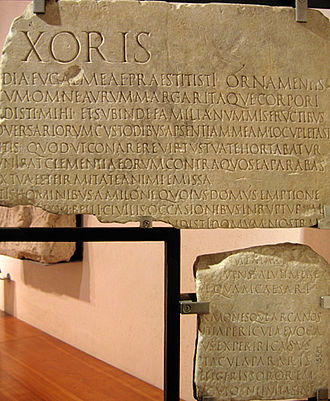
Being Roman. Episode 2: The Vengeance of Turia. This was a fantastic episode. The assassination of Caesar was followed by ten years of civil war. It’s easy to forget the perils of picking a side in a brutal, vicious civil war, where there is no stable government and when the sides keep shifting. Turia’s parents were both killed by thugs, the day before her wedding, and she had to fend off the legal claims of her relatives for her inheritance. Her husband chose the wrong side, and was exiled by the junta that took over after Caesar’s death. Eventually Augustus agreed to him returning, but Lepidus blocked it. She challenged him, and was bashed for her trouble. She and her husband were not able to have children, so she offered to give him a divorce and live in a menage a trois with a woman who could provide him with an heir. He rejected her offer (perhaps because he feared that he was the infertile one?) Anyway, we learn all this from a long inscription on her funeral monument, which just happened to reflect well on him too.
The Rest is History Episode 402 The Mystery of the Pregnant Pope was believed by the Catholic Church for about three hundred years, although in 1601 Pope Clement VIII declared the legend untrue. Later historians have christened the 9th century papacy “pornocracy”, and this is when the Englishwoman Joan was supposed to have lived, and ascended the ladder to become “John VIII”. Tom Holland (who wrote the book Dominion) goes on at length about the Gregorian Revolution which replaced the power of kings over the church with cardinals instead, with the church was conceptualized as the Bride of Christ. Even though most people acknowledge that the legend of Pope Joan is untrue, Saint (Abbess?) Guglielma had many echoes of the Pope Joan legend. When she died around 1280, her burial site became a shrine for the Guglielmites, who believed that she would be resurrected and lead a new church headed by women. The Inquisition charged 30 of her followers with heresy and dug up Guglielma herself, and burned her along with several of her followers. Fascinating.
Things Fell Apart (BBC) This is the second season of this podcast. Presented by Jon Ronson, it looks particularly at conspiracy theories that arose in May 2020, about six weeks into the COVID pandemic. In the first episode, Ep. 1 The Most Mysterious Deaths Ronson looks at the concept of “excited delirium” to explain the death of George Floyd which occurred on May 25, 2020 (I’d forgotten that it occurred during COVID). This spurious medical concept, developed and promulgated by a Dr Wetley, the Deputy Chief Medical Officer of Miami, arose in the 1980s when 32 black sex workers were found dead. Instead of going for the serial killer explanation, which seeme the most likely, Wetley said that it was the result of a mixture of cocaine and sex that led to “excited delirium” which manifested as sudden death in women, but psychosis and superhuman strength in men. The term was eventually debunked, but Wetley continued to publicize it up to 2020, sponsored by the manufacturers of Tasers who argued that deaths during Taser use were the result of “excited delirium”. It continued to be circulated amongst police officers, and indeed during George Floyd’s arrest, one of the arresting officer suggested putting him onto his side because he was suffering from “excited delirium”.
History in the Bible Although I have admitted to a secret enjoyment of ‘what-if’ history, I don’t know if my enthusiasm extends to the Bible. Speculations I looks at the years 35CE to 60CE and asks What If John the Baptist had been bigger than Jesus? His answer: John the Baptist was very popular and both were apocalyptic preachers but John the Baptist wouldn’t have spoken to Gentiles, and he would have been one among many sects in Judaism. Second question: What if Paul had split to form his own independent movement? His answer: perhaps the Jews who were left might have had more influence on Temple worship, and Jesus might have been seen as one of the great rabbis. If Paul had gone his own way, the Jewish part would have faded away, and what was left would probably have got on better with the Christians. Paul might have been able to downplay Jesus completely as the Marcions did later.
Expanding Eyes Episode 56 Book 24 The Meeting of Priam and Achilles is the final podcast about the Iliad. He concentrates mainly on Book 24, which is not a coda (even though it could have finished at Book 22) but instead one of the most important books in Western literature. Book 23, where Homer describes the games (rather boring) shows Achilles being re-integrated back into his society. The gods get involved again, and Achilles is ordered to give up Hector’s body and Priam is told to go and retrieve it. FINALLY we learn why it is called ‘The Iliad’: Priam and his manservant stop at the tomb of his ancestor Ilios, indicating that the whole thing has been about fathers and sons. When Achilles is transformed by the recognition of his grief for his own father, and extends this empathy to Priam, he shows his true greatness. In his speech about the 2 jars of life, that the Gods can dispense at will, Achilles emphasizes that fate is random. The play has a slow and dignified closure, with three speeches by women: Hector’s wife, mother, and rather surprisingly, Helen, whose actions had prompted the whole thing. Although there was a bit of a dip in the middle, I really enjoyed this series and found it really worthwhile. But do I want to launch into Milton’s Paradise Lost? Nah, I don’t think so.
 The Resident Judge of Port Phillip