
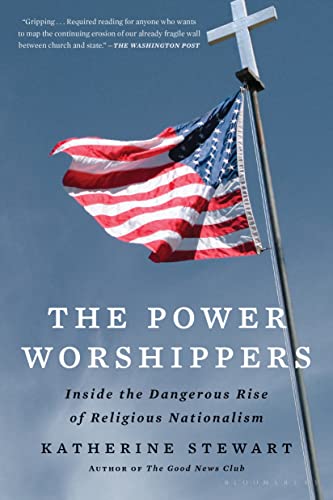
A few months back, I spoke at a service at our Unitarian Universalist fellowship based on Elle Hardy’s book Beyond Belief: How Pentecostal Christianity is Taking over the World. As part of that, I spoke about the Seven Mountains Mandate which calls upon Christians to influence the ‘seven mountains’ of education, religion, family, business, government/military, arts and entertainment and media as a way of ‘taking back’ society and bringing on the ‘end times’. Elle Hardy only really mentioned the Seven Mountains by name in one chapter, as she travelled from congregation to congregation looking at the influence of Pentecostalism. In this book, however, Katherine Stewart looks beyond faith communities to examine broader society and how it is being influenced, often unwittingly by ‘Christian nationalism’ (her preferred term).
Christian Nationalism is not a social or cultural movement, but a political movement and its goal is power.
It is not organized around any single, central institution. It consists rather of a dense ecosystem of nonprofit, for-profit, religious, and nonreligious media and legal advocacy groups, some relatively permanent, others fleeting. Its leadership cadre includes a number of personally interconnected activists and politicians who often jump from one organization to the next. It derives much of its power and directions from an informal club of funders, a number of them belonging to extended hyper-wealthy families.
Introduction
She cautions that we need to distinguish between the leaders of the movement, and its followers. Its followers, she says are
…the many millions of churchgoers who dutifully cast their votes for the movement’s favored politicians, who populate its marches and flood its coffers with small-dollar donations are the root source of its political strength. But they are not the source of its ideas….The leaders of the movement have quite consciously reframed the Christian religion itself to suit their political objectives and then promoted this new reactionary religion as widely as possible, thus turning citizens into congregants and congregants into voters.
Introduction
She starts off at the Unionville Baptist Church, 45 minutes out of Charlotte, North Carolina, at a meeting sponsored by an affiliate of the Family Research Council, “one of the most powerful and politically connected lobbying organizations of the Christian right”, where pastors are being encouraged to use their pulpits for the upcoming half-term elections. Speakers rail against the Johnson Amendment that bars houses of worship and charitable non-profits from endorsing political candidates, they commend the use of NGOs internationally to spread the word of God, and urge the need to bring Latino and Black Americans onto the “right” side of history through their churches.
She visits the World Ag Expo in Tulare, California, where agribusiness leaders elevate politicians who espouse low regulation, foreign trade, water access and minimal workers’ rights. They gain direct access to the White House (and specifically Trump’s White House) through pastors who hold weekly bible studies there amongst the politicians. She ventures into the March for Life anti-abortion movement, where during the 1970s abortion was packaged and sold as the unifying issue of the global conservative movement drawing together conservative evangelicals and catholics in a way that could not have been imagined decades earlier. She talks about the Green family, the owners of Hobby Lobby stores and their Museum of the Bible and the push towards charter schools with sectarian agendas and the insistence that America was founded on Judeo-Christian principles with the intention of being a Christian nation. She emphasizes the interconnection between various groups with innocuous-sounding names, and their affinities with religious nationalist groups in other countries. Throughout, she stresses the connection between seriously-wealthy backerswith their own political agendas, government, and charismatic church leaders who are bringing their congregations and their votes along with them.
This is a wide-ranging, accessible book which has far more local American detail than an Australian reader is likely to appreciate. She makes her argument that Christian Nationalism is a political ideology in the introduction, and spends the rest of the book prosecuting it. It is sobering reading. I might have dismissed it as a conspiracy theory if I didn’t see it playing out in front of my eyes in our own local politics. There’s the influence of U.S. lobbying and advertising firms bringing their ‘expertise’ from sectarian US politics to advise the ‘No’ campaign at our recent referendum. There’s the rise of far-right and populist politics in Argentina and the Netherlands and although these new leaders might not be believers themselves, Christian nationalist believers support them. And most disturbing of all, the seeming untouchability of Donald Trump and his unwavering support among Christian nationalists should make us all pause.
My rating: 8.5/10
Sourced from: purchased e-book
You can read more about Christian Dominionism and its links to Australian politics at Chrys Stevenson’s article Christian Dominionism: Follow the Money which can be found on her Gladly The Cross-Eyed Bear blog.
.
 The Resident Judge of Port Phillip
They fund those mega churches in the outer suburbs too.