
Emperors of Rome Podcast. This is their hundredth episode and to celebrate it was taped in front of a live audience here in Melbourne on 8th August 2-18 (It’s taken me a while to find these podcasts!). Episode C The Death of Caesar points out that it wasn’t just Brutus, Cassius and Decimus acting alone- instead there were about 60 co-conspirators. They chose this particular time because Caesar was just about to go off to the Parthian War. The involvement of Brutus may have been particularly poignant for JC “et tu, Brutus?” because Brutus was rumoured to be Caesar’s illegitimate son.
BBC Radio Being Roman with Mary Beard. I just love Mary Beard. I wondered at first whether I was hearing the soundtrack to a television program, but no, it seems that these have been produced for BBC Radio. Episode 1 Loving an Emperor looks at the letters between Fronto and Marcus Aurelius between 161-181 CE, when Marcus was still a young man. To our reading they are blatantly homoerotic, but who knows how they read at the time.
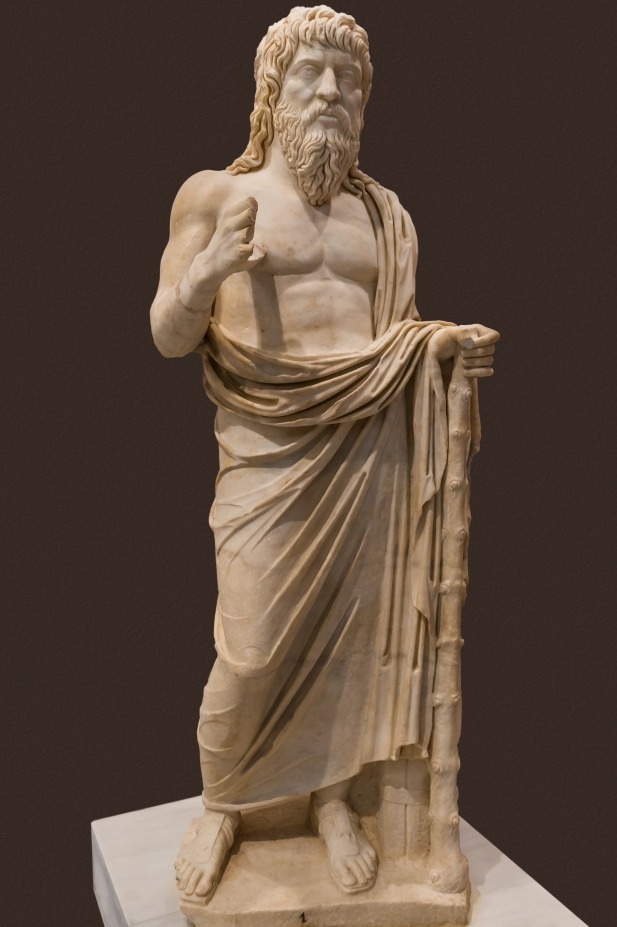
Let’s Talk Religion Yes, at the time I listened to this I was still preparing for my Christmas service at Melbourne Unitarian Universalist Fellowship. I heard this as a podcast, but it’s also a YouTube video The Pagan Jesus? Apollonius of Tyana. Apollonius is often used to argue against Jesus, although they are both historical figures. Most of the information about Apollonius comes from a 3rd century biography written by Philostratus, and there are letters of doubtful authenticity. Difficult to say anything historical about him- it’s easier to talk about the mythical Apollonius, as depicted in Philostratus’ work. He was a wonder-working sage, a Neo-Pythagorean, following an itinerant lifestyle with a focus on numbers. It is said that his mother was visited by the god Proteus when she conceived, and his birth was surrounded by swans (like Apollo’s birth), accompanied by a thunderclap. He went to India and studied with the Brahmins, then returned to the West where he was known as a Sage. He travelled throughout Anatolia and Egypt, performing miracles and raising people from the dead. He rejected animal sacrifice, and may have seen God as a unitary, transcendant being. He was tried before the courts, but disappeared before he was sentenced. Philostratus’ biography of him was written in the 3rd century, possibly as a response to the gospels to show that Jesus wasn’t so special.
Pythagorus and his Weird Religious Cult looks at the ancient mathematician, and the emergence of a neo-Pythagorean lifestyle at the turn of BCE/CE when men would adopt vegetarianism and wear simple, ragged, smelly clothes. Pythagorus himself had an interest in numbers, music and the cosmology of the spheres.
The Rest is History Continuing on with Cortez: Episode 4: The Fall of the Aztecs: Prisoners of Montezuma. Aztec society was a Bronze Age society, similar in technology to the Sumerians, but their city was huge, with over one million inhabitants, well maintained and new (compared with European cities at the time). Who is exploiting who here? Why didn’t the Aztecs just kill them all. Matthew Restall, who wrote When Montezuma Met Cortés: The True Story of the Meeting that Changed History suggests that Montezuma was planning to sacrifice them for display, but then the 18 other Spanish ships arrived to apprehend Cortez for disobeying his orders. Cortez decided to split his troops, with 80 to go off with Montezuma to confront Spain, and the rest of the troops to stay there.
Very Short Introductions This podcast has short interviews with the authors of books in the ‘Very Short Introduction to…’ series. I had just finished reading Marina Warner’s rather dense book From the Beast to the Blonde so I though I’d listen to this episode Fairy Tale- The Very Short Introductions Podcast Episode 20. She explains what a fairy tale is better here than she did in her lengthy book i.e. that anything can happen; it faces difficult themes like cannibalism, incest and jealousy, and it has a happy ending.
History Hit History Hit is responding to the interest in Napoleon prompted by Ridley Scott’s recent film with a short series on Napoleon. Episode 1: Napoleon The Early Years . The episode features biographer Andrew Roberts. He points out that Napolean was not of humble birth- he was from an aristocratic family which could prove its nobility for at least 250 years. His family was impoverished, but it was not nothing. Corsica had been purchased from Genoa in 1768 (the year of Napoleon’s birth) so its French identity was not well-established, and Napoleon himself was conflicted over his Frenchness as a young man. He received a free education from the French military academy, and was a great reader and good mathematician. He was 20 years old when the French Revolution began. He made a name for himself in the battle of Toulon, which is shown in the movie.
Theology in the Raw. Who would have thunk that I’d be listening to THIS? Hosted by Preston Sprinkle (is that even a real name?), it’s unapologetically Christian in its emphasis. The Scandal of Christmas is a four-part series leading up to Christmas and he starts Ep#927 The Scandal of Christmas Part I with Dr. Craig Keener talking about Luke 1-2, the politics and sociological scandal of Christ’s birth, his earthly vocation , the location of Christ’s birth, Matthew 1-2 (and the differences between Luke and Matthew), the problem of genealogies, and much, much more. The guest is rather discursive and sounds rather nervous. He starts by talking about other angelic visitations to announce births e.g. to Zechariah and Elizabeth. Caesar Augustus seems to be setting the agenda, but it was really God (hmmm). Most Galileans were immigrants to Judaea, some first generation others six generations on. It is said that Jesus was born in a cave where animals were kept, attached to a house. When Emperor Hadrian went through Judaea in 135CE deliberately placing pagan sites on Christian ones, he placed one on this cave, so it’s probably the authentic site according to legend. It could have been as much as two years before the Magi turned up, so Joseph, Mary and Jesus may have been in Bethlehem for some time. Nazareth only had a few hundred people, and it was more conservative, especially Upper Galilee. Aramaic was spoken but lower Galilee (where Jesus came from) was more multicultural. It is believed that Jesus spoke Aramaic, but he may have been able to speak Greek as well. Joseph was a ‘hand worker’ – probably he didn’t specialize, but did all sorts of construction. 70-90% of Galilee was agricultural, so as an artisan, Joseph may have had slightly higher status, but could not be said to be ‘high status’. If we only had Matthew’s gospel, we wouldn’t have realized that Jesus came from Nazareth. After Jesus’ birth they went to Jerusalem (about six miles) then returned to Bethlehem before going home to Nazareth. Herod acted like Pharoah did, killing babies to shore up his own power, and the wise men were pagans. There is no historical evidence of the Slaughter of the Innocents, but it’s consistent with his personality. Both Matthew and Luke go through Jesus’ genealogies, but Luke goes back to Adam, while Matthew lists Jesus’ ancestors and there is little overlap between the two genealogies after David.
 The Resident Judge of Port Phillip