
In Australia, we’ve recently witnessed the unveiling of the official portrait of a former Prime Minister, Kevin Rudd, ten years after he quit Parliament. It’s certainly ‘different’- almost reminiscent of a Graeme Base picture book illustration with lots of small symbolic details and, yes, a cat. It must be odd, having your portrait painted- especially an official one, which is going to represent you for posterity.
Art historian Julie Cotter’s book Portraits Destroyed looks at the official portrait, or representation, and its reception (generally negative) from either the sitter him/herself or their family, or by later generations. I was not surprised that she has worked on documentaries on Australian art previously, because this book and its chapter structure would lend itself very easily to a documentary series. I can already see her wandering around an art gallery as host.
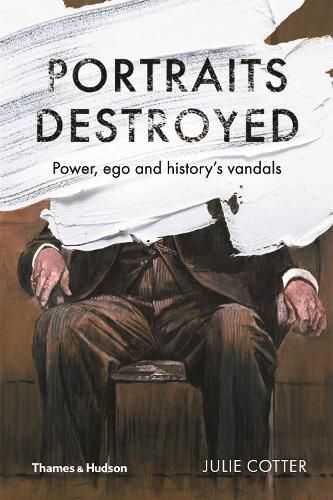
She starts by considering Winston Churchill, whose now-destroyed portrait is represented on the front cover of the book. I only remember Winston Churchill as a fat, jowly old man and that’s very much the way that artist Graham Sutherland depicted him in 1954. It was unveiled by Churchill himself at Westminster Hall on 30 November 1954, on the occasion of his 80th birthday where he announced it “a remarkable example of modern art” (an ambiguous description, given that Churchill himself was a landscape artist of a very un-modern type).
He would have expected a portrait of a face that flickered with his life: a face that reflected the tumult, the devastation, the glorious victories, the might of the British Empire that the twentieth century had experienced. He would have wanted us to recognize ourselves in his portrait- to hear his speeches to the masses to keep fighting, to remain strong and unite against Hitler, to remember where we were when armistice was declared, to mourn those we had lost. He was his own muse, absorbed by his achievements
Instead, he was faced with the image of himself as a ‘down-and-out drunk who has been picked up out of the gutter in the Strand’ he concluded to his private secretary Anthony Montague Browne.
p. 37
After its unveiling, the portrait was never seen again. It was said that, after his death in 1965, his wife Clementine had burned it herself. This wasn’t strictly true: it was too big for her to take into the garden to set alight to it, and instead Churchill’s next private secretary, Grace Hablin, arranged for her brother to help her move it to his house, where it was burned.
It is fitting that the chapter about Churchill should be followed by a chapter about Hitler, given that they were arch-enemies. In this case, she hones in on an oil portrait painted by Dresden-born contemporary artist Gerhard Richter in 1962, who drew his portrait from an image showing Hitler at Nuremberg in 1934, “in a moment of strangulated shouting, hysterically commanding, his face elongated and distorted” with his right arm across his body (p. 44, 45) It was exhibited for the first and last time in 1964, and then Richter (who had since defected from East Germany) destroyed it himself, probably by cutting it to pieces. Richter himself had joined the obligatory Hitler Youth, and his schoolteacher father Horst, was drafted into the military in 1939. When he returned, he was a broken man, unable to teach because of his Nazi associations. Richter’s uncles were killed, his mentally ill aunt was killed under the Nazi’s T4 program of large-scale euthanasia. Cotter suggests that Richter’s destruction of his own work allowed “the release of a stultifying hatred”, but could also have been because of concern about the work’s impact in 1962, when Nazi ideology still circulated.
Chapter 3 ‘Presidents and Dictators’ looks at American presidents: Hayes, Roosevelt -who had two portraits, one he didn’t like by Chartran, and another which he did by John Singer Sargent- and Kennedy; Stalin; Mubarak in Egypt; and Mugabe. Chapter 4 ‘Royalty and Nobility” looks at English and French royal portraits; portraits of Imperial Roman women, especially Agrippina, and the Egyptian portrayals of Queen Hatshepsut. The Medicis used portraiture to express their power during the Renaissance, with an interesting portrait of Bianca Cappello, who bore The Grand Duke of Tuscany an illegitimate son. Then there are the portraits of Henry VIII, Queen Elizabeth I and the absent portraits of Lady Jane Grey. She then moves to the present day with over 150 official portraits of Queen Elizabeth II, including one by Lucien Freud, and the slashed portrait of Lady Diana Spencer which is now one of the National Portrait Gallery’s most popular exhibits.
Chapter 5 ‘Why Not Mao?’ returns to dictators, and I’m a little surprised that she didn’t place this chapter immediately after Chapter 2 which dealt with Hitler. As she points out, without wanting to lessen Hitler’s atrocities in any way, Mao was responsible for 50-80 million deaths if the Great Leap Forward is combined with the Cultural Revolution. Yet the West has not had the same resistance to displaying Mao’s image, and it is ubiquitous in China itself, (albeit, only by official portrait painters),looming over Tienanmen Square. She then explores Andy Warhol’s images of Mao, prompted by reading in Life magazine that Chairman Mao was the most famous person in the world. There has been little concern expressed about Warhol’s images, given the level of antagonism to portraiture of other leaders responsible for deaths on such a massive scale (p. 146)
Ch. 6 ‘Whitewash: Erasing Black History in the West’ examines the fraught issue of art representing black/white history. There was resistance to white artist Dana Schutz’s portrait of Emmett Till, murdered in the American South in 1955, when the rights of white artists to represent black people was brought into question. She explores the representation of Australian indigenous people by William Westall, who accompanied Matthew Flinders in 1801, and Tom Roberts’ representation of nineteenth century indigenous people in the Torres Strait. She discusses Mount Rushmore, U.S. Confederate statues, and John Batman’s statue here in Melbourne, and their removal or disfigurement, before moving on to the desecration of Eddie Mabo’s image on his grave (I did not know about this). Then there is the destruction of a mural representing indigenous political figures on the side of the Uniting Church’s Wayside Chapel in Bondi in 2016.
In her final chapter ‘Artists Destroy and Destroyed’, she looks at the disappearance of Benjamin Duterrau’s group portrait, the 5 metre long The National Picture, painted in 1840, which I had never heard of (I am familiar with his other paintings of Tasmanian indigenous people). She discusses the rivalry between Degas and Manet, and the reuse of canvases by Van Gogh and Picasso. She looks at the politically driven attacks on artwork, like Suffragette Mary Wood’s slashing of a portrait of Henry James by John Singer Sargent, and a similar attack by Anne Hunt on John Everett Millais’ portrait of Thomas Carlyle. Rolf Harris’ portrait of Queen Elizabeth II has disappeared from public view, along with his other portraits. Then we have the Spanish cleaning lady’s attempts to ‘touch up’ Ecce Homo by Martinez in a Spanish church, and the slow drip, drip of the wax portraits of Urs Fischer, created in order to be destroyed.
As you can probably tell, this is a discursive book that takes us to many paintings. Unfortunately, she has a limited of number of portraits included in the book, so you need to rely on her descriptions (I resisted the temptation to Google them). This was not as much of a drawback as you might think, because the book is more about the context and process of creation/destruction of the portrait, rather than the portrait itself. There is enough theorizing in the book to make it more than just a gallery-hop, and you are always aware that she is an academic/historian writing from a theoretical framework and informed knowledge. But thankfully it eschews the insufferable mumbo-jumbo that clags up a lot of writing about art, and is thoroughly readable and enjoyable. Now I just have to wait for the series on the ABC which I am sure will follow.
Rating 8.5/10
Sourced from: Yarra Plenty Regional Library
 The Resident Judge of Port Phillip