
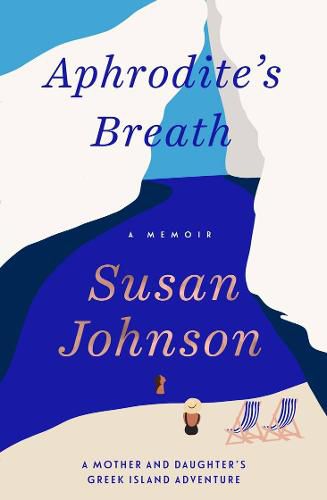
Even though I have very much enjoyed Susan Johnson’s work in the past – I absolutely loved My Hundred Lovers (see my review here) and The Broken Book and enjoyed From Where I Fell (review) and Life in Seven Mistakes (review)- I wasn’t tempted by this book at first. I knew that it was about a writer taking her elderly mother to a Greek island, and I feared that it would be some sort of Eat, Pray, Love book (not that I’ve read it) or one of its many escape-the-quotidian-by-travelling-to-Europe clones.
But I was wrong on both counts. It is a memoir, rather than a novel, and it’s by Susan Johnson, so of course it’s going to be much richer than a travel memoir. I just loved it.
As a long-time journalist and successful-enough author (I think she under-rates herself) she decided to put her hand up for redundancy at the Murdoch-owned newspaper where she had worked for some years. With some back-of-the-envelope calculations she worked out that, with no need to financially support her now-adult sons, she could afford to retire if she lived carefully. She had travelled to Greece as a young woman, and one of the threads of her her novel The Broken Book involved Charmian Clift’s time on Kalymnos and Hydra. Her money would go further if she moved to Kythera, a Greek island that she had fallen in love with, and in her head it was associated with the bright sun of being a young woman with your whole life ahead of you. But she was now over sixty, the promises of her life had not been fulfilled, and as the eldest child and only daughter (as am I) she felt responsible for her now-widowed mother Barbara. She felt that she could not leave her mother, but what if her mother were to accompany her….. She asked Barbara if she went to Kythera, would she come too? And her mother said ‘yes’.
And so they went, but it did not turn out as Susan expected it would (do things ever turn out the way you think they will?) Although Susan fell in love with a house that found online and managed to lease for a full year – quite a feat in a community with a large, lucrative tourist influx ‘in season’- her mother disliked it from the start. Far from being the sunlit, balmy island of her dreams, it was cold and her Brisbane-bred mother hated the cold in a house with no heating. She didn’t like walking, and although neither of them could speak Greek (which surprised me, as Johnson’s text is sprinkled with Greek words), Barbara had no interest in learning it. They managed to break the lease, and took another house further north, which Barbara preferred although, like Johnson, I wonder if it was more that she had a choice over this house instead of her daughter organizing it ahead of time. By this time, spring had arrived and it was warmer and Susan threw herself into the life and traditions of the small village in which they lived, while Barbara participated tepidly and largely kept herself apart. Eventually it is decided that Susan will accompany Barbara to London where she will meet up with her son, and travel with him back to Queensland. While Susan missed her company (because she truly does love her mother), you can sense of sigh of relief.
And so, not really a lot happens in this book. So what kept me opening it up with relish, night after night, and my regret when it finished? Part of it was a rather perverse curiosity about what would go wrong, and when- dementia? the dreaded ‘a fall’? a passionate love affair out of left field for mother and/or daughter? But it was also Johnson’s own self awareness of the Faustian-bargain she had entered into with her publisher that helped to finance their trip: that she would finish the edits on the book that ended up as From Where I Came, and that she would write this book – her memoir of “A mother and daughter’s Greek Island adventure” as the subtitle rather forlornly ventures. How would she depict this stubborn, complaining woman, whom she adored? What if there was no “adventure” but only a grapple between mother and daughter that laid bare all the compromises, micro-aggressions and resentments of many mother/daughter relationships.
The book takes a turn at the end, as COVID makes it impossible to return home as Barbara’s health deteriorates. We all know, unless Fate is perverse, how mother/daughter stories end and so there was an inevitability about the finale, and yet there was a surprise there too. For me, I was left with a sense of a circle closed, a rich love of a daughter for her mother, the psychological integrity of both these two, separate women, and a deepening of my own reflections about mothering and daughtering, aging, travel and home.
Susan Johnson is just slightly younger than I am, and I have always found that her books speak to me, and that they seem to capture where I am at the time of reading. I do wonder how a younger woman would read this book, though. Part of me feels that it is only with age, and the sense of having moved on beyond being a child against an older, more beautiful mother, that a reader can stand outside the Susan/Barbara relationship and observe. For a ‘woman of a certain age’ as both Johnson and I am, this was a really satisfying and perceptive read.
My rating: 10/10
Read because: It was there on the library shelf, and I have enjoyed her other work. But reading about a writer, I felt a bit guilty borrowing it from a library, though (public lending rights notwithstanding). When Johnson talks about her own writing and success, I didn’t quite register how personally an author takes sales figures.
 The Resident Judge of Port Phillip
Yes, her books speak to me too. I loved Life in Seven Mistakes when she goes home for a family Christmas, and it was in many ways so like my experience when my parents retired up north. (It was my mother’s choice, my father was never really happy there.)
Re sales: I don’t think it’s just the money, though it’s important as income, I think it’s about the signal it sends to potential publishers of the next book, and the affirmation. It must be awful to spend years writing a book and then have it sink like a stone; every sale is some sort of consolation that the author wasn’t wasting her time. Probably more so than a favourable review!
PS A*ph*rodite’s…