
The Rest is History. 352. Amsterdam: Kings, Canals and Coffee Houses is the second part of Tom and Dominic’s Amsterdam podcast, and yes, they’re still dragging around that Wise credit card, spruiking it at every occasion. They start by revising the first episode, pointing out the paradox that Amsterdam citizens were obsessed with privacy and domesticity and inward-looking, but also that they looked outwards to commercial expansion. They start at the elite Herengract canal, one of the three canals constructed during the expansion of the city in the 17th century. They then move to the huge Royal Palace, which was originally built as the City Hall. The Netherlands were a republic, but they brought back descendants of the House of Orange as their Stadtholder, and when William III of Orange took over power in Britain, it was the merging of two huge commercial cities, London and Amsterdam. During the French Revolution, Dutch republicans welcomed the French until 1806 when Napoleon installed his son onto the throne, and the City Hall was transformed into the Royal Palace. The King returned after the fall of Napoleon, but the building remained the Royal Palace.
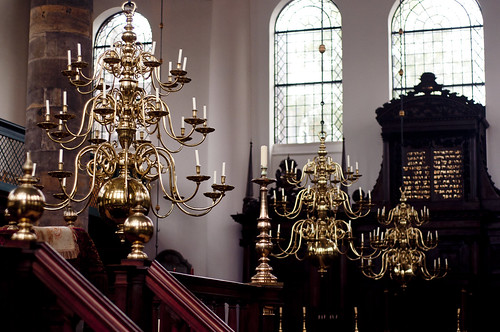
They then stop off at the Portuguese Synagogue, built in 1675. Just as Amsterdam turned a blind eye to the Protestants, so too with Jewish emigrants, many of whom came from the Iberian peninsula when the Inquisition started up. By the 1930s, 50% of the Amsterdam population was Jewish. In February 1941 Amsterdam staged the only public protest against the Nazis, when the unions protested both against forced migration to work in German factories, but also the treatment of the Jews. The Jews in the Netherlands had the lowest survival rate in Europe. Although France and Belgium were liberated, it took until 1944 for Holland to shake off Nazism, and 1944 became the Hungry Winter. Their final stop is the Sex Palace in the Red Light district, and although this might seem incongruous, they argue that this is both a reaction against Nazism as well as another manifestation of the blind-eye liberalism that had accommodated Protestants and Jews in the past. But they suggest that this hyper-liberalism has been pushed to its limits with anxiety about drugs, antisocial Hens Night behaviour and Islamic extremism.
The Guardian Podcast Today in Focus. Although the podcasts I received through the Guardian are usually Australian, this episode from 23 October took up a program from the UK Guardian called How a contested history feeds the Israel-Palestine conflict. Although it could have started anywhere in antiquity, this episode starts with the Balfour Declaration in 1917 which supported a national homeland in Palestine for the Jewish people. During WWII there was an increase of Jewish immigration to Mandate Palestine, and following the war, Britain handed Palestine over to the United Nations. 56% of Palestine was to go to the future Jewish state, while the Palestinian majority, 66%, were to receive 44% of the territory. But the creation of Israel was contested from the start, with the UN vote recording 33 for, 13 against and 10 abstentions. War instantly followed the declaration of Independence, and Israel won increasing their borders even further by declaring nearly 78% of Palestine as Jewish, and expelling 700,000 Arabs out of Jewish areas in the Nakba. With the rise of Arafat and the PLO, the world (and they themselves) came to think of them as Palestinian rather than ‘displaced Arabs’. The Six Day War in 1967 was a huge victory for Israel, although Israel was nearly defeated (at first) during the Yom Kippur War in 1973 after which right wing parties took power. The first Intifada during 1987-1993 was violently suppressed. The Oslo Accords did not mention a separate Palestinian state, and they were rejected by a majority of the Palestinian population, and far-right Israelis. They were followed by a second Intifada during 2000-2005. By now there were three types of Palestinians: those who lived in the West Bank; those who lived in Gaza; and those who lived in Israel but did not have the vote.
The Guardian Audio Long Read Justice for Neanderthals! What the debate about our long-dead cousins reveals about us. I have lost track of how many types of human beings there are now- half a dozen and growing. Out of the various types of hominin, Neanderthals were the dominant type between about 400,000 to 40,000 years ago (which is an incredible thought now that 65,000 years of indigenous habitation in Australia seems to be the accepted number.) The first bones were discovered in 1856 and they were named ‘Neanderthal’ in 1863 (‘neander’ was Greek for ‘new man’ ‘thal’ for ‘valley’) . They were commonly represented as slouching but in 2016 the evolutionary biologist Clive Finlayson commissioned forensic artists Kennis and Kennis to create ‘Flint’ and ‘Nana’ which gave them a far more familiar human appearance. However, this podcast argues that archaeologists are making much of very little, with no new discoveries of bones since the 1970s, although from the archaeological evidence they have deduced that neanderthals walked erect, hunted big game and knew how to control fire. DNA has shown that 600,000 Neanderthals and Homo Sapiens had a common ancestor. There has been an explosion in recent publications emphasizing our common humanity, although is this merely projection? Are they like us or different? Does the question of ‘dignity’ which engages so many current Neanderthal-promoters reveal more about us than Neanderthals?
Expanding Eyes After listening to the podcast about Achilles, I decided that I should read The Iliad. I decided to listen to it. The second chapter nearly finished me off and I was listening to a clunky copy of a CD which required me to keep jumping from track to track. So I have settled for listening to You Tube readings of the Iliad, which although not as mellifluous as the CD, are easier listening. I found this podcast where Michael Dolzani, a retired university professor who studied under Northrop Frye, examines various classical and religious texts. He has a series on Homer’s Iliad. They’re good: it’s just like attending a lecture, complete with the rustling of his notes. Episode 44 (actually, there are two Episode 44s, but that’s a mistake) Ep 44: Introduction to Homer’s Iliad starts by talking about the discovery of Troy in present-day Hisarlik Turkey in 1871 by rich amateur archaeologist Heinrich Schliemann and Frank Calvert, who owned a nearby farm. We don’t know anything about Homer himself (except perhaps a reference to himself as a blind bard?) and we don’t even know if there was a Trojan War, nevertheless Schliemann used Homer’s book to locate where he thought Troy might be. The Iliad was written in Homeric Greek, which is different from the Attic Greek which arose later. It was an oral poem in a society that did not use writing except for business, and it was a performance rather than a text. It was probably written between 750-700 BCE, a time of decline for Greece, which adds to its elegiac tone in looking back to Greece’s better times. Book 1 starts in the middle of the action, with Helen in Troy where she had been taken by Paris ten years earlier.
Episode 46 (there is no episode 45 because episode 44 appears twice) is called The Heroic Code of Honor and the Result of the Quarrel between Achilles and Agamemnon. The Iliad starts off with the word “Rage”, a contagion which spreads all the way to Mount Olympus. We start off with the crisis of a plague sent down by Apollo after nine years of fighting between the Trojans and the coaltion of forces for the Achaeans, led by Agamemnon, the king of Mycenae. Dolzani distinguishes between a ‘shame culture’, where men are driven by the need for status in their peer group, and a ‘guilt culture’, like ours that is driven by individual conscience (although societies combine elements of both). Was Achilles a sook when he lost his war-trophy wife Briseis to Agamemnon, and then got his mother the goddess and sea nymph Thesis involved? Not really. But Thesis getting Zeus to agree to let the Trojans win to sooth Achilles’ hurt feelings but Zeus in a difficult position. Amongst the gods, his wife Hera hated the Trojans because Paris didn’t choose Hera in a beauty triumph and she gave her husband Zeus a hard time when he promised Thesis that he would let the Trojans defeat the Achaeans as payback to King Agamemnon for taking Achilles’ wife. So Zeus couldn’t really let the Trojans win but he could stretch it out and let the Achaeans suffer for a while. And this is why so much of the Iliad is taken up with fighting- something that would have meant much more to Herod’s listeners (many of whom liked hearing about the exploits of their ancestors) than it does to us.
 The Resident Judge of Port Phillip