
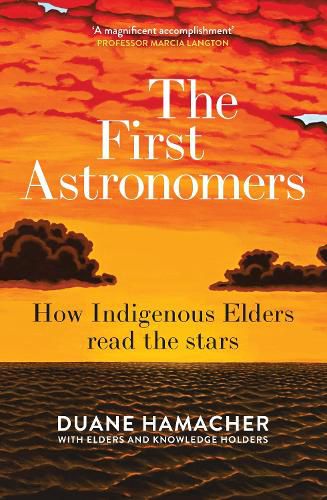
The very first sentence in the preface of the book puts its argument right there, up front. “The First Astronomers challenges commonly held views that Indigenous ways of knowing do not contain science” (p.1). For me, I don’t know if it achieved this aim, although as the most un-science-y person you could ever meet, I’m probably not the right person to discuss the philosophies of science, or philosophies of knowledge. I was not at all surprised that indigenous people have knowledge of the skies – that they ‘read’ (both in past tense and present tense sense of the word)- the stars,moon and climate phenomena. This is knowledge in terms of making sense of the universe and man’s place in it; of finding the rhythms of the universe, and of marking time and making predictions. But is it science? I guess it depends how you define ‘science’, and I probably lean towards the post-Enlightenment and western idea of science being replicable, falsifiable, separate from the individual, and systematic. I’m not sure that the knowledge Hamacher provides, through his indigenous informants, matches these adjectives. I find myself wondering if the question is not so much ‘Is indigenous knowledge scientific?’ but more ‘is our definition of knowledge broad enough?’
He uses ‘indigenous’ broadly supplementing the Torres Strait knowledge which he gathered as part of his own academic career, with indigenous knowledge drawn from cultures across the globe and history. Again, not surprisingly, there are similarities in the stories that pre-modern cultures world wide have developed and read into the star patterns- for example the ‘dark emu’ formed by the dark nebulae clouds of the Milky Way amongst Australian indigenous people is mirrored by the celestial rea (a bird similar to an emu) amongst the Tupi people of the Brazilian Amazon and the Moquit people in Argentina.
The book is simply written, which I appreciated in the more technical parts, although even then my eyes tended to glaze over. However, this simplicity also contributed a flatness to the narrative which, although broken up at times with Hamacher’s own anecdotes (e.g. losing his bearings in the outback despite being quite close to his base camp), felt rather prosaic and far removed from the splendour above that was inspiring his work.
The work is valuable in terms of presenting a breadth of knowledge that has been largely discounted as ‘myth’, and the exploration of the same phenomena explained by different stories across the globe highlighted our common humanity. But I feel as if he was trying too hard on proving its scientific (in the formal, academic sense of the word) credentials, instead of perhaps exploring whether the term ‘scientific’ is broad enough to capture the nature of knowledge more generally.
My rating: 6/10
Read because: Ivanhoe Reading Circle selection for September 2023. Their open meeting featured Duane Hamacher himself, attracting a large audience.
 The Resident Judge of Port Phillip