
I think that my undergraduate degree was wasted on the 21-year-old that I was then. I know that I did a half-unit about the religious sects that emerged during the English Civil War, but I can remember virtually nothing about it, and I don’t know if even then I knew what happened after the Civil War. I wish that I could go back for a few hours now, and sit in on a lecture to see what it was that I was studying.
With all the ceremony surrounding King Charles’ coronation and its reference to antiquity and continuity, it is easy for forget that for eleven years, Britain chose to be a republic, without a King or Queen. It had a revolution one hundred years before the French Revolution; it had a republican government long before the American government, and it was what Australia struggles to be after two hundred years- a republic without a hereditary head of state.
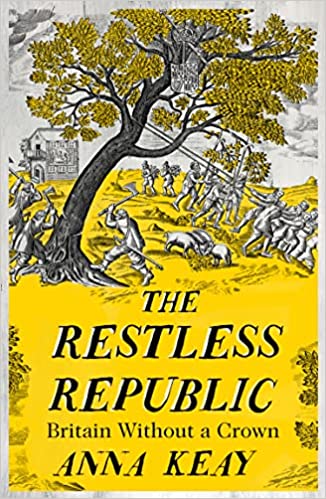
What an amazing, frightening, disorienting time to have been alive! This book captures well the disruption of certainties, the knife-edge of political allegiance, the dangers of an army, the contingency of events and personality, and the instability of florid evangelicalism channelled into politics (something that is apposite today). It starts with the execution of Charles I in 1649, and ends with the restoration of Charles II in 1660, seen through the eyes of nine individuals – not necessarily in their words, but from their perspectives. The book starts with John Bradshaw, who oversaw the trial that led to Charles I’s execution and later became President of the first Commonwealth Council of State; it moves to religious visionary Anna Trapnel whose ‘gift’ of prophesy spurred the Fifth Monarchists and the radical religious fringes of society, and spends time with Charlotte Stanley, born Charlotte de la Trémoille who, as Lady Derby, headed a Royalist family with ancestral land on the Isle of Man, when her husband Lord Derby was executed by the Commonwealth. Then we have the L’Estrange family in Norfolk, who along with other noble families that prized their land and family property above all else, kept out of the fray as much as possible, anxious not to commit to one side or the other. Even here, though, we see brother against brother as the politics splits a family down the middle. The gadfly journalist, Machamont Nedham, played both sides and managed to pick the losing side every time in his editorial allegiances, while William Petty, famous for having ‘resuscitated’ a young woman who was hanged for infanticide, introduced surveying techniques in Ireland using Army surveyors that facilitated the dispossession of Catholic landholders to the West and the influx of Protestant, English families to Ireland. Cromwell – both Oliver and Henry- feature here, but Oliver is depicted as a man who measured God’s approval of his actions by success on the battlefield both in the United Kingdom and in Hispaniola in the Caribbean as part of the ‘Western design’. Henry, sent as Major General in Ireland, seemed to steer a middle path that neither his father nor brother Richard could find, setting up an intriguing what-if scenario had he succeeded his father instead of Richard. Then there is General Monck, and his low-born and possibly bigamist wife Anne, who as his closest confidante was sought by people who wished to get the ear of General as he charted his own course, betraying both sides in turn, in seeking the way through the politics, as many other people sought to do as well.
It is not a chronological history as such, and yet it moves forward chronologically, weaving together these networks of influence and connection, involving both men and women, in a time when the extremes at both political ends were unpalatable. I actually found it un-put-downable in the closing pages because, although I knew the eventual outcome, it was not clear how it was going to be reached. At a time in our own politics where the certainties of liberal democracy are shakier, when religious Dominionism beats out its own agenda, when the influence of drug gangs, coups and private militias makes states ungovernable, I found many resonances in events of four hundred years ago. This is a very readable history for a reader who knows little about the period, human in its scope, and a damned good read.
My rating: 10/10
Read because: the author was on a The Rest is History episode.
 The Resident Judge of Port Phillip