
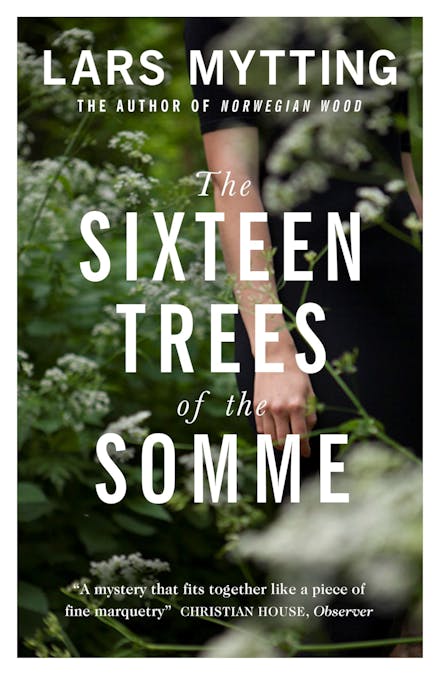
Translated from the Norwegian by Paul Russell Garrett
“Oh, a WW I book. Mud, blood and trenches,” I thought when I saw that this was on the reading list for the Ivanhoe Reading Circle. But it’s not at all. The events mainly take place in the early 1990s as twenty-something Edvard Hirifjell buries his grandfather Sverre. Grandson and grandfather had been potato farmers in rural Norway, living together since 1971 when at the age of three, Edvard’s parents had been killed. Their deaths were shrouded in mystery: they died of apparent gas poisoning from unexploded ordnance from WWI in a copse of trees on a former battlefield on the Somme. Edvard had been there too, but has no memory of what occurred: all he knows is that he turned up four days later over 120 kilometres away. As he begins to arrange his grandfather’s funeral with the local priest, he gathers snippets of knowledge of his family: that there was an estranged great-uncle Einar who fought with the French Resistance in WW2 while his grandfather Sverre served with the Germans on the Eastern Front; that his mother was born in Ravensbruck concentration camp; and most intruigingly, that his great-uncle Einar, a skilled timber craftsman, might not have been executed during WW2 as he thought, but may have instead having been living in the Shetland Islands until the 1970s. He had sent a beautifully crafted wooden coffin to Sverre in the small village of Saksum back in 1979 and when it is finally delivered to Edvard for his grand-father’s body over ten years later, it triggers in him an urge to make sense of his memories and his family history.
And so, his grand-father dead, and much to the frustration of his ex-girlfriend Hanne, Edvard travels to the Shetland Islands, and later to the village of Authuille in France, where his parents died, in his search for the past. On the peninsula of Unst, in the Shetland Islands, he finds strong traces of its Norwegian heritage and meets an enigmatic woman Gwen, who claims to be the caretaker for the nearby ‘big house’ Quercus Hall. Quercus indeed, the Latin name for the genus which includes oak and beech trees, because wood and trees play an integral role in the plot, both as a form of craftsmanship and as a motivation for deception and greed.
The book ends up in the Somme, but instead of focussing on World War I, it illustrates the legacy of war across succeeding generations. War on a global scale, but also war between erstwhile-business associates, and war between brothers.
In many ways, this book conforms with the conventions of the mystery novel. There are lots of name changes: Therese Maurel/Nicol Daireaux; Einer Hirifjell/Oscar Ribaut; Gwen Leask/Gwen Winterfinch. There is the big house. There are clues dropped, false leads and evasiveness on all sides. True to form, there is a cliff-hanger ending, which was rather too melodramatic for my liking. It’s a very cinematic novel. The only image I have in my mind of the Shetland Islands is that of the television series Shetland where the Scots influence predominates, but this is much more a European novel, despite the bleak, windy bluestone of the islands. It was not at all what I expected it to be, and it was probably the better for that.
My rating: 8.5/10
Read because: Ivanhoe Reading Circle. Purchased from Readings.
 The Resident Judge of Port Phillip