
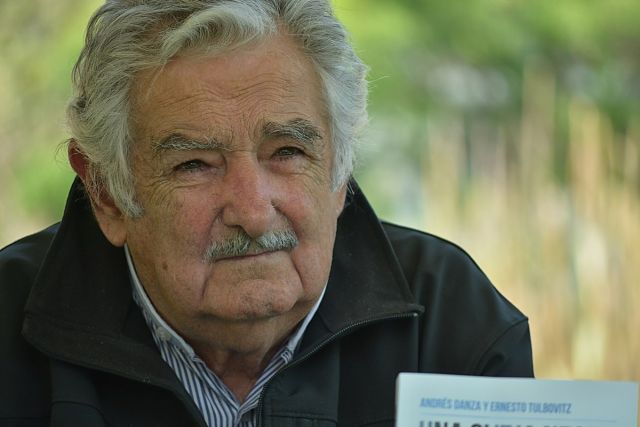
Witness History (BBC) José Mujica Have you heard of this guy? He was the President of Uruguay between 2010 and 2015 when he was known as “the world’s humblest head of state”. I admire him so much. He had been a guerrilla with the Tupamaros (a Marxist-Leninist urban guerilla group) and he was tortured and imprisoned for 14 years during the military dictatorship in the 1970s and 1980s. As President, he was an outspoken critic of capitalism, and certainly of the left. He is now retired, and lives in very humble circumstances outside Montevideo. You can see a video about him here.
Reflecting History I really am enjoying this series. I still don’t know who the presenter is, and he relies heavily on the work of other popular historians (in this case, Edward J Watts, whose book Mortal Republic I have purchased; Mike Duncan’s The Story Before the Storm whose podcast I listened to, and whose book I am currently reading; and Tom Holland whose Rubicon I am on the lookout for.) In Episode 57: The Fall of the Roman Republic Part III-The Gracchan Revolution starts by highlighting the tension between amibition and equality which was built into the Roman republic. It focusses on Tiberius and Gaius Gracchus. They were born of an aristocratic family, but came to head populist political movements that ended in assassination for both of them. Tiberius came first. When the Senate rejected his peace terms contracted in the Numantine War on the Iberian peninsula, he looked to the people who supported the end of the war- i.e. the ordinary people who would have to fight in them. To maintain their support, he introduced land reforms to break up the big estates that were causing an influx of landless peasants into the cities. Although historians argue over how committed he really was to this land reform, he shut down the government in order to get it passed, using the Tribuneship in a way that it had never been used before. The law passed after an influx of funds from the foreign King Attalus III of Pergamum, but it’s questionable whether the legislation was worth breaking so many norms in order to be passed. He was murdered in a riot instigated by his political enemies. The legislation was picked up by his brother Gaius a few years later, but again the Senate resisted, outbidding Gauis in the legislation without ever intending to introduce it. Gauis was voted out, and killed by decapitation.
History Hit The Creation of the NHS marks the 75th anniversary of the introduction of the NHS in Britain. The first calls for a national health service came in 1909, and were later picked up by the Fabians in 1920s and 30s. By the 1930s there was a web of local government, insurance, private and philanthropic health services. During and after WWII, there was a sense that soldiers and their families deserved better, especially when the limitations of urban health provision were made more visible when city children were evacuated to the country. In 1944, the Conservative Party also proposed a health system, but it fell to Nye Bevan, the outspoken Welsh Labor Party member, to introduce it as Minister for Health and Housing. It involved nationalizing the existing system, rather than building a new system, as there were no new hospitals built until the 1960s. It was based on the principles that it should be free and centralized from Whitehall, and in spite of resistance from doctors and Enoch Powell’s plan to rationalize it in 1961, it has continued. The degree of public love varies from time to time- for example, in the 1980s it really was under threat until people got behind it, and today everyone acknowledges that it is a stressed system.
History Extra Big Questions of the Crimean War: aftermath and legacy. This is the third and final episode in this series featuring Professor Andrew Lambert. The Crimean War (which the Allies won) affected different countries in different ways. Russia realized that it had to undergo great change, leading to the abolition of serfdom, industrialization, the rebuilding of coastal defences – and 20 years later they were back at war again in the Russo-Turkish War. France was full of Second Empire bluster, with Louis-Napoleon embarking on rebuilding Paris and looking to control the whole of Europe. Britain was content to bask in its naval superiority, and indulged in a display of technological mastery afterwards, while the Ottomans kept quiet, with the pressure of nationalism building in the Balkans, which would erupt in WWI. It’s hard to know how many people died in the conflict, especially because the French figures are dodgy. There were a number of firsts: the British used the first factory made standardized rifles, which could be fixed easily. The first submarine was used (although it didn’t do anything), and water mines were deployed. The fighting style was hybrid: in spite of the rifles, they still used tight formations and hand-to-hand fighting. It was hard for the British and French to fight together after the relatively recent Napoleonic Wars. Photography was used as the basis for engraving; telegraph communication was possible but too expensive to use for journalism. What the telegraph did do was make it possible for governments to give orders, far from the battle front, undercutting the generals. Florence Nightingale was the press’s middle-class hero- in fact, she wasn’t very middle class because she was very posh with good connections. She was more into management than nursing (although she did have a good sense of sanitation), and she wasn’t the only woman- the Russian and French also had women on the front. It was Army doctors who solved the problem of disease: her main success was publicity. The “Crimean War” as distinct from ‘The Russian War’ as it was known, was a late Victorian construct, and we need to think of it as a navy war, not a terrestrial one. Parallels with today? Yes. The Russians have under-estimated the Ukrainian army, just as they did the Turkish army in the Crimean War and Britain strangled the Russian economy through controlling its exports in both wars. Putin is a great admirer of Tsar Nicholas, and we need to remember that Russia is a creation of the Mongols, which is still evidence in a huge cultural division between Russia and other European nations.
If You’re Listening (ABC). Oh, good! Matt Bevan is back with his ‘If You’re Listening’ series. Instead of devoting all episodes to one theme, he’s taking a weekly approach with a different topic each week. This is also available as a video on I-View, but I prefer to listen while I’m doing other things. This must be the world of the new ABC. How “General Armageddon” and a bromance almost brought down Vladimir Putin looks at the friendship between Yevgeny Prigozhin, the head of the Wagner Group, and General Sergei Surovikin, overall commander of Russia’s “special military operation” in Ukraine. The two men were friends, but when Prigozhin launched his whatever-it-was against Putin, it was Surovikin who was tapped on the shoulder to bring him aback into line. Surovikin hasn’t been seen for a while- he’s ‘resting’. And from today’s news of Prigozhin’s death in an air accident, it’s even more doubtful whether we’ll see Surovikin again.
 The Resident Judge of Port Phillip