
Now and Then. In the episode There’s Something in the Water, Heather Cox Richardson and Joanne Freeman discuss three different scenarios from American history that revolve around water. First they start with the early days of New York, and the attempts by Aaron Burr to privatize the water supply (although his ulterior motive was to start his own bank). Then they move on to Los Angeles where Fred Eaton and William Mulholland cooked up a plan to divert water from the Owens Valley to provide water for the rapidly growing city of Los Angeles in the early 20th century. The episode finishes with the Hoover Dam on the Colorado River, started by Pres Herbert Hoover, but completed under FDR (who changed the name to Boulder Dam, but then it got changed back to Hoover Dam again). Hoover saw it is an exemplar of man taming nature through technology, whereas FDR saw it as a manpower project that would improve the lives of workers. Anyway, it seems that nature is having its revenge through climate change in North America, just as with our own Murray Darling river here in Australia.
Travels Through Time. John Darlington, author of Amongst the Ruins: Why Civilizations Collapse and Communities Disappear takes us back to 1692 and the Port Royal Earthquake. The English captured Port Royal, Jamaica, from the Spanish in 1655 and set it up as a base for trading, piracy and slave trading. The earthquake occurred on 7 June 1692, followed by an tsunami. As we saw in Christchurch, the earthquake caused liquefaction. All this was followed by a cholera outbreak, leading to the shift of population and political power to Kingston instead.
Emperors of Rome Episode LXXXII – Pertinax. No more Dr Rhiannon Evans for a while- instead we have Dr Caillan Davenport (Roman History, Macquarie University). The year 193CE was known as the Year of Five Emperors, but there were really only three, although another two laid claim to be emperor. In the power vacuum after the death of Commodus, army generals from the provinces- Britain, the Danube and Syria- counted on the support of their troops to be declared emperor. Pertinax, who just happened to be hanging around when Commodus was murdered, was probably in on the plot. A bit of a self-made man, his claim to the throne was bolstered by the omen of a dark horse climbing onto the roof, although this might be a bit of after-the-event mythmaking. There is always a tension when a new emperor is on the scene: the tension between maintaining continuity with the last emperor and choosing ‘the best man for the job’. On Commodus’ death, Pertinax immediately stepped up and offered the Praetorian guard three times their wages, but then he squibbed it and only gave them half of what he promised- always a bad move. He tried to be the opposite of Commodus by reigning in the spending and having a big garage sale of all Commodus’ gee-gaws. However, the soldiers disliked him because of his reputation as being a stern disciplinarian, and because of his penny-pinching. So, on 28 March, they killed him, after just 3 months. Episode LXXXIII – Didius Julianus marks a particularly low point for the Roman Empire, not because of how he ruled, but because of how he got there. In effect, the position of Emperor went to the man who gave the highest bid for a bonus for the Praetorian Guards. The winning bidder, Didius Julianus was outside the wall, shouting his bids over the fence, and it cost him 25,000 sesterces per soldier, instead of Pertinax’s measly 3000 denarii per soldier. Naturally, the soldiers liked him , but the people didn’t. They protested and rushed armed to the Circus Maximus demanding that the Syrian governor take over instead. The Senate ordered Didius Julianus killed, and he was, on either the 1st or 2nd of June, after just 66 days. (Still he lasted longer than Liz Truss did- maybe even longer than the Tesco lettuce). Episode LXXXIV – The African Emperor finally sees Septimius Severus come into the picture to give a bit of stability. He, too, was a general, but he was a bit of a workhorse rather than a show-pony. He was born in Libya from a local elite family, and he is known as the first Black emperor (although a portrait painted at the time shows him as being brown, rather than black). He married twice, and his second wife, Julia Domna, was very powerful in reinforcing the Severan dynasty. On taking power, he neutralized the threats against him. There were still two other claimants to be emperor: Pescennius Niger and Clodius Albinus. He defeated Niger and then made Albinus co-emperor with him, although because Septimus already had two sons, this was not going to be a long-term career move for Albinus. And he got rid of those pesky Praetorian guards by dismissing the lot of them, and opening it up to other legions. Finally, he deified Pertinax, marking the end of all this nonsense.
Actually, I have already listened to these episodes, when I was following The History of Rome podcast earlier last year and here is where I summarized Mike Duncan’s take on this section.
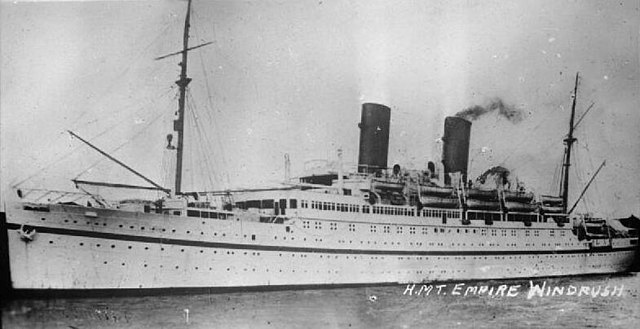
Dan Snow’s History Hit It’s the 75th anniversary of the arrival of the Empire Windrush that docked in Essex on 21st June 1948 with 1,027 passengers, 802 of whom were travelling from the Caribbean to take up reconstruction jobs after WWII and to staff the nascent NHS. I had wondered why they were celebrating the 75th anniversary (rather than the 100th) when I remembered that if they don’t do it now, most of them will be dead by the time the centenary comes around. The Windrush Generation and Scandal describes the sense of Britishness that these intra-empire migrants (as distinct from immigrants) felt, and the betrayal they felt on encountering prejudice and later, deliberate UK government policy in 2018 to force them back to countries they had left decades before.
 The Resident Judge of Port Phillip
