
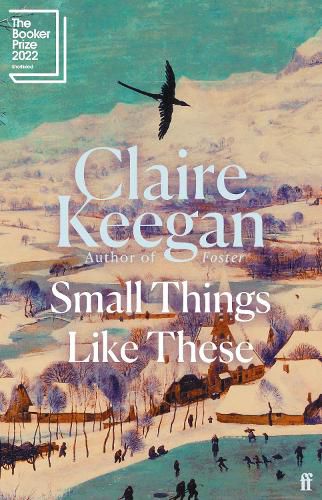
I hadn’t heard of Claire Keegan until she was short-listed for the Booker Prize with this book. It struck me at the time as a strange thing that such a short book of just 116 pages- a novella, really- would be on the Booker shortlist. Between ordering it at the library (months ago) and receiving it (with a further 76 reserves on it when I return it!) I saw the beautiful movie ‘The Quiet Girl’ based on her earlier novella Foster. There are certainly parallels between the two books. Both are set in rural Ireland and both deal with being wanted and rejected. Both are quite heartbreaking, in different ways.
SPOILER
It is 1985 and Bill Furlong, a coal and wood merchant, is busy as the winter sets in before Christmas and the inhabitants of his small town buy in fuel. Although he owns the business, he works alongside his men, and the company is just breaking even. He is married, and he and his wife Eileen, have five young daughters who are all looking forward to Christmas. He has lived in the village all his life, born to a single mother who worked as a domestic servant in a big house owned by Mrs Wilson, a Protestant widow. When his mother fell pregnant, Mrs Wilson encouraged her to keep working, and Bill grew up at the big house too, alongside Ned, another domestic worker. When he married, Mrs Wilson gave him a thousand pounds to establish the business.
Despite his job, wife and family, there is an uneasy emptiness in Furlong. He does not know who his father is. He works hard, and does not know what it is for. His wife and girls are in their own constellation, and he feels that he stands outside it. One bitterly cold night he makes a delivery to the convent which stands outside the village, and when he finds a young woman sheltering in a shed, he starts to question the convent and its treatment of the young unmarried mothers there. He is aware that his own life could have been very different: he owes much to Mrs Wilson and her kindness in keeping his mother on in work at a time when she could have ended up in a similar institution to that where he is now delivering the coal. But he finds his own wife, and the other villagers, closing ranks to form a protective shell around the convent: don’t ask questions, don’t interfere. The church is a powerful entity with tentacles reaching throughout the village.
I often find that the book I am reading speaks to the book that preceded it, and this is certainly the case here. Ghosts of the Orphanage is non-fiction, but Keegan’s novel has its truth too, not just in events but in the human responses of fear, pity and responsibility – all of which were present in ‘The Quiet Girl’ (Foster) as well.
This book is just the right length. It is beautifully written, and I can see the action playing out in my mind’s eye. And yet I wonder if it could be made into a film – it would no doubt do well in picking up a northern hemisphere Christmas market- but I think that film would struggle to capture the layers of feeling in this unsettled, rather inarticulate but good man. It is so carefully, deliberately written, and I’ve found myself turning it over in my mind all day.
My rating: 9/10
Sourced from: Yarra Plenty Regional Library
 The Resident Judge of Port Phillip
I heard this one read on BBC Sounds and absolutely loved it. it reminded me of Peter Mullan’s excellent film The Magdalene Sisters. I now have it on my list for #20BooksofSummer23.
I used to visit a friend in rural Ireland a lot in the 1980s, and the setting and characters in this book are totally convincing. The church was still all-powerful then, though I understand it is less so now. Terrible things were done to women in its name.
I must have a look for it on BBC sounds. I think that it would lend itself really well to being read aloud. Have you seen The Quiet Girl? I howled the whole way through it, and hugged my grandchildren very tight.
I agree, it’s a beautiful book, superbly crafted with a powerful message.
No, I’ve never even heard of The Quiet Girl – I will look it up, thank you.
Pingback: Six degrees of separation: from ‘The Great Fire’ to… | The Resident Judge of Port Phillip
Pingback: Movie: Small Things Like These | The Resident Judge of Port Phillip