
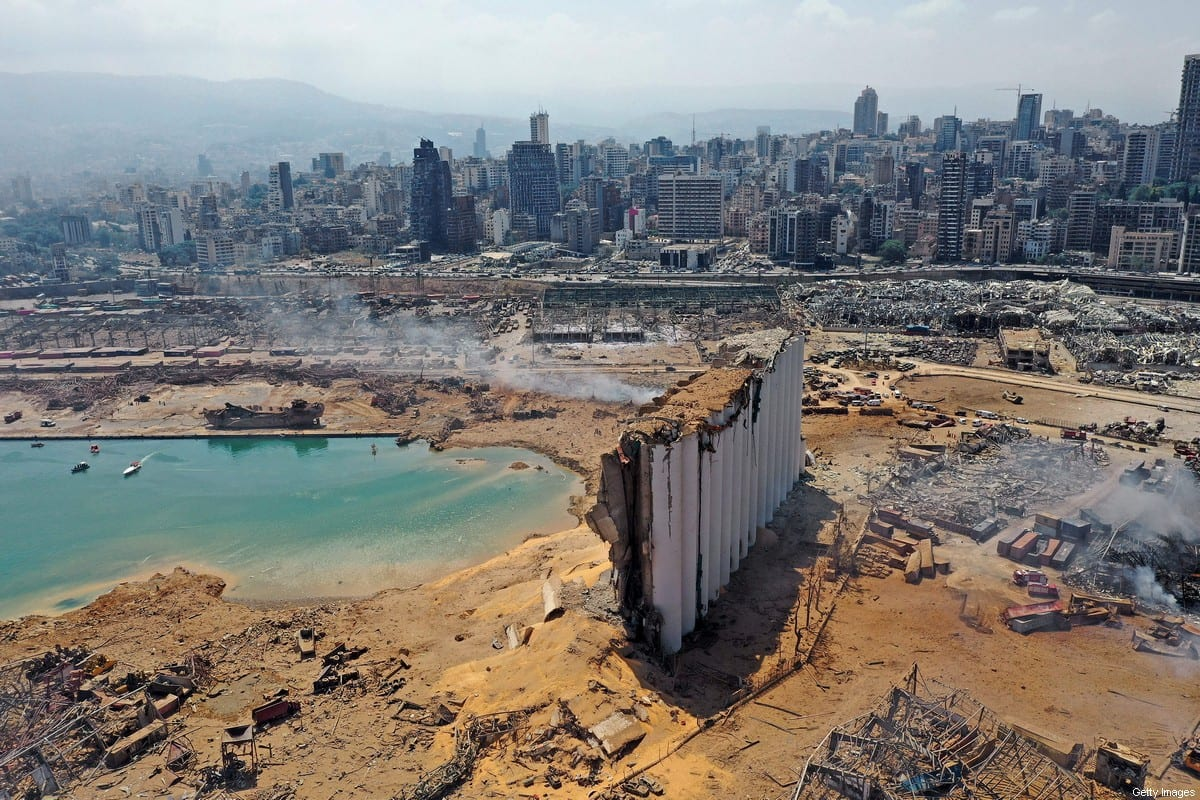
The Documentary (BBC) Beirut: Life in the Unliveable City I love my home city, Melbourne, and I just can’t imagine what it would be like to watch it collapse economically, politically and socially around me. I think of Caracas in Venezuela, Argentina in the grip of inflation, and Beirut in Lebanon. Lina Mounzer is a writer and translator living in Beirut, and here she talks with friends, family and neighbours about what it is like to live there. She lives on the 12th floor of a high-rise, and even though they pay to have a generator, they only receive 12 hours of electricity a day, on an intermittent basis. She overlooks the port and the grain silos that block her view saved her flat when other silos exploded three years ago. In explaining the political situation, she goes back to 1991 and the end of the Civil War when an amnesty froze everything, but also granted immunity to those who had committed atrocities. In 2019 there was a financial collapse, leading to massive 97% devaluation of the currency, followed by the port explosion in 2020. Now 80% of the people live in poverty, with 25% in extreme poverty. Since November 2022 there has been no president. She has seen the rise of ‘generator mafia’, a sector of the economy that owns generators and which now is bigger than the official electricity system in its heyday, so it is unlikely that the electricity situation will improve in the future.
History Hit Dan Snow has started a five-part series on the history of England. In this first episode Story of England: Stone Age to Roman Days, he starts with the footprints on the mudflats at Happisburgh, Norfolk which were made about 900,000 years ago on what was at that time the banks of the Thames. We don’t know what species of humans made the prints, because there have been at least four species of humans in England. There were at least eleven waves of migration to England, and climate plays an integral role. In warm periods there were rhinos; in cold periods there were polar bears. During the Ice Age in 25,000 BCE, human life in England ceased completely, but humans returned again in about 15,000 CE. He then moves on to Stonehenge, which was commenced c. 8000-7000 BCE, with the biggest stones erected in c2500 BCE. The largest stones were collected from about 20 miles away, but the smaller ones, called ‘bluestones’ (though not bluestone as we know it) come from Wales. The stones reflect a solar alignment, and there are acoustic properties to the bluestones. No-one every lived there: it was a ceremonial site. He then moves to Old Sarum. Julius Caesar had brought the Romans over in 54-55 BCE but it wasn’t until 43 CE that Claudius mounted a ‘proper’ conquest. Sarum was already a fort, and the Romans built a temple on it and expanded it further. It became an Anglo-Saxon centre, and when William the Conqueror invaded in 1066, he headed straight for it. This was a really well-produced episode, interesting, and giving enough context that an Antipodean could follow it easily.
Revisionist History. The Mystery of Mastery with Adam Gopnik. This was a taped interview where Gopnik (who I’ve only encountered in the New Yorker) is talking about his new book The Mystery of Mastery. Rather than talk about the book itself, they ramble on about mutual acquaintances and men that Gopnik had encountered who exhibited mastery- magicians, cooks etc. So far the only woman they discuss is one of their mothers rolling out pastry (although Gopnik’s mother is a professor, he says) and I decided I’d had enough of this dickfest.
Emperors of Rome Episode LXXIII – From a Kingdom of Gold Marcus Aurelius died at the age of 59, still with the army fighting yet another phase of the Marcomannic Wars. He probably died of plague, which was still circulating around, although some sources suggest that he received ‘help’ from doctors. He was deified and buried in Hadrian’s mausoleum. His reputation is somewhat tainted by Commodus who followed him, but it is quite clear that Marcus always wanted him as a successor. The ‘five good emperors’ were all adopted, but by pushing his (unsuitable) biological son, he broke the pattern. Marcus Aurelius was really important: he satisfied the senators and he didn’t alienate anyone. He was unfortunate to face two wars and the plague, and he probably would have been an excellent civic emperor, rather than a military one. Episode LXXIV – Iron and Rust In his book, The Decline and Fall of the Roman Empire, Gibbons starts off with Commodus, and anyone who has seen Gladiator will agree. The Roman Empire did begin to lose power at this time, which was perceived as being caused by Commodus’ own immorality. Well, this is what Cassius Dio says, who was an eyewitness and participant- so who knows how objective and reliable he is. Some of his most egregious actions were only picking up on similar actions in the past, but in Commodus’ case, he was actively trashing the Roman Empire. He quickly contracted truces in the Marcomannic Wars which kicked the problem further down the road, and then turned up in Rome for his triumph, along with his boyfriend. He had inherited a good, happy Senate but started executing them, and reverted to treason trials and confiscations as a way of replenishing the coffers. There was an assassination attempt led by his sister Lucilla, so he purged the Senate and the upper classes and put his own men in. Episode LXXV – Flying Too Close to the Sun looks at men who stepped forward to fill the administrative and leadership vacancy while Commodus was off indulging in “orgiastic abandonment” as Cassius Dio puts it. Sextus Tigidius Perenni was the Praetorian Prefect. He lasted a couple of years but was brought undone when 1500 javelin men arrived from Britain, dissatisfied with the Roman government, and Commodus took their side. He was replaced by Cleander, who had facilitated the arrival of the British contingent so that he could get rid of Perenni. He enriched himself (and Commodus) by selling off public office, leading the situation where there were 24 consuls each year- 25 if you count Commodus. But there was a grain shortage and a crowd protest at the races against Cleander and Commodus meant that Commodus had Cleander executed and threw his head to the crowd.
The Rest is History. My grandfather was a Freemason. He died before I was born, but his lodge briefcase was in the garage. Even though my father was not at all interested in Freemasonry, he became very angry when we dressed up in the apron and regalia to parade around the backyard. I’ve visited our local Masonic temple, but I really do not understand it one little bit. So I was interested in this episode The Freemasons: History’s Greatest Conspiracy Theory features John Dickie, whose book The Craft I have reserved at the library. He refutes the lore that Freemasonry started with King Solomon, identifying instead the court of James VI of Scotland (later James I of England) who introduced the stonemasons to the concept of the ‘memory palace’ as a way of remembering the material for entry to the craft. Then in 1717 four lodges formed the Grand Lodge, severing the connection to real-life stonemasonry, and created the 1723 Rule Book. It was associated with Whiggery, and fear of the French Revolution; its ideas influenced the American Revolution, and it did the hard work of the British Empire in providing a web of support for men sent to the colonies, and forming a meeting ground of sorts with the local elite, especially in India. Franco hated them, and they were involved in the Vatican Banker scandal of the 1970s in Italy. I’m looking forward to the book.
 The Resident Judge of Port Phillip
