
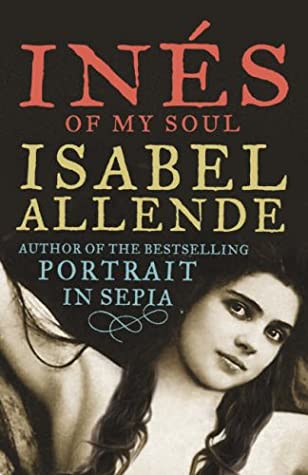
Have you heard of Inés Suarez? I hadn’t, and from Isabel Allende’s Author’s Note at the end of the book, it seems few other people have either, because she was “nearly ignored by historians for more than four hundred years”. She was a Conquistadora born in 1507 in Spain, and along with her partner Pedro Valdivia, and then later with her husband Rodrigo de Quiroga, she established the city of Santiago that is today the capital of Chile.
After marrying Juan de Málaga, she was left in Spain for years as her husband travelled to the New World in search of riches. When he did not return, she received permission to go in search of him. She arrived in Peru in 1538, where she learned that he had been killed. As the widow of a Spanish soldier, she received a land grant and and encomienda rights to a number of Indians. Her land was adjacent to that of the Spanish conquistador Pedro de Valdivia and they became lovers. When Valdivia decided to push into the territory now known as Chile, she accompanied him, ostensibly as his domestic servant, to avoid the strictures of the Church. After a harrowing trip down through the Andes and the Atacama Desert, they arrived at the valley of the Mapocho river, in December 1540, some11 months after leaving Cuzco and established Santiago. The indigenous Mapuche people resisted the invaders over several battles. The Mapuche destroyed Santiago on September 11, 1541 (what is it about that September 11 date?). Vastly outnumbered, the Spaniards retreated to the plaza, where Inés decided to decapitate seven Mapuche hostages who were being held for ransom, arguing that the Mapuche were calling out encouragement to their kinsmen. She threw the heads into the crowd, who fled. However, Santiago itself was in ruins, and the settlement almost starved until it was able to re-establish itself. Meanwhile, her lover Pedro de Valdivia was summoned back to Peru to face charges levelled against him by his enemies. He was found innocent of all charges, except that of living with Inés Suarez in the manner of man and wife. He was forced to break off with her, and bring his own Spanish wife (who had also been left in Spain while he was off adventuring) to Chile. He arranged for Inés to marry one of his generals, Rodrigo de Quiroga, whom he left in charge of Santiago while riding off to try to subdue the Mapuche. She was much younger than Rodrigo, but they fell in love. After the death of Valdivia, Rodrigo became Governor twice, in 1565 and 1575. She and Rodrigo died in Santiago in 1580, within months of each other.
Well, there’s certainly enough in that life to fill a book, and I’m a little surprised that others had not done so before Isabel Allende’s book (there are some earlier attempts, but not very well known). As a well-known Chilean writer, she is well placed to popularise Ines’ story, and she says in her afterword that she spent four years researching her. It’s a shame, then, that the final product is so flat.
Part of the problem is Allende’s choice of a memoir, supposedly written to her daughter, as the frame story. As a result, it is a book with little conversation (as Alice in Wonderland might have complained) and when there is conversation, it seems rather implausible that it would be remembered verbatim. As a historian, I acknowledge and salute Allende’s determination to stay within the boundaries of the history, but it doesn’t necessarily lead to a riveting story. Allende imagines herself into Suarez’s emotional life with her lovers, but the most dramatic scene of her life story (if, indeed it is true- some historians question this) is where she executes the seven hostages, and this is merely reported, with little anguish or regret on her part, and without rich – if gory- description. The narrative voice of Suarez, recounting her memories, is rather stilted and academic, and it was difficult to suspend disbelief enough to go along with the conceit that it is Suarez talking. I can understand that, as a woman writing about another woman, Allende would want Inés Suarez to tell her own story, but I think that a better frame story might have been told from the point of view of an observer.
So all in all, a bit disappointing, especially from a writer with the profile and reputation of Allende.
My rating: 6.5 (There was an Amazon Prime series made of her story, based on the book. It is on YouTube (Ines Del Alma Mia) but the subtitles are only in auto-generated Spanish).
Sourced from: the little library in Macleod Park.
 The Resident Judge of Port Phillip
Pingback: ‘Memoirs of Hadrian’ by Marguerite Yourcenar | The Resident Judge of Port Phillip