Witness History (BBC) Leading up to the bicentenary of independence in Brasil, Witness History has a series of three short episodes about Brazilian history. The murder that shocked Brazil looks at the 2002 murder and torture of investigative journalist Tim Lopes by a drug gang in Rio de Janeiro. The episode features an interview with Lopes’ son in 2014. A second episode looks at the capital of Brasil, Brasilia. It was designed by modernist architect Oscar Niemeyer and opened in 1960 (even newer than Canberra and a lot weirder). Building of Brasilia features an interview with Osorio Machado, an engineer who worked on the city’s construction.
The History Listen (ABC) Fanny Smith: The ‘genocide survivor’ whose voice will echo through the ages If you asked most people who the last Tasmanian aboriginal was, the answer would be Trugannini. But Fanny Cochrane Smith, who died in 1905 proudly proclaimed that she was the last Tasmanian Aborigine. In 1899, twenty-three years after Trugannini’s death, she recorded songs and language for the Royal Society of Tasmania, the oldest voice recordings made by an Aboriginal person and added to the UNESCO Australian Memory of the World Register in 2017. In this episode, you can hear the recordings and interviews with her great, great grand-daughter, who along with other Palawa people, was encouraged by Michael Mansell to see themselves as a ‘people’ rather than ‘descendants’. Well worth listening to.
99% Invisible Who-ever thought that a dingbat was a THING? For the 500th episode of 99% invisible, they embark on a three part series on Vernacular architecture. So what’s a dingbat?- it’s one of those two or three storey apartment buildings with parking underneath, apparently very popular in Los Angeles in the 1950s and 1960s. They also look at A-frame houses in Vermont, and the phenomenon of the front porch in houses in the South, which can be used as the site for story-telling but also a barrier to stoop people (especially black people) entering your (white) house.
The Documentary (BBC) Samburu: The fight against child marriage looks at the Samburu county, in northern Kenya, where it is normal for girls as young as 11 to be married, often to men more than three times their age. To add to the trauma, the day before the wedding the girl undergoes genital mutilation. Josephine Kulea, is a remarkable Samburu woman on a quest to stop these practices deeply embedded in her culture. Interestingly, they take the girls away for a few years, give them an education, then return them to their villages once the impetus for a child marriage (and the early delivery of cattle in exchange) has passed
Conversations (ABC) Richard Fidler really is a very good interviewer. The Fall of Kabul through Andrew Quilty’s Lens is an interview with photographer Andrew Quilty, who returned to Afghanistan as the US, UK and Australian troops withdrew. It’s a really thoughtful, articulate, raw interview- and it makes me want to read his book August in Kabul.
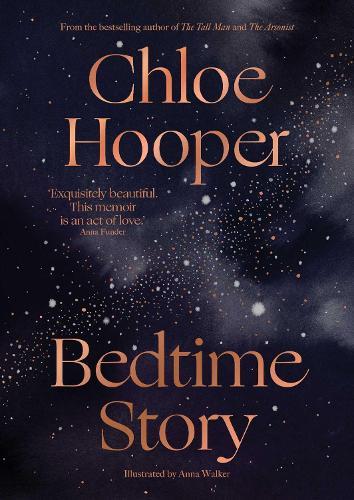
How do you tell a six year old that his father is gravely ill with cancer? Or his four year old brother? What does a child do with that information? When Chloe Hooper’s husband, historian Don Watson, received the diagnosis of a rare and aggressive form of leukemia, she turned to what she and her husband knew best: words and stories. Humans have drawn upon stories for time immemorial- indeed, it may be stories themselves that make us human- as a way of explaining the world around us and containing fears. Cancer, that very adult fear, is often described as a “journey”, drawing on ideas of the hero who inhabits both children’s and adult literature. As adults, we may think of fear of the dark as a childish fear, but it seeps through the pages of this book in Anna Walker’s illustrations that capture the inkblot of fear and death, the brush with spiders’ legs and the oppression of the deep, dark wood.
Hooper pores over the children’s literature shelves of bookshops and libraries, buying but ultimately rejecting the books written especially for children whose lives or families are touched by cancer. Instead, this book is presented as her story for her unnamed elder son, who is addressed as ‘you’ throughout. At one level it is an almost abstract, dispassionate survey of children’s literature from its “golden days” of the nineteenth century but, underneath her summary of the themes and biographies of authors like Tolkein, C. S. Lewis, L. Maud Montgomery is a more plangent question for her: what pain or trauma drove these authors to write for children?
These digressions into children’s literature are a way of avoiding the more immediate threat. Hooper traces through the early diagnosis and initial chemotherapy treatment, then the long, leaching period of ongoing chemotherapy and its side effects. The eye of the writer is always looking. As they drive in silence towards St Vincent’s Private Hospital for the initial chemo, the hospital where her young children were born (as, indeed were my own, more than 20 years earlier), the traffic is stopped on account of a young psychotic man up on the roof of the adjacent public hospital, threatening to commit suicide. The irony of suicide juxtaposed against people like them, desperate to hold onto life, is not lost on her. They sit in their room on an upper floor of the hospital, decorated in an intense purple, waiting, waiting, waiting – as much of the next year will be spent waiting. She reflects:
Is this what everything has been leading to? All the business that fills a life- two marriages, two divorces, a daughter, three stepchildren, a year later two young sons- was the fucking and the fighting and reading and the writing all leading to this high, purple room?
p.105
“Don” as his children call him, was very much an older father – he was aged 62 when the son referred to as ‘you’ in this book was born- and nurses sometimes mistake him as the children’s grandfather. I can only think that it was the presence of this young life around him that gives him the strength to face the chemotherapy regime which extracts its own toll in the time he has left to him (the oncologist Ranjana Srivastava addressed the issue of ‘time toxicity’ in an excellent recent article in the Guardian). The book is, too, a tribute to “Don’s” own achievements with his degree in history from (my own) La Trobe University (pointedly but accurately described on p.105 as “a newly built institution set in a dust bowl between two mental asylums, a cemetery and a drive-in movie theatre”) through to his work as speech writer for Paul Keating, leading to his wonderful biography/reflection Recollections of a Bleeding Heart and later books on the use of language in politics. But it is almost as if she is watching Don from behind glass: it is his struggle, on his own. The world closes in on them, as the family becomes transfixed by the nesting of a pair of white-plumed honeyeaters in their garden, and as the house becomes the centre of Don’s fight. She continues her work on completing The Arsonist, published in 2019 but it is as if all this is happening in another universe. Meanwhile, what they fear most is played out in front of them as the father of her eldest son’s friend dies of cancer too. Books may not be able to tell how to get through this: seeing another family doing so, does. The pages become drenched in black, and the upper-case text shouts “TEAR IT ALL UP” “STORIES AREN’T HELPING” “THEY ARE ONLY MAKING THINGS WORSE” “NO STORIES, NO MORE”
As she notes, readers often jump to the end of a book to find out how it finishes. I won’t tell you.
I finished this book feeling quite wrung out by it, and almost as if I had invaded their family territory. Hooper herself, of course, has invited us to draw close, but I still couldn’t help feeling as if I had somehow trespassed into someone else’s pain. I did find myself wondering about the logistics of writing this book – it followed a chronological thread but it was not a diary. At what point was it decided that it become a publishable piece? Do the commercial decisions of cover, illustrations and editorial shaping undercut its authenticity? What do you do with such an intimate piece of writing? Does the author climb onto the publicity treadmill, numbing herself to rehash the same conversations over and again for an audience?
This is beautiful, honest, human writing, but I really don’t know how to honour it without cheapening it. Do I give it a ‘score’? Stars on Goodreads? Do I listen to the interviews that she is giving (e.g. with Richard Fidler on ‘Conversations’) while I’m driving along in the car? Will it win literary prizes, with all the accompanying hoop-la? I feel as if she was compelled to write this book, as the only thing that she knew how to do. I felt that I wanted to keep reading it, to acknowledge her humanity and generosity in sharing it. But I still feel as if I am intruding.
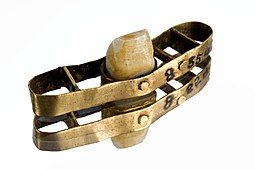
The Ancients (History Hit) So you thought that after finishing the History of Rome podcast, that would be it for the Romans? NO WAY as my little two-and-a-half-year-old grandson would say: I didn’t listen to over 70 hours of podcasts just for it to go in one ear and out the other! So, when I saw Prosthetics in Antiquity, that sounded interesting. Dr Jane Draycott from University of Glasgow explains that there was no actual word for ‘prosthesis’ in antiquity, although they did have wigs, artificial legs and feet, false teeth etc. Unlike today, when prostheses are made to look as natural as possible, in Ancient Greece and Rome it was felt that for a prosthesis to be lifelike was a form of deception and disguise. Instead, prostheses were personalized and, in the case of wealthy wearers, were a form of display. Many examples have been found in tombs, although wooden prostheses were less likely to survive than metal ones. There are also many references in literature to prostheses, although they were mentioned in passing, rather than described fully. Fascinating.
Emperors of Rome. I haven’t listened to this in a while- and Dr. Rhiannon Evans is back! Episode CXCVI – Fulvia looks at this aristocratic woman who lived in the late Roman Republic. Born into an important Plebian political dynasty, she was politically active in her own right too and married three times, most importantly to Marc Antony. She was directly involved in raising troops to fight for Antony in the Perusine War against Octavian (the future Emperor Augustus) in 41-40 BCE. Anthony didn’t appreciate her involvement, though, and he had her exiled. Cicero didn’t have a good word to say about her, and this has influenced the way historians have viewed her.
New Books Network – New Books in Latin American Studies. In this interview, Kate Phillips, the author of Bought and Sold: Scotland, Jamaica and Slavery claims that the Scots role in West Indian slavery is little known. This might be true of the man-in-the-street in Scotland, but it is not true of historians (and I note that Phillips is a retired social development specialist from Glasgow University, rather than a historian). Even here in Melbourne we have the city of Moreland changing its name because of its association with ‘Moreland’, a plantation owned by the family of Farquahar McCrae, who made no secret of their Scottishness. Apart from this questionable claim, however, Phillips has delved into the archives to draw a rich picture of plantation life for both Scots owners and overseers, and their enslaved workers. She points out that the field slave was more likely to be a young woman than a man, because men were generally trained to work as carpenters, bricklayers, mill workers etc. Ironically, after the Apprenticeship system broke down in the 1840s (and Scots slave-owners had applied for compensation for the loss of their ‘property’) formerly enslaved workers squatted on their old plantation lands, when their Scots ‘owners’ just went ‘home’ without selling the plantation. Now that Jamaica is becoming a tourist population, the descendants in Scotland are reaping the profits from these ‘abandoned’ properties.
History Workshop Podcast. Transnational Suffragettes starts off disastrously with about 2 minutes of the presenters all talking simultaneously over each other. However, the problem is soon resolved and a discussion follows, chaired by Australian historian now at Cambridge, Rosa Campbell, with James Keating a historian of nineteenth- and twentieth-century Australia and New Zealand and author of Distant Sisters: Australasian Women and the International Struggle for the Vote, 1880–1914 and Sumita Mukherjee a historian of nineteenth and twentieth century transnationalism, mobility and migration in South Asia, Britain and the British Empire, with a particular focus on gender, and author of Indian Suffragettes: Female Identities and Transnational Networks. They discuss the transnational women’s movement at the start of the 20th century, where the hierarchy was: 1. White Women, 2. Indian and Japanese Women, 3. Black Women and 4. First Nations Women. Although included in international conferences, women from ‘The South’ were not able to get their concerns reflected in the agendas of these larger meetings, although they were able to develop networks. In Australia in particular, the women’s suffrage movement was still very much a state-based (as distinct from national) concern, which did not lend itself easily to international events. Nonetheless, in Aust and NZ, representatives disseminated international news through scrapbooks, newspaper articles, magic lantern shows and circulation of letters. He particularly mentions the Womens Christian Temperance Union, an international body which took an increased interest in Maori women when they achieved the vote alongside white women in NZ. Meanwhile, Indian suffragettes looked back past British colonialism to the Vedic tradition.
The History Listen (ABC) is running a 3-part series called ‘The Loveday Trilogy’ which looks at individuals who ended up in Loveday internment camp in South Australia during WW2. This episode, Francesco Fantin, is actually the second episode, but you don’t need to have listened to the first one. Fantin was born in Italy in 1901 to a working class family. Largely self-educated, he became an anarchist and socialist. When Mussolini came to power in 1922, Australia became a favoured destination for anti-fascists, and he emigrated to Australia and headed for the Queensland cane fields. There he became labour organizer, and he led a strike action to demand the burning of canefields to kill off rats and snakes, a health-and-safety act opposed by the sugar planters. But when he was arrested and interned in 1942, he found himself in a camp where the fascists outnumbered the anti-fascists, and his life was in just as much peril as it might have been in Italy.
The Documentary (BBC) Now that Boris has gone, The Documentary looks at Global Britain after Boris Johnson, in a rather too flattering episode, I feel. Given Johnson’s penchant for Shakespeare, it is presented as a play with 5 acts: 1. Brexit 2. Johnson meets Biden 3. Exit from Afghanistan 4. COP 26 and 5. Ukraine. Almost makes you forget what a twat he is.
History Hit. In A Short History of Humans, Dan Snow interviews economist Oded Galor, the founder of Unified Growth Theory and author of the recently released The Journey of Humanity: The Origins of Wealth and Inequality. He argues that for 99.9% of man’s history, there was no substantial change in the rate of man’s progress, as any technological advance led to an increase in population, which largely cancelled out an advances. However, during the last two hundred years, rapid technological change has led to increased complexity requiring more universal education, for which parents needed to reduce their family size. He sees the Industrial Revolution itself as a red herring, emphasizing acceleration of change, rather than innovation, and he largely discounts cultural and biographical factors in world history. However, he softens this later on in the interview when discussing why Western Europe became the centre of accelerating change. In counter-point to the example of China, he points to Western Europe’s cultural fluidity which led to competitive nationalism, and factors like geography, culture and institutions which affected the “take off” point from stagnation to growth. He suggests that these factors can be “designed into” development programs, leading generally to progressive policy in terms of education, human rights etc. He is very ‘economic’-y, seeing growth as an unqualified good, and in this interview, silent on the effect of climate change.
One of several very good things that the Labor government has done since taking power is to discontinue the case against Bernard Collaery, charged with helping his client Witness K who acted as a whistleblower over East Timor oil negotiations (I reviewed Collaery’s book here). This is not the only case that has been brought by the Australian government that is shrouded in secrecy and non-disclosure (indeed there may be others under way- how would we know?) Just recently we have learned that senior intelligence officer Witness J. was tried, sentenced and imprisoned in secret under s22 of the National Security Information (Criminal and Civil Proceedings) Act 2004. For the individuals involved, their cases might be discontinued, inquiries might be held, sentences may be commuted – but what happens afterwards?
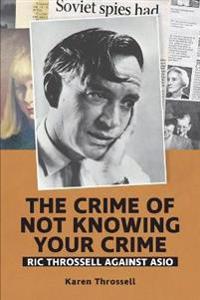
Ric Throssell could tell you. The son of Australian writer Katharine Susannah Prichard (see review of Nathan Hobby’s biography here) and war hero Hugo Throssell, he found himself caught up in the surveillance of his openly-communist mother, was identified by Petrov as a spy, and was brought before the Royal Commission on Espionage 1954-55. He was cleared by this commission, but the allegations never went away. He had already been employed by the Department of Foreign Affairs before these accusations surfaced, and for the rest of his life he found himself passed over for promotion. The allegations continued to be promulgated by media figures and historians.
Karen Throssell, Ric’s daughter, takes up her father’s fight in this book that was shortlisted for the Dorothy Hewett Award for an Unpublished Manuscript It is very much a labour of love, as you see the adult daughter continue her father’s vigilance against repeated public accusations made by historians and commentators, balanced against her memories of a father, a familiar (in both senses of the word) presence in her life. There’s an element of the wounded child there too, as her father took his own life on the same day that her mother died.
The typesetting is very important in this book. There is a lot of white space, with a heading on each left-hand page and sometimes as little as a sentence on the right hand side. It is presented as a series of 103 “Items”, each numbered “Item #103” as a file might be. This evocation of the file is important, because Ric and his daughter’s fight was against files: files made, files with-held. The items comprise a range of genres: poetry, paragraphs, newspaper cuttings, letters, more extended writing over one or two pages.
I’m not particularly keen on a recent form of memoir where the author throws everything onto the table, leaving it to the reader to piece together a narrative (see here and, to a lesser extent, here). I’m old-fashioned enough to expect that the authors have a responsibility to structure the narrative. Throssell’s book does have a narrative, in that there is a roughly chronological order, and the book is divided into sections as the long campaign for justice moves forward. The “item” layout gives a sense of the fragmentary and disconnected.
However, the ordering of the book seems strange to me, although this possibly says as much about me as a reader as it does about the book. There is a system behind the typography, but you only discover the ‘key’ if you turn to the notes at the back of the book. There you learn that the white type on black boxes are Ric Throssell’s own writings, as distinct from Karen’s. Bold format within quotes denotes words written by the author. I would have appreciated this information at the start, because the white on black boxes particularly puzzled me – who is writing this? is this fictional or not? While I acknowledge that this confusion can be interpreted as a meta-comment about truth/allegation and the file as artifact, it did not contribute to my reading at the time.
The book finishes with an essay by historian Phillip Deery which gives the historical context to ASIO, the Royal Commission and the Venona Project but I felt that this would have been much better placed at the beginning. In fact, I’m a little surprised that the author didn’t want to have the last word, instead of turning it over to someone else- after all, the “last word” is what her father had fought for all his adult life.
And, as long as ‘secrecy’ trumps ‘justice’, he won’t be the last to do so.
History of Rome. I’ve done it! I finished!! Episode 177 The Burning Ships sees the last attempt to tackle the Vandals in North Africa. Between 465 and 467 there was no emperor at all in the Western Empire after Severus died. Leo over in the East was too busy dealing with the Huns to pay much attention, and General Ricimer who was the real power behind the Western throne was happy for it to stay vacant. Once he turned his mind to it, Leo wanted Anthemius (who was a bit of a rival, and better off out of the way) while Genseric the Hun (over in North Africa) wanted Olybrius, probably as a way of using family connections to embed himself into the imperial family. Genseric recommenced pirate raids on Sicily and Italy, as a way of throwing his weight around. In response, Leo named Anthemius and sent him off to wage a big war of both the Western and Eastern empires against Genseric on three fronts. At first the Romans were victorious but then Genseric sent empty ships in amongst the Roman fleet and set them on fire. The Romans lost 600 ships in the resulting tumult. In 469CE Anthemius tried to retake Gaul, where the Goths were expanding their territory under King Euric. The Romano-British leader Riothamus was encouraged to invade from the Brittany Coast as part of the attack on the Goths- he may have been the legendary King Arthur (or not). Ricimer and Anthemius were on the brink of civil war, but they had a 12 month truce to fight the Goths unsuccessfully. When Civil War threatened again, Leo sent Olybrius to mediate between Athemius and Ricimer but, secretly, Leo was backing Anthemius and the letter exists to prove it.
Episode 178 Not with a Bang But a Whimper takes up when Leo’s secret letter was discovered. Finding that Leo was on Anthemius’ side, Ricimer and Olybrius killed Anthemius and Olybrius took his place. This made the Italian nobles and Genseric happy. But then Ricimer died, followed soon after by Olybrius. They were succeeded by Ricimer’s nephew Gundobad, King of the Burgundians, who killed Anthemius. Gundobad elevated Glycerius to the position of Western Roman Emperor, but he was not recognized by Emperor Leo in the East, who supported Julius Nepos as replacement instead. By now the Visigoths (Western Goths) and Ostrogoths (i.e. Eastern Goths) were getting restless. Then in 474 Emperor Leo, Julius Nepos’ backer, died and was succeeded by Leo II who was only six years old, with his father Zeno as the real power behind the throne. But then Leo II died too (was he murdered?) but Zeno was happy for Nepos to continue in his position. Glycerius surrendered in the face of overwhelming power and was made a Bishop (a favourite go-away measure). In 475CE came the rise of Orestes, a former Hun, who arranged a revolt against Nepos. Orestes’ son 14 year old son Romulus Augustulus was elevated but of course, he was a puppet too. There was a soldier uprising against Orestes, led by Odoacer. Orestes ended up dead with Romulus Augustulus deposed. And at that point it all got too hard and the Western Empire just faded away. So, in effect, we have gone full circle from Romulus (of Romulus and Remus fame) and ending with Romulus Augustulus.
Episode 179 The End! I got there! Or more to the point, Mike Duncan got there after recording an episode every Sunday for five years, generating 74 hours of content, after nearly faltering at Episode 33 (where he dealt with Marius and Sulla). The whole way through the series, he joked about ‘256 reasons why the Roman Empire fell’ but here he actually does give his summary of the reasons, under 6 (not 256) headings:
Political factors. The Empire ended up a brittle farce, with poor emperors and a corrupt bureaucracy
Economic factors. Inflation destroyed the middle class, and the poor began to see the State as a predator.
Military factors. The Legions were in effect dead. Romans avoided military duty which means that the army was dependent on Germanic mercenaries
Social factors (Mike Duncan’s personal favourite). Failure to integrate Germanic people, and the prejudice of the Italian aristocracy
Religious factors. Duncan doesn’t accept Gibbons’ argument that Christianity led to the fall of the empire, but certainly there was increasing religious intolerance.
Environmental factors. Between 250 and 550 CE there were fluctuations in the climate, with more famines and plagues.
So why didn’t the Eastern empire fall as well, instead surviving as the Byzantine Empire for the next 1000 years? Partially it was geography, with the Western Empire having to grapple with long Rhine and Danube frontiers. The East, on the other hand, dealt with the Sassanids who were at least a stable force. Second, the Eastern empire was wealthier because of its ties with India and China in the East. Third, there was the imperial apparatus itself. The East middle-class thrived, and imperial service was still seen as prestigious.
And there it ends. I can’t believe I’ve done it.
The Real Story. Salman Rushdie and the fatwa. I want to do something on this at our next Unitarian service in September, so I listened to this podcast carefully. Rushdie was born in ‘Bombay’ (which is the way he always refers to it) in 1947 and sent to England for his education. While a student at Cambridge University he first came across the story of the Satanic Verses, a set of verses disputed and later rejected by Islamic scholars. In his book The Satanic Verses he questions the sacred and divine, but he also gives the prophet and two of his wives pejorative names. However, he asks – how could one fictional book threaten Islam? The Prophet in Islam is a man, not a god. The fatwa was announced by a Shia cleric, and in itself is not consistent with Islam, where the only death sentence is for apostasy (i.e. a believer later rejecting the faith). One of the speakers in this program claims that the West has been naive about the proselytizing nature of Islam. In the UK, there was opposition to the book from the start, and the political response was interesting. The Labor Party announced that the book should not be reprinted: Margaret Thatcher, on the other hand, defended him. The speakers end by suggesting that the fatwa has become internalized amongst writers.
The Latin American History Podcast started a series on the conquest of Peru, but the last episode was in August 2021. I even wrote to the presenter (wondering if he was still even alive!) and yes, he is- but he is travelling in South America. So, Episode 3 The Conquest of Peru switched its focus from the Spaniards to the Inca, and here he called upon Nicholas Machinski from the A History of the Inca podcast. Unfortunately, the sound quality of Nicholas’ comments was really poor and hard to hear. Nonetheless, he clearly knows a great deal about Inca history. It was interesting to listen to this after just finishing the History of Rome podcast. In the 1520s, when the Spaniards arrived, the Inca were undergoing their own succession crisis after the death of the Emperor which culminated in a civil war between the claimants. The Inca Empire was at its largest at this time, stretching from parts of Colombia in the north, down to parts of Chile and from the Pacific Ocean to the Andes. As part of its expansion, if the leaders of conquered tribes pledged loyalty to the Inca ruler, they would be left in peace by the Inca authorities, but if they resisted they were forcibly shifted from their ancestral homes to another location. Nonetheless, there was a strong rebellious force underlying this Inca hegemony, and some groups were happy to join the Spaniards against the Inca. Smallpox was already present before the Spanish arrived. The Inca Army was huge (up to 100,000) and mobile because of its road network, but at the time of invasion it was poorly led and undisciplined. There was only one invading European force, so the Inca couldn’t play off European sides against each other as the Iroquois had done in North America with the English and French invaders.
Fifteen Minute History. Despite its name, this podcast from the University of Texas at Austin never quite manages to fit into fifteen minutes- twenty yes, but fifteen no. The Servant Girl Annihilator is a pretty old episode from 2018 where then-Ph D candidate Lauren Henly talks about a series of murders of several young women that occurred between Christmas 1884 and May 1885 in Austin Texas. They didn’t have the vocabulary to talk about a ‘serial murderer’ then, and it took a while for the concept of the same person committing a series of murders to catch on. At first, it was only Afro-American women who were killed, but then two white women were murdered as well. There was speculation that perhaps these were early murders committed by Jack the Ripper, who then migrated to England to continue his spree there (a largely discounted theory). Others have posited that the murderer was a young Afro American man called Nathan Elgin, exposed in a PBS special called “Solved” on account of a missing toe which matched a footprint with a missing toe. In her research, she does not describe the murders herself (instead using reports at the time) and concentrates on the victims and the vibrant African American community in which they lived.
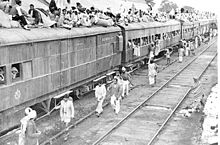
Wikimedia: A refugee special train at Ambala Station
History Hour (BBC)Seventy-Five Years since India’s Partition is a compilation of stories from an earlier series produced by the BBC to mark the seventieth anniversary. I’ve started listening to this earlier series too, called Partition Voices but I’m finding it a bit repetitive and you’re just as well off with the History Hour episode. The History Hour episode also discusses the death of Nehru and the Indian poet Rabindranath Tagore, became the first non-European to win a Nobel Prize for Literature. The stories about Partition are horrifying, on all sides, and although the migrants who fled to England didn’t particularly want to talk about it at the time (largely through shame), their children are more intent on finding out what happened. The attitudes of the British are appalling too, with one radio announcer declaring that both sides needed a “good hard smack on the nose” to stop the pre-Partition violence. Yes, that would do it.
Partition Voices (BBC) Actually, I take that back. I persevered with Partition Voices, and found it well worthwhile. However, I listened to it in the wrong order because that’s how it came out on BBC Sounds. The right order is: Division, Aftermath and Legacy. It’s quite sickening to hear the cossetted and oblivious views of English colonials living in India at the time in Episode 1; the violence is appalling in Episode 2 where both sides engage in ethnic cleansing; and Episode 3 shows the effect on later generations, a phenomenon noted with Holocaust survivor families, but not so much with ‘East Asians’ who, in British society, are lumped together despite this bloodied history.
It’s the first Saturday of the month, and so it’s Six Degrees of Separation Day. Kate, who hosts this meme at her blog Books Are My Favourite and Best has taken a different approach this month. Instead of her choosing the book, this month you start off with the book that you finished with last time and then link six other books that you associate together in some way.
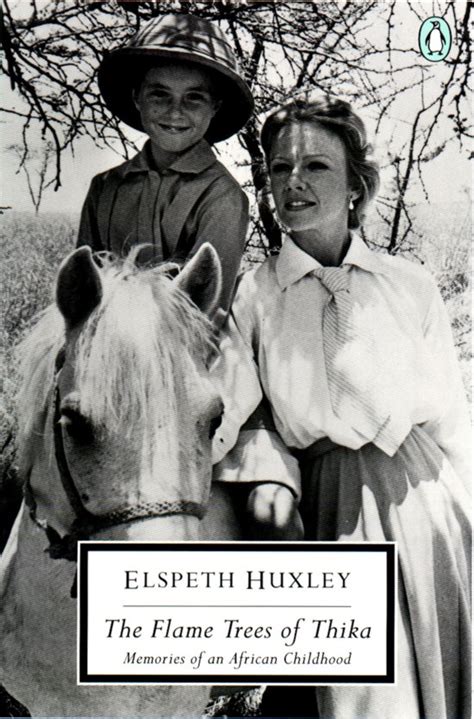
Well, in August my last book in the chain was Elspeth Huxley’s memoir The Flame Trees of Thika. I read it a long time ago, and intended re-reading it on one of my several trips to Kenya to see my son, who was living in Nairobi at the time. So, my Six Degrees this month all revolve around Africa in one way or another.
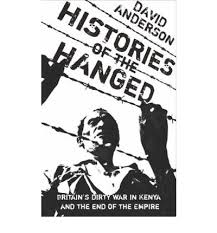
David Anderson’s History of the Hanged (2005) is a history of the Mau-Mau Rebellion which took place in Kenya between 1952 and 1960. He starts by contextualizing the rebellion in terms of colonization and de-colonization, then shifts to a more individual approach through his use of court reports, both from the Supreme Court and the Special Emergency Assize Courts. (My review here)
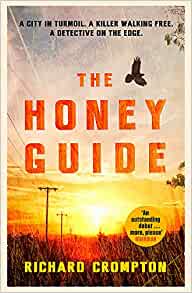
Another more recent troubled period in Kenya’s history occurred after the 2007 elections. The Honey Guide (2013) is set at that time. It’s actually a detective story, featuring Mollel, a Massai policeman amongst a police force notorious for its corruption made up of Kikuyus and Luos who clashed during this post-election violence. Mollel’s wife had died several years earlier in the 1998 bombing of the American embassy in Nairobi, leaving him to bring up their son. I’m not usually a fan of detective fiction, but I loved the real-life setting of this book.
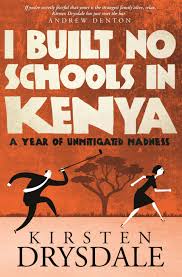
Let’s move away from violence in Kenya for a bit with Kirsten Drysdale’s memoir I Built No Schools in Kenya (2019). You may know her from ‘The Hungry Beast’ or ‘The Checkout’ on the ABC – come to think of it, I haven’t seen her for a while. In 2010, between shows, she shifted to Kenya for a year to care for an old man with dementia and became caught up in the family tensions. I found it laugh-out-loud funny at times, and I loved her descriptions of Nairobi. (My review here)
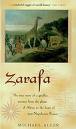
How about something going out of Africa (other than Karen Blixen)? Zafara by Michael Allin is the story of the giraffe donated to the King of France Charles X by Muhammed Ali, the Pasha of Egypt in the mid-1820s. In this book he traces Zafara’s journey from her original capture in Sudan, across to Khartoum strapped onto the back of a camel (I’m finding it quite hard to imagine this), then down (up?) the Nile to Alexandria, where she embarked a ship to Marseilles. On arrival at Marseilles, it was decided that after a winter lay-over, she would walk the 900 km to Paris. Her trip, which took 41 days, excited keen interest in the crowds that greeted her at each stop and indeed, the whole of France was convulsed with ‘giraffe-mania’. He tells the history of the fascination with ‘exotic’ animals, the effect of the Enlightenment and the fascination with Egyptology. It’s a real work of love. (My review here).
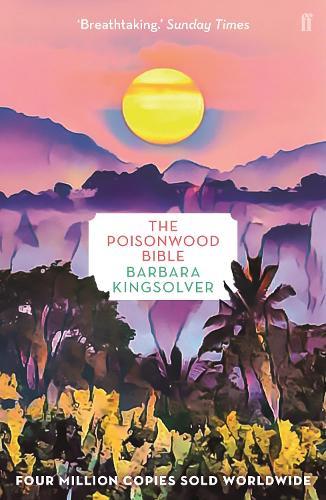
Or lets go the other way, into Africa. That’s where four young girls, Rachel, Leah, Adah and Ruth-May are taken by their rabidly evangelical father in The Poisonwood Bible by Barbara Kingsolver. Told alternately by each of the four girls and their mother, it captures well the grip of mania as their father is oblivious to the irrelevance of his message, and the effect on his family as they live as outsiders in a Congo village in the jungle.
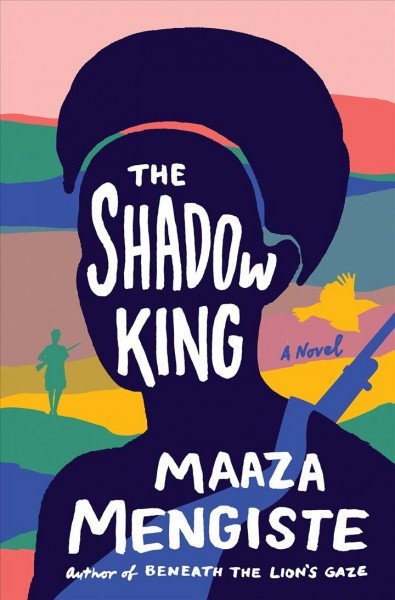
The Shadow King (2019) by Maaza Mengiste takes us to another African country – Ethiopia- during the Italian/Ethiopian war in 1935- something that I knew absolutely nothing about. There’s crazed violence in this book too, as Carlo Fucelli, the leader of those Italian troops, indulges in sadism, forcing a Jewish Italian photographer amongst his troops to photograph the atrocities that he commits. Meanwhile, The ‘Shadow King’ of the title is a peasant with an uncanny likeness to the now-exiled Emperor Haile Selassie. While Selassie frets in Bath UK, his ‘shadow’ appears, almost like a vision, before the Ethiopian troops to inspire them. This book was shortlisted for the Booker Prize in 2020 and was beaten (rather unjustly, I feel) by Shuggie Bain. (My review here).
So there we go – all in Africa – but moving from Kenya to Egypt, Congo and ending up in Ethiopia.
I can remember this book being on the shelves at my high school library, but I was never tempted to read it. Perhaps its length was off-putting then, and that’s probably just as true today at 640 small-print pages. (My Kobo estimates a reading time of 22-24 hours). Who has time to read such a lengthy book? But – oh, what we would miss out on!
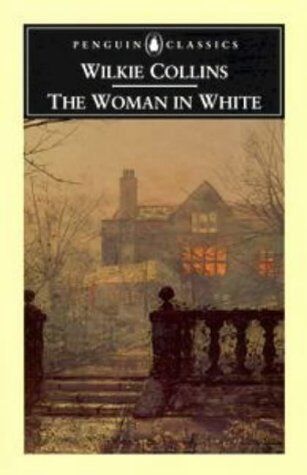
The Woman in White was serialized in 1859-60 and first published in book form in 1860. It is pure Victoriana, with its grand houses, fortune hunters, madness, swapped identities, secrets, dastardly deeds, swirling fog and graveyards. It uses a favourite Victorian technique of doubles: two sisters; two houses; two villains. But it also comes over as quite modern with its multiple narrators, evoking the structure of a court case, with its steady accumulation of evidence and witnesses. It starts with a young drawing-master, Walter Hartright (is that a pun?) who helps a distressed young woman, dressed all in white, on a dark country road. When he is later appointed as a vacation art tutor to two sisters, he notices the similarity between the youngest sister, Laura, and the unknown Woman in White. He falls in love with her, despite the differences in their social standing, but Laura is already promised to Sir Percival Glyde, a man many years her senior. Sir Percival is not all that he seems, and Laura is the unwitting victim of a conspiracy to defraud her of her inheritance. And I’ll stop here….
It is easy to dismiss as “Victoriana” the concern with inheritance, and women’s financial powerlessness until the passing of the Married Women’s Property Act in 1870 in the UK. But the heiress kidnappings, and the ‘gas-lighting’ of women to the point of insanity were not just literary plot devices: they were real. In fact, Collins dedicated the book to Bryan Proctor, the Commissioner for Lunacy, who had championed Louisa Nottidge, whose real-life story encompasses many of these themes. Although an utterly evil, decisive bout of murder might have solved all the plot machinations, Collins maintains enough ambiguity about his characters – even the baddies- that as a reader you’re glad that the author hasn’t taken such a bloodied step (besides, that could finish the book in 200 pages, instead of 600!) He is a very visual writer, and although his language is convoluted, the accretion of small details helps the reader to ‘see’ the characters and setting. Although it was serialized, its careful plotting right from the start means that you don’t have whole chapters of ‘filler’ and implausible false-leads as you sometimes get in Dickens.
He sustains the tension so well over these 600 pages, so much so that I could hardly put it down at the end and kept sneaking away to snatch covert 15-page reads whenever I could. It has been described as a melodrama, but I prefer to think of it as a thriller, with mounting suspense and a sense of dread, ratcheted-up as the story proceeds. There’s nothing hard-boiled about it at all: instead, it is intricate, verbose, lush, formal – and a damned good read. Even at over 600 pages.
My rating: 9/10
Source: CAE bookgroup (aka The Ladies Who Say Oooh)
History of Rome Podcast. I’m getting so close to the end that I can almost taste it! Episode 174 The Sack of Rome Part II We left off with the ascension of Petronius Maximus as emperor in 455AD. He ruled for 77 days only, and his main effect was to provoke the Vandals to sack Rome. As a way of cementing his legitimacy, he forced Eudoxia to marry him (after murdering her husband Valentinian) and wanted to marry his son off to Eudoxia’s daughter who was already betrothed to the son of the Vandal king Genseric. Genseric was not amused. On hearing that the Vandals were heading towards Rome, Petronius Maximus advised the resident of Rome to “run away!”, which they did, murdering him on the way. The Vandals sacked Rome for the second time over a period of two weeks, and although the name ‘Vandal’ has gone down in history for thoughtless destruction, perhaps it wasn’t as bad as it sounds- there is no archaeological evidence for wanton obliteration. Genseric went back to North Africa, taking Eudoxia with him. Meanwhile, the Gallo-Roman Avitus, who had been sent by Petronius Maximus to Theodoric II to get the support of the Goths, learned about Maximus’ death, and Theodoric suggested that Avitus become emperor. Theodoric might have thought that this was a good idea, but Emperor Marcian in the East wasn’t sure; Genseric started raiding again and the Italians were resentful about the ascent of the “Gallo-Roman” emperor. So Ricamer and Majorian deposed Avitus, but didn’t kill him immediately, making him Bishop of Piacenza instead, perhaps because they didn’t want Marcian to get angry, or to keep Gothic support.But then Marcian died anyway, and Avitus was killed soon after.
Episode 175 Trying to Take it All Back sees Majorian marching around trying to reassert Imperial authority over the provinces while Ricimer remained in Italy. Ricimer knew that he couldn’t become emperor in his own right because of his Germanic background so Majorian was proclaimed emperor with Ricimer behind the scenes. They wanted to “make the empire great again” and they reinstituted the navy and Majorian invaded Gaul and defeated the Goths. The Gallic nobles acquiesced when they found out that their tax debts would be waived. Majorian then turned his eyes to Spain, as a step in his broader plan of invading North Africa. But Genseric, knowing that they were coming, destroyed his own province Mauritania in a scorched-earth policy that would make an invasion difficult and infiltrated the ship-building port to destroy Majorian’s navy. The North African invasion was shelved. Ricamer and Majorian had a falling out, and Majorian was murdered on Ricimer’s orders.
Episode 176 The Quote Unquote Emperor. Well, the murder of Majorian didn’t go down well with a number of generals (especially Aegidius in Gaul and Marsellinus in Dalmatia) or the Vandal King Genseric in North Africa. Ricamer sent off old Agrippinis to his native Gaul, where he offered the Goths the region of Narbonne, which they jumped at because they had been wanting a Mediterranean port for ages. The rebel general Aegidius and Agrippinis met in battle, and Aegidius won. Meanwhile, the Vandals were still skirmishing and Genseric was starting to make Attilla-the-Hun type demands on the fortune of the Theodosian women that Genseric had taken back to North Africa with him, claiming that because he was protecting them, the fortune should go to him. After the murder of Majorian, Ricamer wanted someone pliable, so he appointed Emperor Severus, who was very weak and ended up dying anyway (possibly at Ricamer’s hand too). Ricamer took his sweet time in appointing a replacement.
Lives Less Ordinary (BBC) The Family That Went to War with a Dictatorship tells the story of Moshood Abiola, also known as MKO, a wealthy businessman who stood as presidential candidate in 1993, in the brief hiatus between military dictatorships in Nigeria. He was arrested and imprisoned for his efforts. His daughter Hafsat Abiola Costello and her mother agitated for his release, but both women paid a price, in different ways. This reminded me a bit of Gillian Slovo’s Every Secret Thing (my review here) in that politics can extol a high price from the family- and it certainly happened here.
New Books Network. Australian and New Zealand books don’t often feature in the New Books Network, so when Alastair Paton’s Of Marsupials and Men was featured, I decided to listen. I must admit that I hadn’t heard of this book, which is marketed as “the fascinating and often hilarious history of the men and women who dedicated their lives to understanding Australia’s native animals.” The author is a journalist rather than historian, and it sounds a rather breezy read, full of anecdotes. It seems to cover early attempts to draw animals, the acclimatization movement, collecting and sale of ‘exotic’ animals, and chapters on platypuses, sharks and snakes (not all of which are marsupials, the last time I looked). It sounds a pretty light read.
A narrow boat on one of Birmingham’s canals when we visited in July 2011
Archive on 4 (BBC). With the holding of the now-completed Commonwealth Games, Brum Britain looks at Birmingham, whose citizens hate being called the “second city”. It touches on the history of Birmingham, especially during the Industrial Revolution, but focuses mainly on the contribution of performers and comedians from Birmingham, including Ozzy Osbourne, Tony Hancock, Lenny Henry, and Julie Walters. Also thrown into the mix are Tolkien and Heavy Metal (Black Sabbath, Judas Priest, Led Zeppelin) to Duran Duran, UB40, and Peaky Blinders.
File on 4. Dementia: The Final Indignity. There’s no dignity in dementia, and it is exacerbated by the haste with which dementia patients are bundled into adult nappies and incontinence pants, often to make life easier for the carers who do not have the time or availability to take a frail older person to the toilet. This is particularly true when an older person is admitted to hospital. But the person behind the wish to go to the toilet is ignored, and the last shreds of dignity are often discarded. Very depressing.
There are many reasons why a reader might pick up Elizabeth Finch. After all, Julian Barnes is one of UK’s notable writers; each of his books tends to be quite different from the others; and he displays wit and erudition in his works. I’ve read quite a few of his books after being stunned by History of the World in 10 1/2 Chapters and Flaubert’s Parrot (both read before I started blogging), and all up I have read eight of his books.
But the real reason that I read this book was because, nestled between Parts I and Part III is an essay on Julian the Apostate. I should imagine that for many readers, this section on Julian was an obscure and boring distraction – after all, who has an essay in the middle of a novel, especially about a long-dead Roman emperor? But if you follow this blog, you’ll know that for the last 18 months I have been listening to Mike Duncan’s ‘History of Rome‘ podcast- a mighty 189-episode performance. I was fascinated by Julian, later designated ‘the Apostate’, who was the last non-Christian ruler of the Roman Empire and who tried to undo his uncle Constantine’s tolerance for -and indeed encouragement of- Christianity. I know that ‘good’ historians shouldn’t indulge in ‘what-if?’ history but -oh- alternative scenarios just unroll before your eyes when considering the suppression or withering away of Christianity before it really got started: no churches; no Popes; a whole range of gods to choose from. Perhaps. But ‘what if’ Julian didn’t die at just 31 years of age, but instead lived to become more intolerant and repressive and ended up ‘Julian the Cruel’ instead? This is one of the threads in the 48-page essay about Julian the Apostate in Part II of this book, an essay which may have led me to choose this book, but probably repelled many more readers than it attracted.
Parts I and III of the book return to the eponymous Elizabeth Finch, a quietly-spoken, demure lecturer in a Culture and Civilisation course for adult students. The narrator, Neil, is one of the older students in the class, and while he shares the fascination of his fellow students for this inscrutable, rather insipid, teacher, Part I is almost a love-letter to her and her effect on transforming his ‘paltry thoughtlets into something of fuller interest’ (p.15). The course completed – even though Neil didn’t get round to writing the required essay on a topic of his choice- he and Elizabeth (abbreviated to E. F.) continued to meet for lunch for the next twenty years. Pasta, one glass of white wine, coffee: she always paid and the meal always lasted seventy-five minutes. When she died, she left to him all her books and papers, although her only sibling Christopher was the executor of the rest of her estate. It was while going through her papers that Neil realized that E.F. (like me!) had been drawn to Emperor Julian, and it was now- 20 years later- that Neil wrote the essay that he had failed to write at the end of the course- and it is this essay that makes up Part II of the book. In Part III we return to Neil, who is by now trawling through E. F.’s life, trying to make small snippets fit, and recalling what Neil came to think of The Shaming, when a small public lecture for the London Review of Books given by E.F. blew up into a small but ultimately inconsequential controversy. Neil is making a dogged attempt to reconstruct her biography, but the pieces don’t fit. Her rather dull brother Christopher knows only ‘Liz’, his fellow students have had their own interactions with her, of which he was completely oblivious, and have made their own judgements. The hero-worship of Part I gives way in Part III to a rather bleak acknowledgment of the unknowability of any other person and the unrecoverability of the past.
I must say that I am rather puzzled by this book. It reminded me of J.M. Coetzee’s Elizabeth Costello in more ways than one. Barnes’ choice of title evokes Coetzee’s book, and both are about the research passions of middle-aged academic women (both written by middle-aged academic-type men).
As far as Elizabeth Finch is concerned, I don’t really know what it’s for. I wasn’t particularly convinced by Elizabeth Finch’s brilliance, I found Neil’s adoration rather mawkish and his attempts to trawl through her life intrusive, and his essay -his act of devotion- on Julian rather uninspiring. I don’t know whether to be disappointed or to wonder whether there was something I missed.
My rating: 6.5/10
Sourced from: Yarra Plenty Regional Library
Other reviews:Lisa at ANZLitLovers reviewed it and discovered that the front cover has been carefully designed to highlight the fragmentary nature of our knowledge of other people – something that was completely lost on me, because my library book had been covered in plastic! (E-book readers will miss it too)
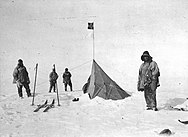
The History Listen. Perhaps some things should only be on video, not audio. Like this podcast, Inexpressible Island, which has beautiful descriptions of Antarctica, but I wish I could actually see what they’re describing. I only know Raymond Priestly from the Uni of Melbourne building that bears his name, but he was one of the Northern Party that was part of Robert Falcon Scott’s ill-fated Terra Nova Expedition (1910–1913). Scott and his team perished, of course, but the Northern Party had a pretty rough time too, unable to be relieved because pack ice prevented ships reaching them, and spending literally months in a dark ice cave. They had to walk for five weeks to arrive back at their ship.
History of Rome. Episode 171 The Gathering Storm. The Huns were not so much about sacking the empire, but as extorting indemnity payments. Why would you wreck a functioning economic structure??- you’re better off leaving it there and just threatening them. Theodosius II agreed to pay the go-away money. Meanwhile, in the West, Aetius was determined to hold on to Gaul, Hispania and Italy. He defeated Theodoric the Goth, then the Frank king Clodio. Over in the east,Theodosius II died after falling from a horse, and his sister Pulcheria stepped into the vacuum (just as she had when he was a kid). This time she was forced to find a husband, so she chose Marcian, who was so nondescript that he wouldn’t cramp her style. In fact, she crowned him.
Episode 172 Showdown. Valentinian III’s older sister Honoria was supposed to be married off to Herculanus who was dull and predicatable. She was neither of these things, and she appealed to Attila the Hun to come and rescue her – well, that’s the story, anyway- it may well have been a pretext. Either way Attila invaded Gaul, and when Clodio died, Aetius and Attila backed different sons in the Frankish succession. Attila seemed to be playing mindgames with all sides, and sowing discontent amongst the different sides so that they wouldn’t unite against him. In 451 he crossed the Rhine and marched as far as Orleans until the people locked them out. Theodoric the Goth finally agreed that the Goths would join Aetius and perhaps 150,00 Roman/Goths and Huns faced off at the Battle of the Catalaunian Plains. The Huns had to retreat, and the Goths went home to choose a new King. After licking their wounds, the Huns invaded again in 452 this time, heading for the Po Valley. They razed Aquileia (a major town) completely and Emperor Valentinian fled from Ravenna back to Rome.
Episode 173 The Broken Bow. Attila headed for Milan and sacked it. Valentinian sent envoys, including Bishop Leo of Rome to seek peace and amazingly enough, Attila agreed to withdraw! Why? Well, the Huns didn’t really want land and they had to take all their plundered gold home, their supply lines were stretched, and Attila’s troops were suffering from disease. He was getting ready to invade the East when he died. Then there were a succession of deaths: Valentinian killed Aetius himself (even though he was the most successful general Rome had), perhaps as an act of pre-emptive self defence, then Valentinian was assassinated. Between 450 and 455 those indomitable women Galla Placidia and Aelia Pulcheria died too. Petronius Maximus, who had plotted Aetius’ death became Emperor. By now, it is the end of imperial dynasties in the West- now it’s just a series of “Last Emperors”. And at this point, Mike Duncan announces that he’s going to finish at 475 AD because it’s a good spot to finish AND because his wife is having a baby! (Who is, by now 10 years old, given that I’m listening to this 10 years too late!)
The Philosopher’s Zone (ABC) I don’t very often listen to this program but I was interested in this episode Simone de Beauvoir: becoming a woman that unpacks Simone de Beauvoir’s statement in The Second Sex that “One is not born, but rather becomes, a woman” – a statement that has acquired new meaning in recent years in transgender debates. The episode features Toril Moi, James B. Duke Professor of Literature and Romance Studies and Professor of English, Philosophy and Theatre Studies at Duke University. She points out that de Beauvoir personally never felt that she had been discriminated against, and it was only when she went back to the archives that she realized the historical discrimination against ‘the second sex’. The sex/gender distinction was a product of 1960s anglophone countries, and not even thought of in 1949 when she wrote The Second Sex. However, she thinks that de Beauvoir would be comfortable with the thought that all roles are evolving all the time.
History Hit Now that I’m drawing close to the end of my History of Rome series, I’m happy to backtrack on Roman history, and this episode of The Ancients: The Origins of Rome goes way, way back to Romulus and Remus.Professor Guy Bradley from Cardiff University points out that all of the sources that we have on early Rome were written seven centuries after the events in 8BCE, and so the distinction between mythology and history was muddied. Romulus and Remus were supposed to have been born in Alba Longa, but no evidence of the city prior to Rome exists, although there is pre-1000 BCE evidence of settlement in Rome itself, including walls and remains of the 8BCE Temple of Vesta. It is almost impossible to separate out Roman archaeological artefacts from those of surrounding cultures, and there are logistic difficulties in digging under Roman ruins to find anything from earlier settlement.




 The Resident Judge of Port Phillip