
Good grief- what am I going to do with Jamie Oliver’s The Naked Chef as the starting book? I don’t even really like cook books much. The Six Degrees of Separation meme on the first Saturday of each month is hosted by Kate at Books Are My Favourite and Best, starting with the book that Kate has selected – in this case, The Naked Chef . You then associate it with six other books you have read, making the links between titles in any way you like.
But The Naked Chef? Perhaps all those years of Sunday School paid off because the only thing that I could think of was from the Bible. (Not a book that I’m in the habit of quoting).
For I was hungry and you gave Me something to eat, I was thirsty and you gave Me something to drink, I was a stranger and you took Me in, I was naked and you clothed Me, I was sick and you looked after Me, I was in prison and you visited Me.
Matthew 25: 35-36
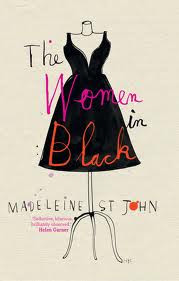
Okay- “naked and you clothed Me”. The Women in Black by Madeleine St John is set in the Ladies Cocktail Dress department of F.G. Goode in Sydney- a thinly disguised David Jones. The main character is Leslie, who has adopted the more sophisticated name ‘Lisa’, and she works as a young casual alongside the older permanent women as one of the “women in black”, changing from their street clothes into the black uniform of F. G. Goode before starting work. She just works the one Christmas/New Year period, then she moves on. I think that St John has captured the early 1960s well here: the wariness and yet curiosity about ‘New Australians’ who seem cultured and exotic with their strange food, coffee and wine; the stifling embarrassment about sexuality even among married couples, and the world of promise opening up with universities that is stretching the expectations of women for their lives. It is an intellectual coming-of-age book too, in a way, as Lisa finds herself feeling embarrassed about her home-made clothes and dipping her toes into adult social life. (My review here).
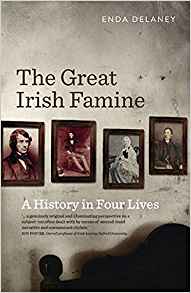
“I was hungry and you gave Me something to eat”. I’ve read several books about famine, but one that stays with me is Hungry: The Great Irish Famine. A History in Four Lives by Enda Delaney. The four lives that Enda Delaney has chosen, because of the limitation of the sources, are not the victims. Instead, they were at the other end of the famine. There is John MacHale, the Catholic Archbishop of Tuam, who at first saw the famine as God’s punishment on his flock for their sins. Over time, he became increasingly critical of the British Government response. There is the radical nationalist John Mitchel, a leading member of the Young Ireland and Irish Confederation “movements, who ended up in Van Diemen’s Land for his seditious activities. There is Charles Trevelyn, the assistant secretary to the Treasury, who has often been depicted as the Main Villain because of the policies implemented by the British Government. Finally, there is Elisabeth Smith, the Scottish-born wife of a Wicklow landlord, whose sympathies for the Irish peasantry became increasingly rigid. The power of this book is seeing these politics of ideology, and the politics of resistance being expressed in the words of individuals, and watching their positions harden as the crisis continued. If you’re looking for ‘getting to know’ these individuals at an emotional or moral level, this is not the book for you. The book does work, however, at the level of personalizing the political. (My review here)
“I was thirsty and you gave Me something to drink.” They were thirsty on the Western Australian goldfields, and C.Y. O’Connor’s ill-fated project was to bring water from Mundarring Dam to Kalgoorlie. Robert Drewe’s book, The Drowner fictionalizes this endeavour, with his main character William Dance employed as a water engineer on O’Connor’s scheme. I enjoyed the book, but found it very disjointed, and I wondered how someone who did not know about O’Connor would make sense of it. No review- it was before I started blogging.
“I was a stranger and you took Me in”. Well, there’s a stranger in Sarah Waters’ The Little Stranger, but I don’t think it’s the sort of stranger Jesus might have been thinking about. Instead, it’s a ghost. It is a gentle, slow tale told by the local doctor, Dr Faraday, who becomes enmeshed in the distress of the local gentry Ayres family, whose house harbours a ghost. Their home, Hundreds Hall is falling into disrepair with tangled gardens, vermin, leaking roofs and windows and the family- the vague, aristocratic Mrs Ayres, her son Roderick who has returned from the war with a leg injury and ‘nerves’, and the practical, plain daughter Caroline- cling futilely to a vanishing world of servants, farm labourers and estates. (My review here).
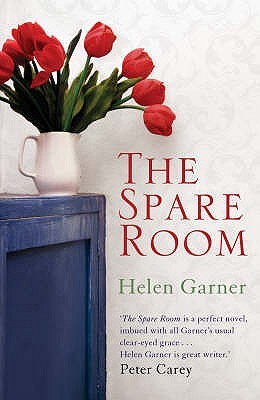
“I was sick and you looked after Me”. In Helen Garner’s brutally honest The Spare Room Helen offers to look after her friend Nicola who is coming to Melbourne to seek an alternative therapy for advanced cancer. Nicola’s death is not really the core of this story: instead the drama of the book is Helen’s rage and inadequacy in the face the demands of friendship, and her frustration at her friend’s relentless faith in a “cure” that Helen feels is quackery. (My review here).
“I was in prison and you visited Me”. Well, not visited but certainly wrote letters. The full title of this book is Just Send Me Word: A True Story of Love and Survival in the Gulag. In this book historian Orlando Figes brings his deep knowledge of Russian history and society to contextualize the archive of almost 1300 letters that were written between Lev Mischenko and his partner Svetlana Ivanova while he was imprisoned in the gulag, working in the wood-combine generator that powered the timber works in the frozen forests at Pechora Labour camp. But the real, real strength of this book is Lev and Sveta’s story, and the beautiful, nuanced, tender letters that they shared over this time. They met at university and went out together for three years. When war was declared, Lev rushed to enlist but was soon taken captive by the Germans. He was able to speak German, and as a prisoner-of-war, used his linguistic skills to translate camp orders. When the prisoner-of-war camp was liberated, he was arrested almost immediately and falsely accused as a ‘fascist collaborator’. The trial was a farce, he was tricked into a confession, and sentenced to ten years at Pechora. For the first few years, he struggled silently to survive in the cold and deprivation. It was only then that he dared to write to an aunt and asked, almost in passing, whether Svetlana and her family had survived the war. Svetlana, who had thought that he was missing in action, wrote immediately on learning that he was still alive. And so the correspondence began. My review here.
Well- I’ve travelled quite a distance from Jamie Oliver. Who would have thought?
 The Resident Judge of Port Phillip