Yearly Archives: 2018

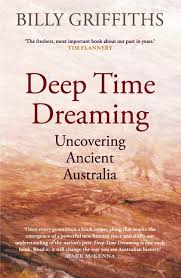
‘Deep Time Dreaming: Uncovering Ancient Australia’ by Billy Griffiths

griffiths_deep_time_dreaming

2018, 296 p. & notes

For me, one of the signs of having read a really good history is that on finishing reading, suddenly the themes explored in the book seem to pop up everywhere. This is the way I felt after finishing Billy Griffiths’ Deep Time Dreaming. I pricked up my ears at the the news of the nomination of the Barrup Peninsula for world heritage listing, and it seems that I’ve had several little prods over the last couple of days that have brought Deep Time Dreaming to mind. It imbues the Uluru Statement from the Heart with new meaning.

The book has attracted a lot of attention from historians I admire, but it wasn’t at all what I thought it was going to be. I expected an archaeologist’s account of pre-settlement Australia, but  Griffiths is not indigenous, nor is he an archaeologist but a historian writing about archaeologists.  I wondered a little at his choice of title, but it was quite intentional and double-barrelled:

The Dreaming describes a varied, contoured and continually transforming tradition. But here I draw upon the word’s more common, vernacular meaning: the archaeologists in this book imaginatively inhabit the deep past; they dream of deep time. The Australian public, with their seemingly insatiable thirst for old sites, are also deep time dreamers….The revelation at the heart of Australian archaeology, as this book demonstrates, is that Indigenous history is ancient, various and ever-changing. (p. 8-9)

This book is not a history of Australia, but is instead a history of the archaeology discipline as practised in Australia, written from an outsider’s perspective, “from the fringes, steeped in the neighbouring discipline of history”.(p.4)  Moving chronologically, each chapter is devoted to a particular archaeologist (Mulvaney, Bowler, Rhys Jones), or an archaeological dig that moved out of academe into the wider politics of Australia (e.g. the Franklin River, Lake Mungo). The book documents the recognition of an ever increasing span of indigenous habitation in Australia, from 5000 years to 40,000 and now pushing 60,000. It reflects the interest in ‘deep time’, and the question of human activity in a starkly changing climate.

In Australia, over the past sixty years, we have had our own time revolution. The human history of Australia is now understood to have spanned three geological epochs: the Pleistocene, the vast period of recurring glaciations in which Homo Sapiens evolved in Africa and began to spread around the world; the Holocene, the most recent interglacial or warm period that began some 11,700 years ago; and the proposed ‘Anthropocene’, beginning around 1800, marking the era in which human activity became the dominant influence on climate and the environment. When people discovered geological time, they were themselves becoming a geological force. (p. 5)

His survey approach, moving across the work of multiple archaeologists and sites, throws up several themes.  First, it illustrates the change from the ‘cowboy-dig-it-up’ method, where archaeologists scooped up the surface to extract and spirit away the largest artefacts, to new recording and dating methods including stratigraphy, carbon and luminescence dating, and integration with written and oral history sources.  Some of these methods came from the increasing academic training, most particularly from Cambridge, which in turn influenced Australian universities when they began offering courses in archaeology.  Other methodologies emerged from the disposition and values of individual archaeologists, most particularly female archaeologists, who are well-represented in this book.  Some of the archaeologists are Australian-born, while others are from Britain and America, signposting the increasing importance of Australian sites as part of the world-wide question of early man’s mobility and settlement patterns.

Second, the book highlights the way that archaeology fed into wider political debates. Rhys Jones, for example, felt the backlash from the resurgent Tasmanian Aboriginal Community for his involvement in the film The Last Tasmanian, and from other archaeologists over his claim that Tasmanian isolation led to cultural degeneration.  In the political arena, the discovery of archaeological remains was fundamental to saving the Franklin River from being dammed, and in the declaration of Kakadu National Park.

Third, and most importantly, the book documents the increasing recognition of Australia’s first people as a living culture, that has given indigenous people a claim on archaeology, challenging the authority and proprietorship of the profession.  Some archaeologists became gradually aware of a stiffening of attitude, others  learned the hard way, as they were excluded from further excavation for years. In this regard, I’m surprised that there is no little representation of indigenous people as archaeologists in their own right in this book, even though it is often mentioned that they are working as archaeology students themselves, or alongside European Australian archaeologists. The indigenous voice ‘informs’, but it is not considered in the same professional frame. What is unmistakable is that the era of the white academic archaeologist sweeping in, digging up, and moving on is over.

This is a beautifully written book. Each chapter starts with an engaging anecdote, making you feel as if you’re starting with a clean slate each time, although the connections soon become apparent.  The narrative is broken up with three ‘interludes’ that place archaeology within the broader political and professional context. At heart, his argument is that archaeology is a human endeavour, and this humanity shines through. It’s an excellent and important book.

My rating: 10?/10

Sourced from: Yarra Plenty Regional Library.
 

Movie: Ferrante Fever

This is showing at the moment in Melbourne as part of the Italian Film Festival. It is a documentary about the Elena Ferrante phenomenon, exploring the universal popularity of her books and contextualizing the Neapolitan novels amongst Ferrante’s other works. It doesn’t necessarily dwell on who the author is, but instead considers the effect of having an invisible and unknown author, both on readers and the book marketing industry.  The documentary features several well-known talking heads, most particularly Elizabeth Strout and Jonathan Franzen for Western readers and translator Ann Goldstein, intercut with animations and small film clips. It has subtitles.

I also saw Nonnas on the Run, one of two ‘Nonna’ films being shown as part of the Italian Film Festival. It’s a bit of a romp with two ladies-of-a-certain-age breaking out of their aged-care hostel. It teeters on the edge of laughter and a stab of sorrow, which is a good thing.

Infanticide: an interesting article

There’s an interesting article on the Australian Policy and History website today. It’s called “‘How is this not murder?’ Infanticide and the Law in Australian History”, written by Caroline Ingram.

I hear with my little ear: 24 Sept- 30 Sept

News in Slow Spanish Latino #275 and #276. Episode #275 had a fascinating section about why written Spanish uses punctuation marks at the beginning as well as the end of a sentence. Apparently in the 18th century the Royal Academy, which guards the purity of the Spanish language, decreed that long sentences should have ? and ! at the beginning and end so that someone reading it out loud would know what the intonation should be. The definition of a long/short sentence was vague, so they changed the rule so that the punctuation appeared on all sentences. ¡Up until 2014 an exclamation mark was known as a ‘sign of admiration’ which wasn’t always true, so they changed it to ‘sign of exclamation’!

The Thread Series 1. It might be story-telling but it sure ain’t history. As a historian, I feel a bit embarrassed admitting that I listened to The Thread first series because its approach to causality is very suss and some of the claims made had me snorting with derision. It’s better to think of it as a ‘Six Degrees of Separation’, as it moved from the shooting of John Lennon to Vladimir Lenin. On the way, it passed J.D.Salinger, Eugene O’Neill, Oona O’Neill and Louise Bryant and her husband John Reed (as seen as in the 1981 film ‘Reds’). The individual biographies were interesting, but the “if only…” history behind it is a bit of a stretch.

Rear Vision. (ABC) On the tenth anniversary of the GFC, this Rear Vision episode The legacy of the Global Financial Crisis gives a really good overview.

Russia if you’re listening (ABC). The series has officially finished, but Matt Bevan issues ‘Trumpdates’ if anything interesting comes along. And, with Donald Trump, something usually does. They are shorter episodes, generally featuring Matt Bevan discussing events with a (usually Australian) commentator  This time: Will Rosenstein lose his job?

Movie: RBG

With the State Judiciary Committee hearing into Brett Kavanaugh’s nomination, it seemed  particularly apposite to go to see RBG (Ruth Bader Ginsberg) in its last days.  An intelligent lawyer (and strikingly beautiful as a young woman) she worked quietly in the courts, steadily building up cases that showed that everyone loses by discrimination – women in particular.  Nothing came easily to her: the quotas of female students at university (5 male students to every female student), her difficulty in getting a job even though she was an outstanding student because she was a woman – there’s no entitlement here. The documentary does touch on her inappropriate comments about Trump’s nomination, and the question of whether she should have resigned while Obama was still in power. Who knows? Look at the Republican stonewalling over Merrick Garland. But with the prospect of two men on the Supreme Court with sexual assault or harassment allegations, to say nothing of the President, I’m glad she’s there.

Update: Serenading Adela

The best-laid plans of mice and men….

The full length version of Serenading Adela will not be shown after all, because of technical difficulties. They’ll still be showing the other short film, and the cut-down version of Serenading Adela that had already been released online.…and there will still  be cake.

Serenading Adela: The Film Launch

adela

Update: The full-length film of the performance will not be available for the event. They will still show ‘Against the Odds’ and the shorter version of the film already released online.

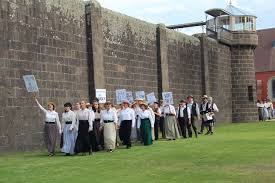
You might remember that earlier this year I was involved in the ‘Serenading Adela’ project. It commemorated the night, one hundred years earlier, when women marched up Sydney Rd to Pentridge Prison to ‘serenade’ Adela Pankhurst, who was incarcerated there under the War Precautions Act.  They made a film of our performance, and they’re launching it tomorrow Friday 28th September at the Brunswick Scout Hall, 213a Weston St Brunswick at 2.30 p.m.  As well as the film of the performance, there will be a short feature ”Against the Odds: The Victory over Conscription in World War I’

Surely that’s better than watching two footy teams that we don’t care about – indeed, may even actively dislike- marching in the city!

See the Facebook event at

https://www.facebook.com/events/299952080796125/?active_tab=about

Or if you’re boycotting Facebook, here’s the blurb:

Did you love “Serenading Adela, A Street Opera” and want to watch it again? Or were you one of the many who were too late for tickets?

Please join us to launch our new full-length archival video of the Centenary Performance of Serenading Adela, a Street Opera. It’s being edited from footage of four cameras there on the day, by Jeannie Marsh and Bernard Peasley.

In the best matinee tradition, we’ll show a short first: ‘Against the Odds: The Victory over Conscription in World War I’ tells how diverse groups and individuals collectively defeated conscription and left a lasting legacy for Australia. From the Living Peace Museum, with a Brunswick focus.

We’ll be serving a delicious afternoon tea to follow the film.

FREE ENTRY but donations towards film costs and future projects will be enthusiastically solicited.

The Scout Hall is 213A Weston Street Brunswick. Note as this is the Grand Final Public Holiday, crossing the city by tram may be a challenge – a train to Parliament, then the 96 tram to Miller Street, recommended (or check PTV for updates).

I Hear with my Little Ear: podcasts 16/9/18 -23/9/18

In Our Time (BBC). At least Melvyn Bragg has stopped coughing. Making Montesquieu exciting is a big ask, but the two Richards and a Rachel did a fairly good job.  Even though he died in 1755, Montesquieu’s ideas about liberty and constitutions affected the compilation of the American constitution and provided an intellectual basis for Robespierre during the French revolution.

I Have to Ask (Slate). I’ve been reading Ta-Nehisi Coates recently, and this podcast suggested that it would be about his book ‘We Were Eight Years In Power’. It’s rather rambly, and there’s not really that much about the book as such. A bit disappointing.

Conversations (ABC) I always enjoyed listening to Bea Campbell (Communist, feminist, writer on Princess Diana) on Philip Adams’ Late Night Live, and in this episode she is interviewed by Sarah Kanowski.  Oh- it’s a repeat! Oh well.  Then there’s the interview with Tim Minchin, who has featured on this blog before here and here.  And finally, an interview with Gwynne Dyer, a journalist whose work I’ve enjoyed. Here he is not as pessimistic about democracy as one might have thought he would be.

Revolutions Podcast  Old Porfirio Diaz just kept on keeping on, until he said that he wouldn’t. Episode 9.05 The Creelman Interview.

News in Slow Spanish (Latino) Episode 273 had a fascinating segment on Blanca Luz Brum, who I’ve decided to talk about (in Spanish) at my Spanish class. The only problem is that everything on the internet is also in Spanish (hello Google Translate). Episode 274 had segments on NAFTA and the new figures for fatalities in Puerto Rico after Hurricane Maria, and the protests about labelling the drink mezcal.

Movie: The Breaker Upperers

I suspect that this is a bit of a love-it-or-hate-it movie, and I’m afraid that I lean more towards the latter.   Two best friends work together to organize an ‘out’ for people who want to break up a relationship, by deception, confrontation or other devious means. It was too loud and in your face for my liking. It’s a New Zealand film, with layers of Maori-Pakeha relations, and an exploration of female friendship. I did laugh in places, but it didn’t have the quirkiness of ‘Hunt for the Wilderpeople’.

My rating: 2.5

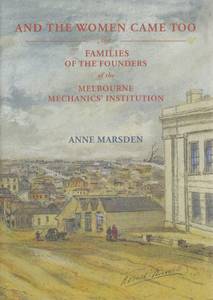
“And the Women Came Too: the Families of the Founders of the Melbourne Mechanics’ Institution” by Anne Marsden

marsden

2018, 187p.

This book is one of a pair, the author having released The Making of the Melbourne Mechanics’ Institution some two years ago. In that earlier book, Anne Marsden looked at the men who were elected to the committee of what later became (and still is) the Melbourne Athenaeum. The Melbourne Mechanics’ Institution (established 1840) was one of the very early cultural and educational institutions in Melbourne. Through her enquiry into the men who were movers and shakers in pre-Gold Rush society, we see the networks and practices that supported nineteenth-century masculine respectability in a new colony.

It’s not hard to find many of the most prominent of these men in the newspapers, churches and business world of Port Phillip: indeed, many of them are interlaced through the pages of this blog that relate to Port Phillip.  Ah- but the women and families of these men! There‘s another degree of difficulty altogether.  In a very few cases there are diaries and letters, as in Georgiana McCrae’s family, but much of Marsden’s information has had to be gleaned from snippets of information. There are brief allusions to the women in the biographies of their husbands and sons, or tangential mentions in newspaper articles and personal notices. Marsden’s challenge has been to integrate these biographies of the families of the founders of the Melbourne Mechanics’ Institution into a perspective on the lives of women and children in Port Phillip. It’s a task long overdue.

The book is divided into two parts. Part I, ‘The Challenges faced by immigrant women’ looks at early Port Phillip from the perspective of women, who were expected to operate within the domestic sphere, support without question her husband’s career aspirations and performance, and most of all, have children. Many of these women had travelled to Port Phillip either from Sydney or Van Diemen’s Land, or had emigrated with their husbands or families.

The book takes a little while to get going with an introduction, a second introduction,  and a prologue addressed in the second person to Barbara Dalrymple, who will marry Dr Alexander Thomson and arrive in Port Phillip in 1836, the first of the women of the Melbourne Mechanics’ Institution.  Introductions over, the text starts off with leaving home and follows the women on the journey, generally cabin class rather than steerage. There is a short chapter about Port Phillip’s brief European history ‘The Settlement’s Early Months’ to set the scene, then she moves onto the ‘Growth of Early Melbourne’. This is in two parts:  (i) the administrative and physical environment, and (ii) the people and community. The final chapter of this section is titled ‘The Early Melbourne Community: divisions and diversions’.  Each chapter is headed with a quote from either Finn’s Chronicles of Early Melbourne, a letter, or a contemporary newspaper.

This section does tend to be rather ‘bitty’. Marsden has used subheadings liberally, and while it makes information easy to locate, it does interrupt the flow of the narrative.  The chapter headings, complete with numbering (i) and (ii) and numerous subheadings give the sense that you are reading from notes, rather than an integrated text. Nor are the separate chapters conceptually distinct from each other.  ‘Community amenities and pleasures’ could fit equally suitably in the ‘Growth’ chapter (where she has, indeed placed it) or the ‘Early Melbourne Community’ chapter.   Nonetheless, there is a life-cycle logic to the information that she has selected, with its focus on finding housing and making it bearable, health and the bearing of children, and educating children – thus bringing to the fore the issues that Port Phillip women had to negotiate.

In the second part of the book ‘The Women’s Stories’, Anne Marsden looks at individual women whose husbands were influential in establishing the Melbourne Mechanics’ Institution. She starts chronologically, with Martha Lonsdale, who accompanied her husband Capt Lonsdale down from Sydney to be the first police magistrate in Melbourne, the earliest form of administration from Sydney. Her second chapter involves Sophie La Trobe, the French-born wife of Port Phillip’s first superintendent. Much of the information (and scuttlebutt) about Sophie La Trobe comes from the (compromised) but very useful journals of Georgiana McCrae, who is dealt with in the third chapter. Familial relations are also important in her chapter ‘A tale of two sisters’ which covers Henrietta Yaldwyn and Caroline Simpson/Braim.  The fifth chapter ‘The minister’s wife’ involves Margaret Clow, whose husband the Rev James Clow arrived in 1839. Mamie Graham, ‘The merchant’s wife’, also had a connection with the McCrae family, thus highlighting the familial as well as professional networks within this small community. She married James Graham, whose extensive archives of correspondence give us  an insight into the family’s domestic life. This is followed by another chapter about sisters – or at least sisters-in-law, Caroline Wright and Elizabeth Kirby, who married brothers David and Donald McArthur. Their husband’s (and thus their own) fortunes varied, with David becoming a highly-prominent banker, while Donald’s  career as a surveyor faltered. So too did the marriage, and Elizabeth McArthur became a well-known and respectable school proprietor.  The final two stories are of more shadowy relationships: Celia Reibey (daughter of Mary Reibey who featured on the $20 note) who died soon after marrying Thomas Wills, then his two partners Mary Ann Barry and Mary Anne Mellard.  Four ‘more elusive women’ complete the analysis: Mary Anne Peers, Mary Wintle (the jailer’s wife), Elizabeth Beaver and Hester Hurlstone. These brief biographies highlight the difficulties of finding sources and reading between the lines of the public record. The final chapter ‘Out of the shadows and into the half-light’ serves largely as a summary of the book.

Marsden has been very faithful to her sources. While speculating and assuming in places where the documentary record falls silent, she has tethered her analysis of early Port Phillip society to the lives and experiences of these women. While I respect her fidelity to primary sources, I wish that she’d roamed a little further into the secondary literature. She cites Penny Russell’s Savage or Civilized, but I think that she could have used Russell’s analysis of ‘manners’ more fully and explored the meaning of ‘the visit’ and the nature and implication of chain migration in family clusters. As a British colonial outpost, Port Phillip did not differ greatly from other such port towns, and she could have drawn on Kirsten Mckenzie’s work, and sources from Upper Canada that also explore the women’s world, with its own stringent expectations, that existed underneath the more publicly-documented world of their husbands.  In addition, by tethering her analysis of Port Phillip in Part I to the experience of these particular women, there is also a fair bit of repetition when the same details are retold in Part II. The final chapter summarized the preceding text, but did not prod the reader into new questions.

Notwithstanding, Anne Marsden’s book is a testament to her patient digging as a historian and her recognition that all these ‘mover and shaker’ men starting up new enterprises and institutions in an infant colonial town, had women behind them. It reminds you that Port Phillip was a town for women and children as well as for the ambitious new arrivals, and that even though it might not be readily visible in the public record,  the domestic always underpins the civic.

Sourced from: Melbourne Athenaeum Library. $20.00 – well worth it.

AWW-2018-badge-rose-199x300

I have posted this review to the Australian Women Writers Challenge Database.