
Monthly Archives: October 2014

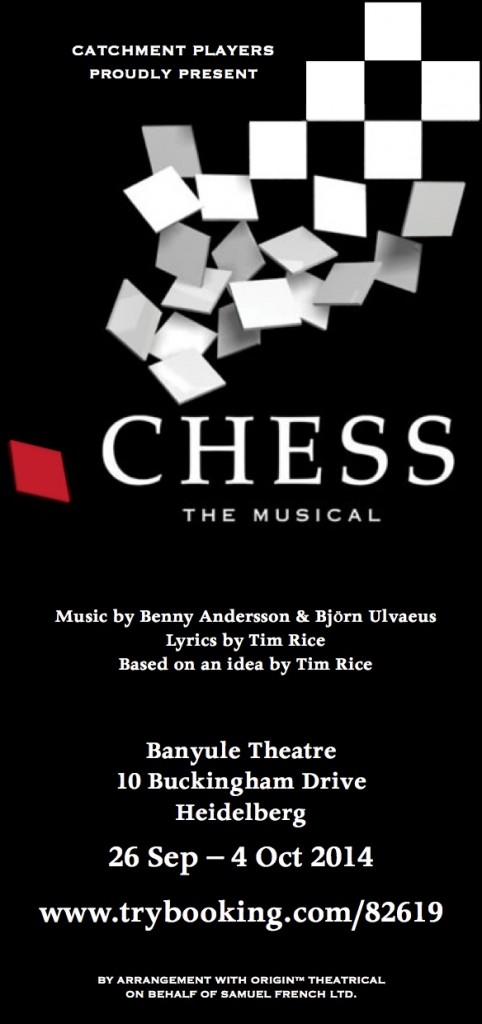
‘Chess’ by Catchment Players

Chess-Flyer03-1-482x1024

On any Saturday night you could go into the city to see Les Mis or Once or some other musical.  You’d see clever staging and very talented artists. You’d have to book well ahead, and you may have to pay well or you may end up in the gods which is where I often find myself sitting.  Increasingly the show will be one of the franchised, highly commercial ‘biggies’ doing the international circuits and you’ll probably find yourself saying “What? It’s coming back already?” or wondering why anything that succeeds on film inevitably ends up on the stage, or vice versa.

Or, you could go to your local community theatre on a Saturday night.  You’ll see talented artists, doing what they love, for the people who love them, and you’ll be proud and grateful that there are enough people like you to support our shared human love of singing and dance and performance.  And, in my case, I wish that I’d seen this earlier in the season so that I wasn’t blogging about the final performance.

Chess is loosely based on the Bobby Fisher/ Boris Spassky tournament of the Cold War era and the rivalry of Soviet grandmasters Viktor Korchnoi and Anatoly Karpov.  The lyrics are by Tim Rice (of Jesus Christ Superstar fame) and Benny and Bjorn from ABBA wrote the music.  It’s complex music: lots of words, lots of harmonies.   It’s an ambitious choice for a local theatre company.  The music is non-stop,  there are no set changes and there is very little dialogue.  The ensemble is on stage for much of the performance, and it’s very full on.

When you flip through the biographies in the program, you realize that the cast  have many connections.  Many have performed with other amateur theatre companies, several have undertaken tertiary studies in performance and musical theatre; others have connections with groups like the Production Company or have performed in television roles.

For me, the standout performers were Rosa McCarty (who played Florence) and Dennis Clements, who played Alexander Molokov.  Their diction was good; Rosa McCarty had beautiful, nuanced control over the softer songs, and Dennis Clements had good stage presence.  I had my eye on Courtney Crisfield in the ensemble, too. The whole cast worked hard, without a single flat spot. The chessboard scenes were tautly staged and impressive to watch although at times I felt as if the performers seemed rather more comfortable with singing than dancing.

Unfortunately the performance was poorly served by the design of the theatre itself. There was a live orchestra, but because it was located in a separate room off-stage, it was reliant on a sound system that thinned out the sound. There were some odd crackles and at times the singing sounded a bit shouty and overwhelming, making it hard to distinguish the competing lyrics.

This was an energetic and intelligent performance of a demanding work.  There’s a real intimacy in a small theatre, where the performance is on the same level as the front seats and where the performers are right there.  And as for the last note, a note that had so much riding on it- Rosa McCarty just soared, confidently-  brilliant!

Well done.
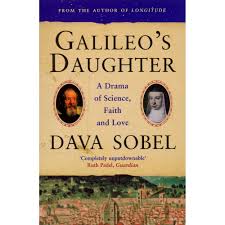


‘Galileo’s Daughter’ by Dava Sobel

galileos daughter

1999,  432 p.

The whole way through reading this book, I was thinking how much my husband (who had read it before I did) must have loathed it.  A man of scientific inclination, given to dot-points and resistant to ‘dumbing down’,  he grumbles when a plot line in a crime show or a documentary becomes clogged up with relationship-type stuff.  This book offends on both counts. Although titled Galileo’s Daughter, it is actually about Galileo and his discoveries and theories in astronomy,  explained simply for the non-scientists among us, and framed through the letters that his daughter wrote to Galileo.

Galileo had three illegitimate children through the same woman.  He was able to ‘buy’ legitimacy for his son, but to circumvent the disadvantages that illegitimacy and lack of dowry would confer on his two daughters, he placed them in a convent.  If you’ve read Mary Raven’s Virgins of Venice, you ‘ll know that convents were used as a way of solving the  dynastic problems of the Venetian (and other Italian state) noble families.  If a girl could not be married successfully and strategically, then a convent provided a means of providing for her, and in a deeply religious society, bolster the family’s heavenly credit through her lifetime of intercession on their behalf.   Convents  were not necessarily stark, isolated experiences.  They were often filled with educated, noble women who maintained an interest and knowledge of her family’s outside activities, albeit from behind a grille.

Galileo placed both his daughters with the Poor Clares in the Convent of San Matteo in Arcetri, Florence.  His eldest daughter, Virginia, took the name Suor Maria Celeste, while the younger daughter became Suor Arcangela.  The book reveals the letters that Suor Maria Celeste wrote to her father, translated by Sobel herself, interwoven with a narrative of Galileo’s development of his astronomical theories and the resultant conflict with the Inquisition.

Here is the historian’s lot writ large: a cache of letters from one party only.  However, continuous archives like this, where the letters were frequent- and these ones certainly were- allow for reconstruction of the missing side of the correspondence.  I was struck by the waste of this lively intelligence.  Although Suor Maria Celeste’s writing is larded with expressions of deference and spirituality that don’t sit comfortably with us today, she was well aware of her father’s work and made good copies of his correspondence.  She assisted him in more quotidian ways too: making repairs to his clothes, cooking jams etc. and making solicitous inquiries about his health.  Certainly this convent was more straitened than those described in Virgins of Venice, with the nuns often going hungry and poorly served by the priests who ‘ministered’ to them.

Although the story of Galileo’s clash with the Inquisition is well-known, Sobel argues that he was, and remained, a deeply religious man.  But she also reveals the rather duplicitous manoeuvres that Galileo made to appear to conform, while ensuring at the same time that his controversial theories, so blasphemous in the eyes of the Church, reached beyond the Inquisition’s grasp.  She creates a nuanced overview of theology, and Galileo’s challenge to it, and a clear (if rather simplified) explanation of his theories.

I must confess that I preferred the letters to the science in the book, and felt tempted at times to skip over those sections.  But I did feel genuinely saddened by the short and constrained life that this intelligent woman lived.  I enjoyed the book, even if my husband didn’t.

My rating: 8

Read because: It was a bookgroup (Ladies Who Say Oooh) selection.