Monthly Archives: May 2010

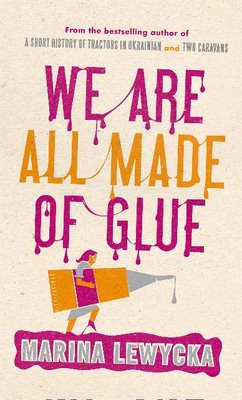
‘We are all made of glue’ by Marina Lewycka

2009, over 400 pages but large print.

As I may have mentioned, like nearly every 50 plus, middle class suburban woman, I belong to a book club.  I’m very fond of my Ladies Who Say Ooooh.  That’s my daughter’s name for  the group after listening to us chortling and “oooohing” when the meeting was held at my place once.  We have good discussions.  Although we might go off-topic occasionally, we always answer the questions in the booklet that comes with the book , which yields us a satisfying conversation of  well over an hour.   I always read the book, or re-read it if I’ve read it before and I’ve never once abandoned a book club book. But with this book, I was sure tempted.

We had read A Short History of Tractors in Ukranian previously, and enjoyed it well enough, so I was happy to read this one too.   I couldn’t tell at first if it was a parody of bad writing- it was, after all supposed to be a comedy- but unfortunately, I don’t think that was the case.

I’m not even going to try to describe the plot.  Just a few words, then.   Marriage breakup; sonky teenaged son; batty old lady; the Holocaust; a mystery;  tangled identities; Israel; nefarious real estate agents; old people’s homes; Palestine; apocalypses; cat poo.  Holding all this together is the metaphor of glue, and if you don’t get the metaphor, I’ll tell it to you again because Lewycka sure did.  Glue.

There are just too many threads in this story and the book cries out for a good edit.  It’s touted as “black humour”- are you supposed to laugh at black humour?  Or is it slapstick?- certainly not a genre I’m fond of.  I kept reading, expecting that at some stage it might all come together and that I’d be overwhelmed by how cleverly the author had disguised her intentions behind this implausible, overburdened storyline.  By page 350 I had resigned myself to the likelihood that it just wasn’t going to happen.

When, at the end of the discussion we awarded our notional stars out of five, I gloomily intoned “ONE”.  The others, to be fair, stretched to three, and one Lady even gave it four.  “You don’t HAVE to finish it, you know, Janine” they said.  Ah, but I do!  It’s a book club book!

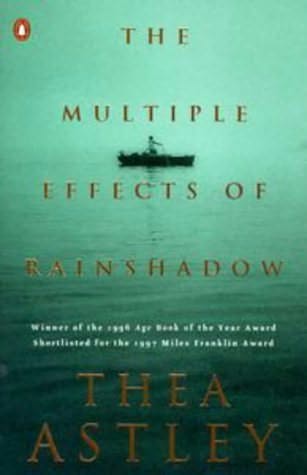
‘The Multiple Effects of Rainshadow’ by Thea Astley

1996, 296p

Thea Astley’s book was written fifteen years ago about an event that happened in the 1930s but this historical fiction has turned out to be tragically prescient.

It begins with the cyclone that annihilated the Aboriginal settlement Mission Beach and led to the establishment of a new mission on Palm Island and it ends with the 1957 strike of the Palm Island men against the menial tasks they were expected to do- an industrial action that was severely repressed.  And though Thea Astley didn’t know it, we could add another post script to her story with the Palm Island death of Mulrunji Doomadgee that Chloe Hooper has described so sensitively in her book The Tall Man.

The central action in the book is the massacre inflicted by the superintendent of the island, Robert Curry (known in the book as “Uncle Boss Brodie”) who, crazed by the death of his wife and suffering from neuralgia, torched his own house killing his children,  shot and wounded the Doctor and his wife (mistress in the book), set fire to the other houses and blew up the buildings on the reserve.  He was eventually shot by one of the Palm Islanders on the orders of one of the white officials.

At first I thought that the book was going to unfold as a series of Rashamon-like chapters, each telling of the killing from different perspectives.  The book started with an Aboriginal English telling of Palm Island’s history – a technique that non-Aboriginal writers might flinch from now.  Then the narrative voice shifts to Mrs Curthoys the hotel-keeper;  then Morrow the inept Works Manager;  and finally Brodie himself.  But then it jumps ahead some fifteen or so years and picks up on other characters who had been there on the island that night: the teacher, the Catholic priest, and even beyond them to the children of those witnesses who had not even been born at the time of the massacre.

Brodie dies; the Aboriginal boy who shot him is jailed but then released.  At one level it is over, but the witnesses and their children are drawn back to it like a web.  The jobs they take, the marriages they make, the choices their children make are all set wobbling onto a different trajectory by what happened on Palm Island in the 1930s.  On Palm Island, too, Brodie is replaced by other administrators who, like their predecessor, become crazed with their own authority and the tension builds again.

I had mis-read Astley’s metaphor of the rainshadow.  I had in my mind those billowing afternoon clouds of tropical Queensland that build like towers in the sky until the rain pours down, the skies clear overnight and then the whole cycle starts again the next day.  I thought that she was referring to the oppressive humidity, or the fury of rain.  It seemed apposite:  Palm Island’s recent history seems to have been a succession of crises that build, burst, abate then begin to build again.

But a rainshadow is a desert, not a jungle.  It’s the phenomenon by which rain falls on one side of a mountain range but it remains dry on the other side.  Now that I know this,  the rainshadow metaphor works well too.  There is a cataclysm; it occurs, then there is parched emptiness. There is a dessication about the people in this book: they move out from Palm Island onto the mainland where they live unhappy, meaningless lives.

The book ends in despair and hopelessness.  There’s no redemption here for anyone. Even less for the Palm Island that Chloe Hooper brought us some eighty years later.

Postscript

If you read the comments below, you’ll see that Whispering Gums and I both wonder if our reviews (her review is here) emphasize strongly enough that the book is fiction.  As I look at my posting, I think that’s a valid point.  The bookends that frame the book- the rampage and the strike- are both factual events, but she has fictionalized the characters.  Even Brodie/Curry (a factual character) has been filled out from the imagination, as he did not survive to give any account of his motivation.  So- look for Astley on the fiction shelves, not the non-fiction! and tease out a little more that eternal conundrum about history and fiction…

The newspaper reports of the day provide a sobering illustration of the imaginative space that Astley had to roam in- they are stark, skimpy reports that read as if they were coming from outer space or a distant, distant frontier .  From the National Library newspaper site, here’s an article about Palm Island that will make you cringe written prior to the event;  and here’s one about the rampage itself.  There’s others too- just search “Palm Island”, narrowing the dates to around 1930.

Uplifting Quotes for the Uninspired Historian #2

From my pin-up biographer, Richard Holmes in his book Footsteps: Adventures of a Romantic Biographer. He speaks about the biographer’s feeling of being haunted by their subject as being part of  the essential process of writing biography:

As far as I can tell, this process has two main elements, or closely entwined strands. The first is the gathering of factual materials, the assembling in chronological order of a man’s “journey” through the world- the actions, the words, the recorded thoughts, the places and faces through which he moved: the “life and letters”.  The second is the creation of a fictional or imaginary relationship between the biographer and his subject; not merely a “point of view” or an “interpretation”, but a continuous living dialogue between the two as they move over the same historical ground, the same trail of events.  There is between them a ceaseless discussion, a reviewing and questioning of motives and actions and consequences, a steady if subliminal exchange of attitudes, judgments and conclusions.  It is fictional, imaginary, because of course the subject cannot really, literally, talk back; but the biographer must come to act and think of his subject as if he can. (p.66)


Tony Judt

You may have caught Big Ideas on ABC Radio National on the weekend.  If not, head over and listen to the podcast.

It’s Tony Judt delivering the 2009  Remarque lecture “What is Living and What is Dead in Social Democracy?” and there’s an edited transcript here. The lecture was given in the context of the American debate about health care. He explores the frozen language of social democracy that is mired in debates of 70 years earlier and has been co-opted by politicians across the board now, leaving nothing new to say.  But, he says, social democrats need to lay claim to past successes that are being dismantled and challenged and to assert anew that a public sector, collective identity and common purposes  are things that are worth fighting for.

If you do listen to the podcast, you’ll hear that the delivery is stilted and strained- not easy listening.  Tony Judt was diagnosed with motor neurone disease in 2008 and this lecture was delivered from a wheelchair, assisted by a breathing machine.  That’s courage.

He wrote a brilliant piece called “Night” for the NYRB. Read it, and be grateful and humbled.

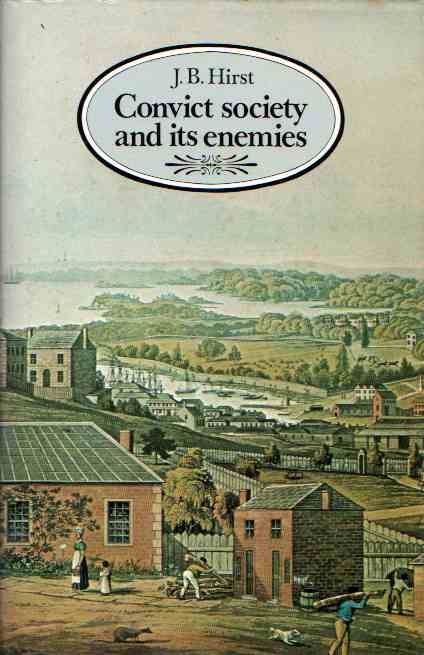
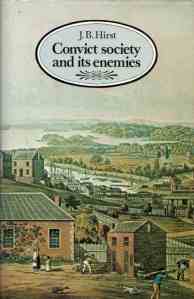
‘Convict Society and its Enemies’ by J.B Hirst

1983 , 217 p

This book has been recently re-released, along  with its companion volume The Strange Birth of Colonial Democracy as a new book called  Freedom on the Fatal Shore.  In the foreword to the new version, Hirst writes of his affront at the wealth of  publicity that Robert Hughes’ book The Fatal Shore attracted, compared with the muted attention that his own book had received.

The phrase ‘the fatal shore’, originally in a convict ballad, has been made famous at the title of Robert Hughes’ magnificent book on the convict system. The advance publicity for The Fatal Shore had no need to tell lies about it, but it made the claim that this was the first book seriously to examine the convict system in Australia.  I was ropeable.  Why was my book Convict Society and its Enemies, then four years old, being overlooked?   When this claim was repeated in a quality newspaper, I determined to write a letter-to-the-editor to correct this error and push my own claims.  My wife told me I should not think of doing such a thing until I had seen the Hughes book.  I am very pleased to have followed her advice  (p.vii)

Because in the introduction, Hughes acknowledges Hirst’s book upfront:

Colonial Australia… was a more ‘normal’ place than one might imagine from the folkloric picture of society governed by the lash and the triangle, composed of white slaves tyrannized by ruthless masters.  The book that best conveys this and has rightly become a landmark in recent studies of the system is J. B. Hirst’s Convict Society and its Enemies. (Hughes ‘The Fatal Shore’ ,1988, p.xiv)

Yet although Hughes agreed with many of Hirst’s arguments about the normality of the system, the overwhelming “takeaway” from Hughes’ book was that the Convict System was a cruel, dehumanizing, oppressive system.   Although Hughes admitted that the secondary punishment system he describes was not the norm, it is his depictions of  the lash and the triangle that a reader remembers.

Hirst argues instead that, right from the beginning- even at the planning stages of the First Fleet- there was an intention for something other than a harsh, punitive penal society.  Women and children were included on the First Fleet, complicating from the start the creation of a strict penal system;  convicts were encouraged to marry; there was an unfulfilled intention to pick up more women from the islands on the way (and what a what-if scenario that gives rise to!) .  The overall concern of the British authorities was that they not return to England; hence they were given grants of land and known as ‘settlers’ once their sentences had expired.  Because it was intended that they become part of a British capitalist economy, they had more legal rights than they could have had in England- the right to sue, the right to give witness in court- and there was no bar on their economic activities once freedom was attained.  The early food shortages amplified the imperative that an agricultural sector be developed as quickly as possible. When convicts were turned over to private landholders they were called ‘assigned servants’;  they refused to work all day and insisted on “own time” after their tasks were completed;  they often lived in huts separate from the owner’s house compared to the suffocating oversight of servant life in England; even flogging was controlled by law.

So who were the “enemies” in Hirst’s title?  The  “exclusives”  spring immediately to mind:  emigrants with capital who came to the colony and resented the wealth and social acceptance of the ex-convicts who surrounded them.

But Hirst complicates this simplistic explanation.

First there were the Benthamites back in England, whose own commercial proposals for the Panoptican-style penitentiary were thwarted by the settler-model penal scheme that underpinned the First Fleet.  They had a vested interest in promoting their own model, and had increasing influence from the 1820s on in making the system more uniform.

Then there were the liberals and humanitarians themselves (not necessarily the same thing), particularly in England, who decried the dehumanizing effect of convictism and its parallels with slavery.   Ironically, in their efforts to overturn transportation, they themselves had to demonize the system by highlighting its inequality, cruelty and degradation.  It was also a rather tenuous line to tread, because in many ways British labourers during the Industrial Revolution had more difficult lives than transported convicts in the colonies.

Third, by the turn of the century there was an increasing group of native-born white Australian who, unlike both exclusive emigrants and convicts, were born in the colony.  They were shaping up as a fine generation: good food and the beneficiaries of an emphasis on education that far outstripped that in Britain. They grouped together both emigrants and ex-convicts as British, not Australian like themselves.

It was the mooted re-introduction of transportation that galvanized these groups into action.   The supporters of transportation- the wealthy squatters with large pastoral properties- wanted to portray the benefits and normalcy of the convict system.  The opponents of transportation- many of whom were free emigrants who wanted to protect their high wages and respectability-  needed to  develop a narrative of convict society that highlighted its aberrant features and suppressed its successes.   They needed to distance themselves from the convict past.  In agitating against the revival of transportation, the blurred edges and compromises of the system had to be downplayed and convict society had to be framed as a de-humanizing system, steeped in cruelty and violence.   The irony is, Hirst argues, that even today our understanding of convict society is based on the assumptions of its enemies.

This is a punchy book.  Its footnotes are utilitarian: there is no alternative narrative being played out in the notes at the back of the book.  Its argument is made upfront, and pursued relentlessly throughout the body of the work.  From a structural sense, there are two fairly short opening chapters, then a long third chapter that examines convict society in terms of the economy, the law, rebellion, status and the politics of dependence.  The book closes with a short but succinct conclusion.

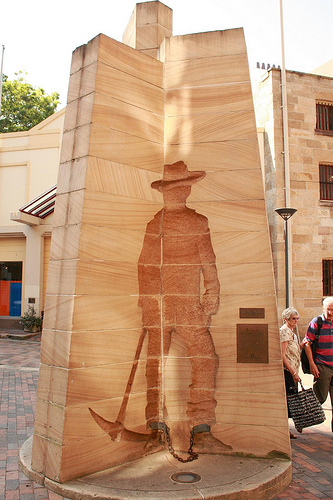
It’s also fairly pugnacious book, determined to convince, and it does not take a backward step at all.  This becomes rather strained in the section on flogging, which is written carefully but insistently.  It is unashamedly  a book of the head rather than the heart.   At times this can be rather exhausting, but in its sheer doggedness it raises some interesting questions.  For example, Hirst notes the convict sculpture at The Rocks in Sydney.
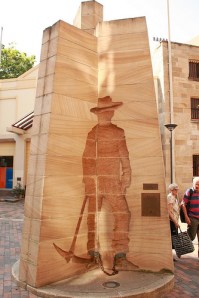
Hirst’s caption to the photograph is interesting:

A persistent symbol: ‘The Convict’ is put in chains though, as the plaque on this modern sculpture explains, only incorrigibles suffered this fate. (p. 214)

His decision to persevere with the illustration and to caption it in this way  makes me pause.  He has done the right thing in acknowledging the plaque on the sculpture, and thereby undercutting its usefulness to him as an argument. The plaque has done the right thing in pointing out its artistic licence in depicting the unusual. However,  I’m not sure whether the plaque was there from the start, whether it was itself part of the artist Bud Dumas’ creation, or whether it was added later perhaps even in response to Hirst’s criticism.

For as Hirst pointed out in his book, visually convicts and free labourers were indistinguishable from each other.  He cites an episode from Alexander Harris’ book The Emigrant Family where a magistrate rides up to make enquiries amongst a group of farm workers who have come onto the farm to collect their rations.  When rebellion breaks out and the magistrate is brought in to intervene, he calls for those who are prisoners to stand on one side and the free men on the other.  The magistrate could not tell, just by looking or by the men’s activities, who was bond and who was free.   Convicts were not chained; they dressed like free men, and collected the same rations.  Fencing and clearing stumps was work exclusively undertaken by free men although labouring with a hoe was performed almost exclusively by convicts because that was all that smallholders could afford to employ.  In all other categories of work- shepherding, shearing, ploughing, clerical work, school teaching- convicts and free men worked alongside each other. (p. 104)
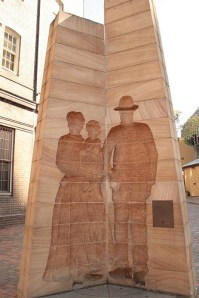
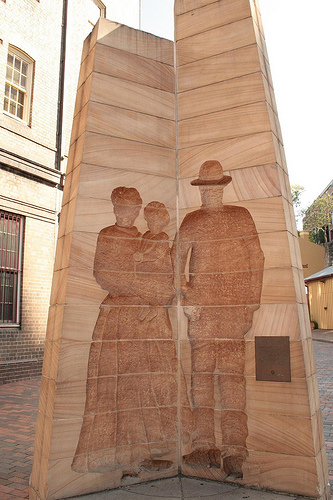
It is the chains that mark out the “Convict” from the man in the “Immigrant Family” sculpture above.  In this sculpture, the immigrant man stands with his family, but he was just as likely to wield a mattock in a sunhat when he was at work.   But when we take the chains away from the convict, what are we left with visually? Just men.  And that’s the conundrum.