Monthly Archives: July 2008

Farewell Judge Willis- July 1843

I seem to have missed the anniversary for Judge Willis’ departure from Port Phillip. After all, where else to start but at the end? It hasn’t just been inattention though: Behan (unreliable fellow that he is) dates the departure as the 18th July 1843 (Behan p. 285); The Patriot (13 July) dates his departure as that day; while the Gazette and Herald list the Glenbervie ‘clearing out’ on the 12th and ‘sailing’ on the 14th. I’m not really sure what the distinction is between the two terms: I assume that ‘clearing out’ involves moving from  moorings in Hobson’s Bay while perhaps ‘sailing’ denotes passing the Heads?

Nonetheless, it seems that on a wintry mid-July day, a crowd of people stood at the wharf, watching Judge Willis board the paddle steamer Vesta to be taken out to the barque Glenbervie anchored further out in the bay, headed for Valparaiso and home. I can assume that they left from Coles’ Wharf.

Coles Wharf was constructed between William and Queen Street by George Ward Cole (who later married into the McCrae family)in 1841 along the banks of the Yarra by building on sunken ships’ hulls (www.portaustralia.com/port-melb.htm) . At the time, the Yarra was bisected by falls roughly at the bottom of Queen Street. Above the Falls was fresh water- crucial to the small village, and below the Falls was saltwater. The maintenance of the falls to separate freshwater from saltwater was of vital importance initially, even though the presence of this chain of rocks across the river prevented ships from traveling further upstream. Much time and attention was to maintaining the Falls but by 1880 they were finally removed as part of river engineering works.
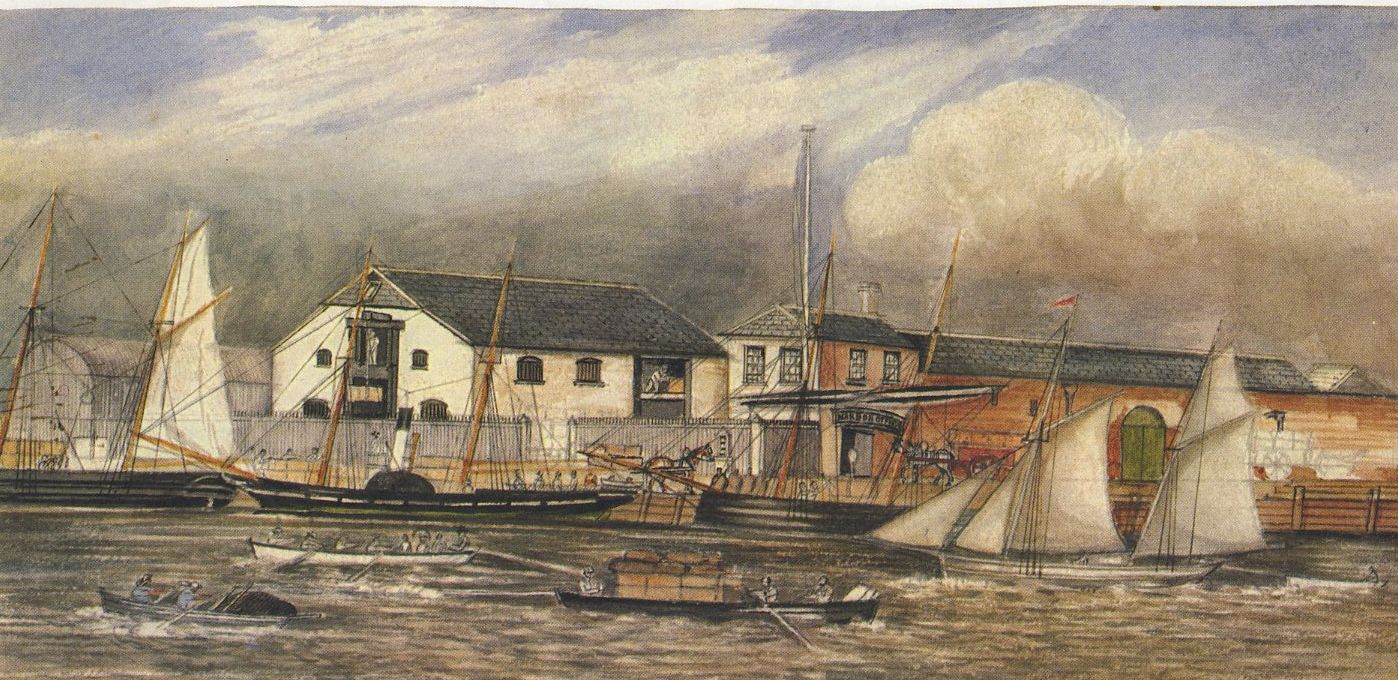
Here’s a description of Coles Wharf from The Times 22nd August 1853 that is perhaps a little less glowing than Liardet’s picture above.

There are two landing-places, and the steamers stop at the worst, called Cole’s Wharf. An enormous amount of traffic has certainly been thrown suddenly upon this spot; but, considering the revenue derived from it by the proprietors, something might have been done to redeem it from being, as it is, a disgrace and scandal to the city. Goods are tumbled on to the bank, and the drays back up to them to be loaded through pools of black mud, in which they stand nearly axle-deep. Boxes, cases, and bags (no matter what their contents) may roll into the slush, and stay there soaking till called for. Expensive as horseflesh is, half the power of the animals is wasted in getting out of these pits and the deep ruts of the roadway, which a few loads of stones would fill and level. There is no shed to protect goods liable to be damaged by rain. Reckless indifference to everything but collecting the enormously high freights up the river, and the still higher rate of carriage to the city, seems to be the rule. Combined, these charges have frequently amounted to more, for a distance of six or seven miles, than the freight of the goods from England. The other landing-place, the Queen’s Wharf, is a little higher up the river, and here the accommodation is much superior, a proof that improving is not so impossible as represented.

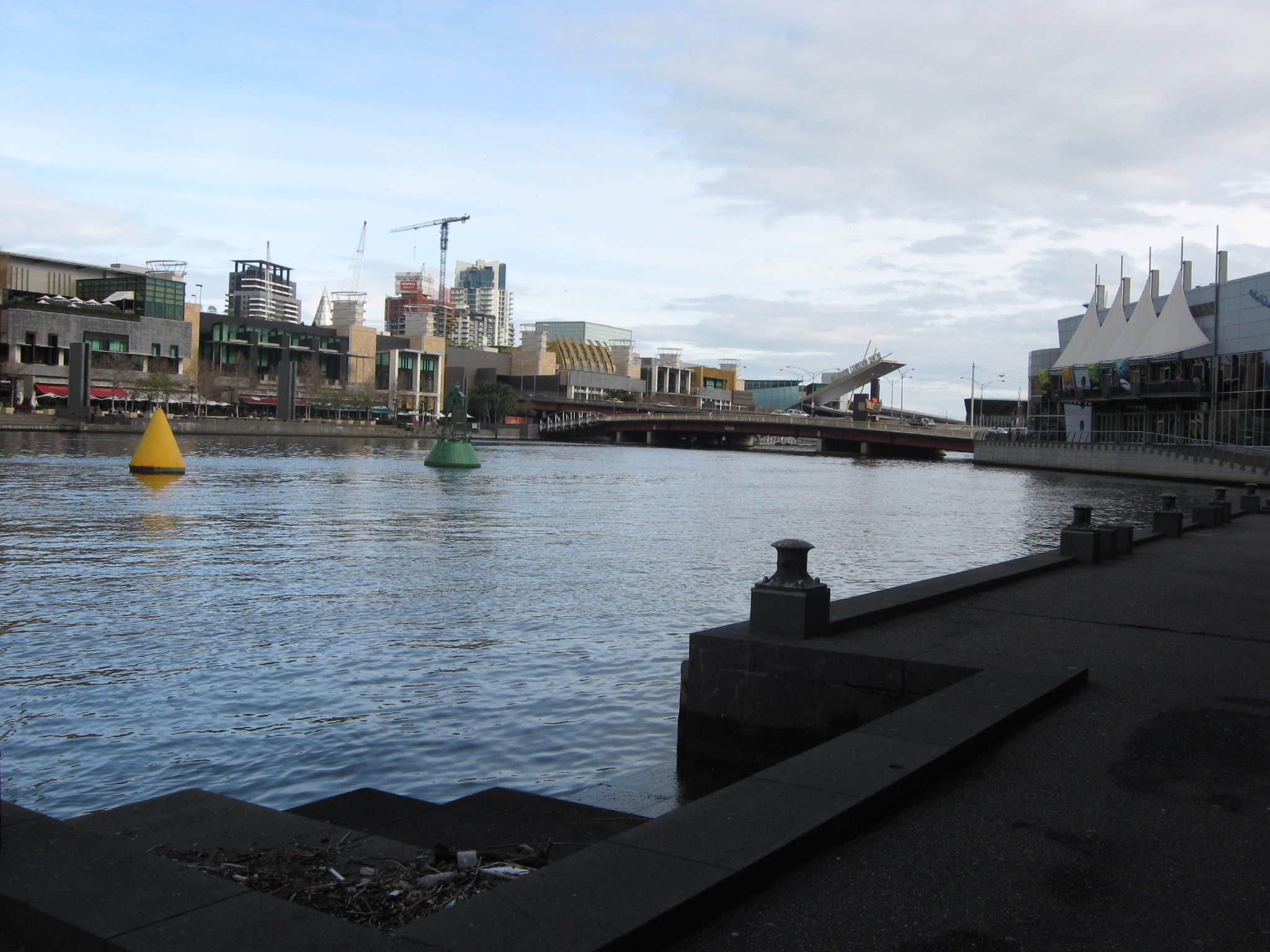
I stood where the wharf was today. It’s hard to picture it. The smell of chip oil is too strong as it wafts from Flinders Street Station and the roar of the traffic is a constant background noise. I’m sure that the air must have been saltier and tinged with wood smoke from the paddle steamer. Perhaps it sounded like Echuca, with the steam whistles, the shouts while loading and unloading goods and the sound of horses’ hooves in the streets behind. The sky would have seemed bigger with no high-rise towers, and the green of the bush would have crept up to the river banks in places, or formed a backdrop against the horizon. But today, like then, there is a stiff breeze that blows across from the water.
The Port Phillip Patriot (13 July) announced:

THE LATE RESIDENT JUDGE

His Honor Judge Willis embarks for England today by the Glenbervie, and will probably leave this port in the course of tomorrow. A large number of our fellow townsmen have signified their wish to accompany his Honor or board, and the Vesta steamer, has in consequence been engaged, to convey the numbers who are desirous of joining in this last tribute of respect before his Honor’s departure from our shore, whence he carries with him the esteem and veneration of nine-tenths of the whole community.

The steamer will leave the wharf at eleven o’clock; it will be necessary, therefore, to be in attendance punctually at that hour.

And a couple of days later, The Port Phillip Gazette (15th July) reported:

On Thursday last, at 12 o’clock, His Honor Mr Justice Willis took his departure from Melbourne, in the Vesta, steamer, which had been specially engaged for the purpose. About four hundred of the inhabitants were in attendance at the Wharf to bid His Honor farewell. Several gentlemen accompanied His Honor down the river, and saw him on board the Glenbervie. A general gloom seemed to prevail on the Vesta heaving her moorings with our late talented and injured judge on board.

Who were those gentlemen, I wonder? I can’t imagine that any of the men who had signed the petitions against him would have been in attendance. Probably those men who had supported him throughout- Verner and the Boldens, perhaps Rev Alexander Thomson from St James? Were there manly handshakes, throat-clearings and fine sentiments expressed?  Was there genuine pain, or did the bluster and bravado of injured feelings and outrage dominate?

Were their wives there, I wonder? Mrs Willis, who was to deliver her second child when the ship docked at Valpairaso- had she overcome the queasiness of morning sickness as the steamer throbbed towards the Glenbervie? What a tumultuous three weeks- their possessions were sold off in Heidelberg’s First Garage Sale, and they shifted into the Royal Hotel in Collins Street to make their final preparations. Did she have friends that she was leaving behind? When did they make their farewells? Like so much else of women’s experience in early Port Phillip, this is another male dominated performance. The women may have been there, but we just don’t know.

And what happened next, as the paddle steamer moved up along the river, out of sight with perhaps just a smudge of smoke to show that it had ever been there? Perhaps there was another round of cheers, but eventually the crowd would have to disperse, picking its way through the muddy Melbourne streets (Port Phillip Herald 18 July). And Judge Willis, his wife and child headed for home.

W.F.E Liardet and the documenting of history

You may wonder about the picture I’m using as my header at the moment. It’s a picture of Judge Willis and his legal officers entering the first Supreme Court building for the opening of the Supreme Court in Melbourne in April 1841. You may think that it’s a rather humble building, and you’d be right. It had previously been used as a government store, located on the corner of King and Bourke Streets. By the following year construction had commenced on a new Supreme Court building, on the site now occupied by the closed City Court Building on the corner of Russell and La Trobe streets. Although Judge Willis took a proprietorial interest in the “new” building, he had been dismissed by the time it opened.

This painting was one of a series produced by W.F.E. Liardet who himself is an interesting character.

Born in England, Wilbraham Frederick Evelyn Liardet had inherited a fortune of 30,000 pounds which he managed to fritter away- now, this is some frittering, because Judge Willis’ wage was 1500 pounds a year so we’re looking at 20-odd years worth of Judge’s wages. Once the fortune had been exhausted, he, his wife and nine children emigrated to Australia, with good contacts with Governor Bourke in his pocket and the intention to establish himself as a pastoralist. Wilbraham and his four older sons travelled steerage to save expense while his wife and younger children travelled intermediate class. On arrival and faced with the utter chaos of disembarking in Hobson’s Bay, he recognized the entrepreneurial opportunity to establish a ferry service to the ships in the bay, connected to a carriage route along the lagoon to the banks of the Yarra in Melbourne- a transport monopoly at the time as until then people had had to row the eight and a half miles upstream. He established a hotel on the Port Melbourne beach, started up a mail run and became a noted Melbourne personality.

However, he never actually obtained land title for his beachfront hotel, he lost the mail contract and by 1845- along with many other people in Port Phillip at the time- was declared bankrupt. His wife and youngest five children returned home to London to lobby the Colonial Office for compensation but they returned empty-handed. As a result Liardet and his family returned to England, but only until news of the Gold Rush reached them, when they returned yet again to Melbourne. It strikes me that this pattern of boomerang migration was unusual for the time. Colonial civil servants, like Judge Willis, would return to England in their retirement, never to return to the colonies. Wealthy pastoralists would shuttle back and forward with a base in both hemispheres. But this pattern of pack-up-everything-and-emigrate back and forth does not seem to be common.

Another financial depression in the late 1850s again saw him insolvent, so he shifted to New Zealand. However, before leaving he had heard Johnny Fawkner, one of the two claimants to be the founder of Melbourne, giving a public lecture in Collingwood of his reminiscences of the early days. Over in New Zealand, Liardet began painting his memories of early Port Phillip landscapes, prior to the Gold Rush. Returning yet again to Melbourne, he set about on a project to comprehensively record the past, using his paintings as the core of a history of Melbourne using old documents, newspapers and pioneers letters. The task was largely beyond him- his notes and paintings are in the State Library Victoria, but the book was never produced before he died, back in New Zealand yet again, in 1878.

This nostalgic concept of documenting the past was brought home to me while browsing the early editions Victorian Historical Journals, produced by the Royal Victorian Historical Society. This society was established in the early 1900s, and reflected a concern at the time to tell “what really happened” while the original settlers were still alive. I was amazed to see presentations to their meetings by people who had arrived, albeit as children, in the 1840s. A similar imperative drove Curr, Boldrewood, Westgarth and Garryowen (Finn) to chronicle the early days in their histories- all colourful, quirky, boosterish and idiosyncratic sources, redolent with nostalgia for a simpler time.

“A Thinking Reed” by Barry Jones

2006, 528p.

Barry Jones has been typecast, to his chagrin, as a “lovable eccentric”, and is best remembered for his appearances on Pick-a-Box quiz shows during the 1960s and has recently reprised his quiz-show persona on “The Einstein Factor” on ABC television.  His contribution to public life, though, is much wider than this.  He served as both a state and federal Labor politician, he was ALP President, a delegate to UNESCO, the author of “Sleepers Wake” and a major contributor to the since-discarded  (but probably more pertinent than ever) Knowledge Nation policy.  He can often be seen around Melbourne and has the status of National Living Treasure.

In many ways this book reflects its author very accurately: rather pompous and yet awkward, fact-bound and passionate.  At times its very didactic and rather strained writing style frustrated me but by the end of the book, I was absolutely won over by the innate goodness and complete authenticity of the man.  He has much to be bitter about, and he does not hide his disappointment and sense of betrayal, but he keeps on giving- and there is his true nobility.  His last chapter is the most passionate, but at the same time the most disillusioned- I hope that since November last year he has more cause for optimism, although I’m not really sure that he has.  There is no “front” in this book- Barry Jones just is as he is, and we are all the better for it.  8.5/10

Raising the dead

As part of tracing through the progress of the controversy over Judge Willis in Melbourne, I’ve been reading the Port Phillip Herald very closely. Of the three regular Port Phillip papers, the Port Phillip Herald is the only one that is available online, so I’m using it as the ur-newspaper, and just referring to the other two papers (the Port Phillip Gazette and the Port Phillip Patriot) on microfilm when I want to concentrate on a particular episode.

I’m struck by the high proportion of interstate and international news in each edition. Each edition was four pages in length, with the first page devoted largely to paid advertisements as their revenue stream. Pages 2 and 3 generally contained news from the other Australian colonies and local news from Port Phillip. Page 4, however, was generally devoted to extracts from overseas newspapers across the Empire and, to a lesser degree, from American papers. As might be expected, British news predominated and in 1841 (which is as far as I have reached so far), there is quite a bit of emphasis on China news and- rather disconcertingly for colonists on the other side of the world from ‘home’- shipwrecks! The selection of extracts wasn’t solely on the basis of their newsworthiness or interest: they could be used to make a political point. On 15 October 1841 when the Herald editor George Cavenagh was feeling particularly aggrieved at Judge Willis’ behaviour towards the press, the international news comprised an exegesis on the judicial character of Lord Denman the British Chief Justice, a report of the drowning of the Chief Justice of Sierra Leone, a romantic story of the female editor of a French newspaper who fell in love with one of her anonymous correspondents, and a humourous extract from an American newspaper about the perils of an editor working out what to print in his newspaper. There does seem to be a bit of a theme running through these extracts!

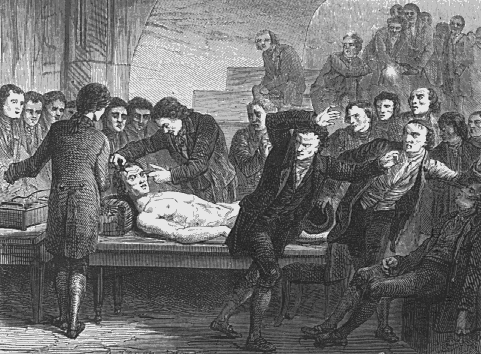
I was fascinated, and rather transfixed, however, by this rather ghoulish extract from the Port Phillip Herald on 29th October 1841:

WONDERFUL EFFECTS OF GALVANISM

The following, which is going the round of the papers, headed “Wonderful effects of Galvanism” is from an American paper, and we give it in illustration of the tone of feeling prevalent in the Model-Republic:-

“John White, convicted of the murder of Messrs. Gwatkin and Glenn, on board a flat boat on the Ohio river, was executed in Louisville, United States, on the 8th ult, a little after six o’clock in the morning. The rope not “playing” well occasioned the knot to slip over the chin instead of being under the ear, so that his neck was not broken by the fall. Previously to his execution he wrote a letter to his father, in which he stated that he was present when the unfortunate men were murdered; that he did not participate in the act, but was compelled to beg his own life from two men who murdered them. He was cut down after hanging about 25 minutes, and his body given to the doctors for the purpose of experiment.

The Louisville City Gazette gives the annexed extraordinary circumstances attending an experiment with the galvanic battery:- The poles of powerful galvanic pile, which had been prepared for the occasion, were immediately applied to him, and, to the unutterable joy of all present, with the most perfect success. On the first application of the fluid to his body, which was yet warm and trembling, a universal tremor was seen to pass over his frame; on a sudden he arose from the bench to a sitting posture, and, with great eagerness and impatience, raised his hand to his neck, trying to grasp the scar with his fingers and tear it from his throat. He first snatched at it with great rashness, as though the rope was yet around his neck, and then continued some moments picking at the seam with his fingers, as though it was something that adhered to his throat giving him great uneasiness. But this symptom was soon forgotten, for almost the next moment he rose upon his feet, raised his arms level with his breast, and, opening his bloodshot eyes, gave forth from his mouth a most terrific screech, after which his chest worked as if in respiration in a very violent manner. Every one at this minute was as mute as death, when one of the surgeons exclaimed that he was alive. The excitement was too great to allow time for a reply to the remark; every eye was riveted upon the agitated and shaking corpse. The operator continued to let upon it a full quantum of the galvanic fluid, til the action upon its nerves became so powerful that it made a tremendous bound, leaping by a sort of imperfect plunge into a corner of a room, disengaging itself entirely from the wires which communicated the galvanism.

All immediately drew around the body. For a moment after its fall it seemed perfectly motionless and dead; a surgeon approached, and, taking hold of its arm, announced that he thought he felt a slight though a single beat of the pulse. The galvanic operator was just going to arrange his machine to give him another charge, when the surgeon exclaimed that he breathed. At this moment he gave a long gasp, rising and gently waving his right hand; his sighs continued for two minutes, when they ceased entirely. His whole frame seemed to be agitated, his chest heaved, and his legs trembled. These effects were supposed to be caused by the powerful influence of the galvanic fluid upon the nerves; none of these movements were yet supposed attributable to the act of life. It was considered that the animating principle of nature had left his frame and could never be again restored. In the very height of anxiety, the surgeon announced that he could feel feeble pulsations. A piece of broken looking-glass was immediately held before his nostrils, which was instantly covered with a cloud. The most intense anxiety was felt for some seconds, when the motion of his chest, as in the act of respiration, became visible. He rolled his eyes wildly in their sockets, occasionally closing them, and giving the most terrific scowls. In about five minutes his breathing became tolerably frequent, probably he would give one breath, where a healthy man would give four. His breathing, however, rapidly increased. The doctors began to speak to him, but he gave no indications that he heard a word. He looked upon the scene around him with the most death-like indifference. A young medical student approached him, and, taking hold of his arm and should, White rose upon his feet, took two steps thus supported, and seated himself in an arm-chair. His muscles seemed to relax, and he appeared somewhat overcome with the exertion he had made. A bottle of hartshorn was immediately applied to his nose, which revived him, but his life seemed to be that of a man much intoxicated. He seemed upon one occasion to try to give utterance to some feeling, but from an unknown case, an impediment probably occasioned by the execution, he was unable to give utterance to a word. His system was critically examined, and though he was pronounced by the doctors to be perfectly alive, yet he could live but a very few minutes, for congestion of the brain was rapidly taking place. Every method was adopted to equalize the circulation, and save the patient from the terrible consequence of so sad a catastrophe, but in vain. The blood vessels of the head were enormously distended, and his eyes appeared to be balls of clotted blood. His system was immediately thrown into direful spasms, and he died in a few minutes in the most excruciating agonies.”

I remember reading about the Tyburn executions in Britain, and the hanging traditions about three-times botched hangings that resulted in the victim being set free. I’m curious and somewhat amused by the “anxiety” evoked by the “catastrophe” of his death- he had, after all, just been executed by the state!

Another form of procrastination?

And so I start.  I’m not really sure whether I am doing this from the very best of motives or not. Is this just another form of procrastination to avoid REALLY putting fingers to keyboard, or is it- as I will attest- an attempt to think myself into the act of writing?  I wrote a blog last year while we were overseas www.wickhouse.blogspot.com and I found that I viewed the world differently- I was on the conscious look out for things that I could blog about.  And so, I am hoping that this blog might likewise encourage me to approach my research as a writer, and not just a reader only.  Time, no doubt, will tell.