
Today is the 166th anniversary of one of the most momentous ceremonies in Port Phillip up until that date- the laying of the foundation stone of the new court house. The 25th July 1842 was a “black and lowering day”, and the ceremony itself had been postponed because of inclement weather. But at 12.00 o’clock, just as the procession was about to begin “the sun burst forth with all his splendor and dissipated the clouds of mist and vapour, all nature seemed to rejoice, while contentment and happiness beamed forth from the countenances of the assembled multitude.”
Starting off from the old court house (seen above in my header), this was some procession!
The Ranger on Horseback
Mounted Police
Melbourne Police
Band
The Schools
Odd Fellows
The Ancient and Honorable Fraternity of Free and Accepted Masons
Civil Officers of Government
Chief Constable on Horseback
Magistrates of the Colony (two and two)
Civil Officers of the Government who are heads of Departments (two and two)
Tipstaff of the Court
Members of the Bar
Police Magistrate and Staff
The Resident Judge (supported by the officers of his Court followed by members of the legal profession) (two and two)
Inhabitants
It was estimated that 4000 people were in attendance: quite a turn-up in a city of about 7000 people. The presence of the Masons is emphatic and striking. The involvement of the school children is heart-warming. But where was Superintendent LaTrobe??
The procession wended its way along Collins Street, up Elizabeth Street and turned right along Lonsdale Street to make its way to the site of what is now the closed City Court on the corner of Russell and LaTrobe streets. This location was in close proximity to the newly-completed Old Melbourne Gaol just behind it and was on the outskirts of the settlement.
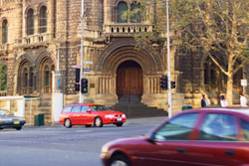
Peter Ackroyd, in his book London, described that city as a palimpsest where different iterations of buildings, often serving the same purpose, were built on the one spot. This is true here: the ‘new’ Supreme Court building built in 1842/3 was demolished by the end of the century, to be replaced by the City Court (which to my eye looks much older than that). It is no longer used as a court, and has been taken over by R.M.I.T.
The ‘new’ Supreme Court building was the most expensive erected in Port Phillip to that date, with an initial quote of 7480 pounds (Deas Thomson to LaTrobe 23 July 1842). There was professional jealousy and argy-bargy between Lewis, the Colonial Architect up in Sydney, and Rattenbury the Clerk of Works here in Melbourne over the size, design and cost of the building. In particular, Lewis was critical of the lancet windows that Judge Willis was particularly enamoured of.
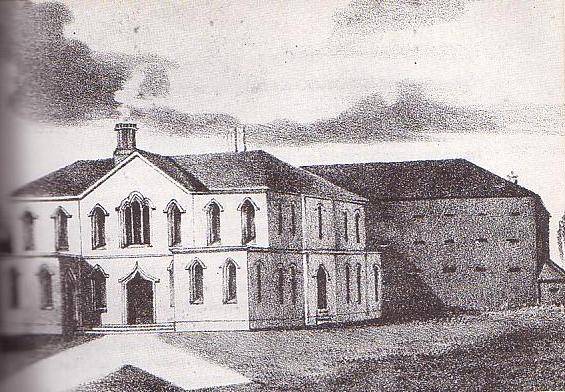
Supreme Court 1843
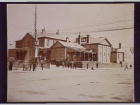
The 'new' Supreme Court 1900s prior to demolition
There’s something rather ironic, and if I am to be charitable, bitter-sweet about Judge Willis’ oration to the assembled crowd:
He added that in all probability before its walls were grey with age he would long have left them; but that wherever and in whatever position he might be placed, his warmest wishes and best exertions would ever attend the colony, which if left to its own resources and own self-government, unshackled by other districts, would rapidly rise in general prosperity and be the first province of the crown in this hemisphere.
Port Phillip Herald July 26 1842.
A bit of playing to the gallery there: Port Phillipians were clamouring for self-government, and the Sydney/Melbourne rivalry that still exists today was there in 1842 as well.
Warmest wishes for the colony? Bah! He fulminated about Port Phillip and Gov. Gipps the whole way home.
And as for the walls being grey with age? Not likely. They hadn’t even finished painting the building when he headed off for home, after being dismissed. It opened for business as his ship sailed for South America. He’d laid the stone; he’d gone for a stroll each time to inspect the progress; he’d pushed for those lancet windows…but he never got to sit in ‘his’ court. It opened the week after he left, with his successor, Justice Jeffcott presiding.
 The Resident Judge of Port Phillip