
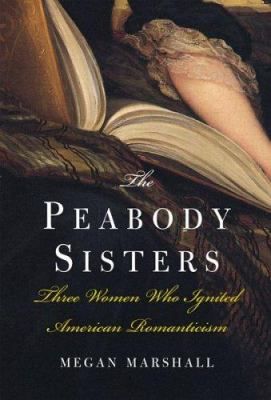
At our Unitarian Universalist fellowship, I usually volunteer to take the March service because March is Women’s History Month here in Australia, and I like to look at the stories of significant women and groups- some Unitarian, others not- who have grappled with living our their commitment to social justice and yearning for spirituality. Over the years I’ve looked at Martha Turner, Catherine Helen Spence, Mary Montgomerie Bennett, the Women’s International League for Peace and Freedom, and this year I decided I’d look at the Peabody Sisters- three Unitarian women born in New England during the first decade of the 19th century.
I had vague memories of visiting the Peabody Museum in Salem (same family, different branch) and other than that I knew nothing about them. I’d heard them mentioned in passing in a course on Unitarian Theology (yes, there is such a thing), and a reference to the book by Megan Marshall, so I chose them as my Women’s History theme for the month.
Marshall’s book The Peabody Sisters starts and finishes with a wedding. It starts with Sophia Peabody’s wedding to the author Nathaniel Hawthorne on July 9 1842, and it ends with her sister Mary Peabody’s wedding to the politician and education reformer Horace Mann on May 1 the following year. All three sisters were to live to beyond middle age (indeed, Elizabeth the eldest was to live to the age of ninety) but Marshall has chosen to end her book here. Perhaps it’s because a married woman’s life was so easily obscured by her husband’s, especially if he was prominent in political or literary affairs, as was the case here. Perhaps there was a drying up of the source material at this point, or perhaps Marshall’s interest was more in the sisters as a unit: she doesn’t make it clear.
The three girls had three brothers, but the brothers seem to have been a rather lacklustre group, perhaps because of the tepid example of their father, Nathaniel Peabody, who struggled to make a living as a doctor, dentist and later, farmer. The girls, on the other hand, were spurred by their mother Eliza, to become teachers or to earn their living in some way. Their mother Eliza conducted a boarding school in their home for the daughters of the local town, and was herself a creative and progressive teacher in her own right. The family was on a downwardly mobile trajectory, but Eliza herself had memories of her grandfather’s house at Friendship Hall and the library that was available to her to educate herself. The strong matriarchal influence in the household dynamics put Eliza’s daughters in good stead.
The eldest was Elizabeth, born in 1804, a brilliant linguist, teacher and conversationalist. Her mother came from a Unitarian background, but the young Elizabeth was transfixed by Unitarian luminary William Ellery Channing, known as the ‘Father of Unitarianism’ who preached at her church when Elizabeth was about 8 years old. She threw herself into Unitarian literature and a wide range of reading with such enthusiasm that one summer she was banned from reading anything but the Bible, which she did, reading the New Testament thirty times over a summer, each reading directed towards a different aspect of doctrine. She developed a close friendship with Channing, and as the group that came to be known as the ‘Transcendentalists’ forged links with, and then sometimes broke away from, Unitarianism, she and her sisters were brought into the heart of intellectual life in Boston. She learned ten languages, and through her translations of European texts, she introduced men like Ralph Waldo Emerson, Henry Thoreau and others to Continental and Romantic thought that fed into Transcendentalism. She was loud, gregarious and talkative, but heedless to her personal appearance and dress, much to the chagrin of her mother.
She was a strong sibling to contend with, but her youngest sister Sophia (with emphasis on the ‘i’ when pronouncing her name) was a strong personality too. She did not compete directly with Elizabeth, but instead took to her bed, prostrated by headaches, and the family came to a silent halt so as to not distress her further. She warned her sisters to have no expectations of her, and they didn’t, thus relieving her of the need to financially contribute to the family on a regular basis. Eventually her family, fearing for her life, turned to William Ellery Channing’s physician brother Dr Walter Channing. His interests were in women’s health, and particularly the ‘bed case’ of young women whose poor health confined them to their bedroom. He was skeptical that there was any physical sickness. He was more critical of the medical establishment for letting young girls like Sophia linger in bed for decades, and less critical of Sophia the patient. It was interesting watching Marshall negotiate this issue of female illness and its relationship with emotional and power relationships. She notes that neurologist Oliver Sacks, who wrote at length on migraines, also suggested an emotional bind that is set up in the ‘situational migraine’. As seemed to occur repeatedly with the sisters, once Sophia had the handsome Dr Walter Channing as her confidante, she became infatuated with him, and later infuriated with him when she sensed that he was judging her.
In between these two strong forces was Mary Peabody, the quintessential middle sister. She was said to be the most beautiful of the sisters, but the remaining photograph of her doesn’t show her in a particularly flattering light. She was often swept along in Elizabeth’s plans to re-establish her school in different towns after the school had failed to make money through economic downturns or as the result of scandalous gossip. Elizabeth took up all the oxygen in the room, and although she may have been interested in the conversation, Mary had no wish to be in the centre of it. However, when she was called upon to accompany her sister Sophia to Cuba in the hope that the climate would improve Sophia’s health, her social conscience was assailed by the sight of enslaved people working on the plantation, sparking her interest in social justice.
The relationship between the sisters was at its most fraught and tense when potential partners came onto the scene. Elizabeth competed with both her sisters over men that they had fallen in love with, although she channelled this into a more ‘sisterly’ vein once their sisters had landed their catches. That said, I wouldn’t trust Elizabeth at all.
She threw herself into the intellectual milieu surrounding the Transcendentalists, becoming a writer in her own right (although the little bit of her work that I read was turgid and indigestable) and editing the sermons of William Ellery Channing and writing up Ralph Waldo Emerson’s lectures. She was involved as a teacher in Bronson Alcott’s Temple School, and wrote a book that publicized it, although they fell out over it later. She is credited with the establishment of kindergarten education in America. In 1840 she opened a bookshop in Boston- the first woman to do so. It was bookstore, a lending library, and a place for scholars, liberal thinkers, and transcendentalists to meet. It stocked transcendentalist material and foreign books and shipped books to interested readers. Margaret Fuller began holding ‘conversations’ there in her discussion group comprising both men and women. Elizabeth recorded those too. She began publishing in her own right as well, and became the publisher of ‘The Dial’, the journal of the Transcendental Club.
Group biographies can be difficult, especially family group biographies where one family member may be perceived to overshadow the others. Elizabeth is best remembered by history, but Marshall has worked very hard to provide a family context and bring forward the achievements of the other Peabody sisters beyond marrying prominent men. The book was well received, earning Francis Parkman Prize, the Mark Lynton History Prize, the Massachusetts Book Award in Nonfiction, and it was a finalist for the Pulitzer Prize in biography and memoir. Marshall paints a vibrant picture of intellectually engaged, active women who, although not as well known as the men with whom they socialized, were contributors to Transcendentalism, and American society more generally, at a time when women’s roles were becoming increasingly circumscribed.
My rating: 9/10
Sourced from: Kobo e-book via subscription
Read because: I gave a presentation at my Unitarian Universalist Fellowship to celebrate Women’s History Month.


 The Resident Judge of Port Phillip